
TL;DR:
- Côte d’Azur luxury properties appreciate faster due to limited supply and global demand.
- Owning property there offers long-term appreciation, income, and legacy-building opportunities.
- Proper structuring and tax strategies enhance returns and simplify inheritance for international investors.
There is a persistent misconception that owning luxury property on the Côte d’Azur is purely a statement of personal success. In reality, the most astute investors we work with view their Riviera estate as a cornerstone of a broader financial architecture: a living asset that appreciates, generates income, shelters wealth across generations, and carries the kind of timeless glamour that no stock portfolio can replicate. From the lemon-scented promenades of Menton to the yacht-dotted marinas of Antibes, this coastline offers something genuinely rare. This article unpacks the strategic, tax, and legacy advantages that make international property ownership here one of the most compelling moves available to high-net-worth individuals today.
Table of Contents
- Why the Côte d’Azur attracts global property investors
- Appreciation, value growth, and legacy building
- Income generation: Making seasonal rentals work for you
- Taxation and structuring for optimisation and protection
- A fresh perspective on global property wealth
- Your next step: Secure Côte d’Azur property advantages
- Frequently asked questions
Key Takeaways
| Point | Details |
|---|---|
| High appreciation potential | Côte d’Azur luxury properties consistently outperform standard markets in value growth. |
| Income and ROI | Seasonal rentals offer strong returns and growing demand for international owners. |
| Tax and legacy advantages | Optimal structuring and local tax laws enable wealth protection and generational transfer. |
| Diversified portfolio | International property ownership spreads risk across assets and geographies. |
Why the Côte d’Azur attracts global property investors
The French Riviera is not simply beautiful. It is structurally scarce. Hemmed between the Maritime Alps and the Mediterranean, the coastline cannot expand. New land is not forthcoming. That fundamental constraint, combined with relentless international demand, creates a property market that behaves differently from almost anywhere else in Europe.
Luxury properties appreciate at rates higher than standard markets, driven by limited supply, sustained demand from high-net-worth individuals globally, and continued infrastructure investment across the region. The figures are striking: the France luxury real estate market is valued at €30 billion, with rental growth projected at 17%, powered by concentrated demand in Nice, Cannes, and Monaco.
For investors who hold only domestic assets, this matters enormously. International ownership introduces currency diversification, exposure to a separate economic cycle, and access to a rental audience that is genuinely global. The Côte d’Azur is not seasonal in the way that many assume. Demand stretches from the Cannes Film Festival in May through the summer regattas, the Nice Carnival in February, and the Menton Lemon Festival, which draws visitors well into spring.
What makes this market essential for investors is the convergence of lifestyle prestige and financial resilience. Consider what the region offers:
- Privacy and exclusivity: Cap d’Antibes and the Monaco border provide discretion that few European locations can match
- Year-round demand: Events, climate, and culture sustain occupancy beyond the summer peak
- Infrastructure investment: The TGV, Nice Côte d’Azur Airport, and ongoing urban regeneration protect long-term values
- International rental audience: Tenants are typically HNWI themselves, commanding premium nightly rates
- Lifestyle utility: Owners enjoy personal use while the asset works financially during letting periods
The market value on the French Riviera reflects all of this. Properties here are not priced on local wages or domestic sentiment. They are priced on global appetite, and that appetite shows no sign of softening.
Appreciation, value growth, and legacy building
Having established the Côte d’Azur’s international allure, we shift focus to the long-term value and generational power of owning property in the region.
The numbers tell a compelling story, but the real argument for Riviera ownership is what it means across time. Wealth preservation in real estate is not simply about avoiding loss. It is about building something that compounds quietly, year after year, while also serving the family who owns it.

| Asset type | Annual appreciation | Rental yield | Resale liquidity |
|---|---|---|---|
| Côte d’Azur luxury villa | 5 to 8% | 3 to 5% | High (global buyer pool) |
| French mainstream residential | 1 to 3% | 2 to 3% | Moderate |
| European luxury average | 3 to 5% | 2 to 4% | Moderate to high |
| Equities (broad index) | 6 to 8% | Variable | Very high |
The distinction is not just yield. It is resilience. During periods of market volatility, Riviera luxury property has historically held its value far better than equities or mainstream residential assets, precisely because its buyer pool is international and its supply is fixed.
“A Riviera estate is not a transaction. It is a chapter in a family’s story, a sanctuary that appreciates in meaning as much as in value, and a financial anchor that holds firm when other markets drift.”
For inheritance and legacy strategies, the Côte d’Azur offers particular advantages. Restored Provençal farmhouses near Valbonne or Monaco-adjacent plots can be structured to pass efficiently between generations, minimising friction and maximising continuity.
Pro Tip: Consider holding your Riviera property through an SCI (Société Civile Immobilière), a French civil property company. An SCI allows you to transfer shares in the company to heirs rather than the property itself, which can significantly reduce inheritance tax exposure and simplify succession planning across multiple beneficiaries.
Income generation: Making seasonal rentals work for you
Once you understand the generational benefits, it is equally important to realise how your asset can actively generate income every year.
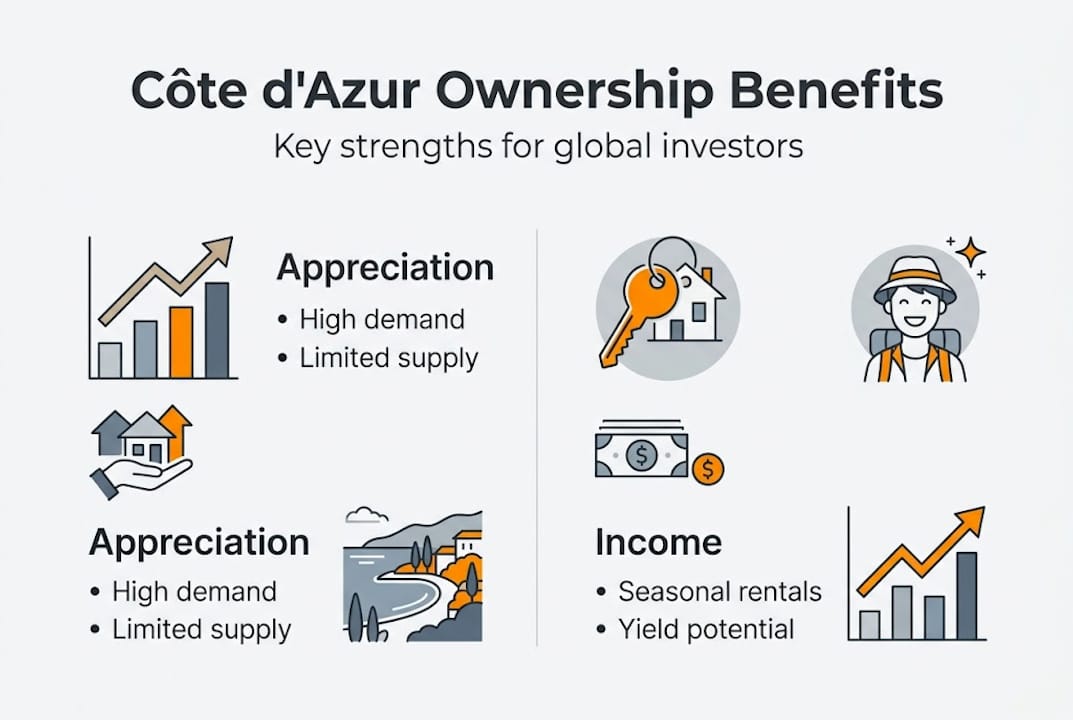
The Côte d’Azur is one of Europe’s most lucrative seasonal rental markets, and the projected 17% rental growth in the French luxury segment reflects a structural shift: the world’s wealthiest travellers increasingly prefer private villa rentals over hotel suites. Your property, positioned correctly, sits at the heart of that shift.
| Destination | Average weekly luxury rental (summer) | Annual yield potential | Peak season length |
|---|---|---|---|
| Côte d’Azur (Cannes, Antibes) | €15,000 to €50,000 | 3 to 5% | May to October |
| Tuscany, Italy | €8,000 to €25,000 | 2 to 4% | June to September |
| Algarve, Portugal | €5,000 to €18,000 | 3 to 4% | July to August |
| Ibiza, Spain | €10,000 to €40,000 | 3 to 5% | June to September |
The Riviera’s advantage is its extended season. A villa near Pampelonne in Saint-Tropez or overlooking the Croisette in Cannes commands premium rates not just in July and August, but across the Festival season, the Grand Prix weekend in Monaco, and the autumn shoulder months when discerning travellers seek quieter luxury.
To maximise your seasonal income, focus on these key drivers:
- Location precision: Proximity to marinas, beaches, and event venues directly influences nightly rates
- Presentation and amenities: Infinity pools, private terraces, and concierge services attract the highest-paying tenants
- Professional management: A dedicated local management partner ensures occupancy, maintenance, and guest experience
- Strategic pricing: Dynamic pricing aligned with event calendars captures peak premiums
- Digital visibility: Listings on curated luxury platforms reach the right audience globally
Pro Tip: Explore the LMNP (Loueur en Meublé Non Professionnel) furnished rental regime if you are a non-resident investor. It allows you to offset depreciation of the property and furnishings against rental income, often reducing your French taxable income significantly and improving net yield.
For a full breakdown, our international property investment guide covers structuring options in detail, and our real estate investment tips page offers practical guidance tailored to the Riviera market.
Taxation and structuring for optimisation and protection
Income and growth are only meaningful when the right structure and tax strategy are in place. Let us clarify what investors need to know.
French taxation for non-resident property owners is nuanced, but it is far from punitive when navigated correctly. The key instrument to understand is the IFI (Impôt sur la Fortune Immobilière), France’s wealth tax on real estate. As confirmed by the IFI threshold for non-residents, the tax applies only to French real estate assets exceeding €1.3 million in net value, and non-residents are assessed solely on their French holdings, not their global wealth. Deductions are available for mortgages secured against the property, which makes leverage a particularly effective tool for reducing IFI exposure.
On capital gains, the position is equally structured. The capital gains taper relief works as follows: the standard rate is 19% income tax plus 17.2% social charges, but relief accrues progressively with each year of ownership. Full exemption from income tax is reached after 22 years; full exemption from social charges after 30 years. For long-term legacy holders, this is a powerful incentive to hold rather than sell.
The principal holding structures available to international investors include:
- Personal ownership: Simple, direct, but exposes the full estate to French inheritance rules
- SCI (IR regime): Preserves capital gains taper relief, facilitates share-based succession, and allows transparent income reporting
- SCI (IS regime): Suitable for investors prioritising depreciation deductions over capital gains treatment
- Foreign company ownership: Possible but subject to anti-avoidance rules and annual reporting obligations
Our French property tax guide and capital gain tax details page offer deeper reading on each scenario. The consistent message from experienced advisers is this: structure early, before acquisition, because restructuring after purchase carries its own tax costs.
A fresh perspective on global property wealth
Most guides stop at the mechanics. We believe the deeper truth about international property ownership is this: the Côte d’Azur is one of the very few places on earth where lifestyle utility and financial performance genuinely reinforce each other rather than compete.
Seasoned investors we work with do not separate the pleasure of watching the Baie des Anges turn gold at dusk from the satisfaction of knowing that view is also appreciating at 5 to 8% annually. They are the same experience. The salt-kissed terraces of Èze, the lavender-laced lanes of the arrière-pays, the Croisette at dawn before the crowds arrive: these are not indulgences. They are the lived dimension of an asset that also performs.
What newcomers often underestimate is the compounding advantage of experienced local advisers. The tax optimisation strategies, the SCI structuring, the LMNP elections, the event-driven rental calendars: none of these are especially complex, but they require someone who knows this market intimately. Our real estate investment strategies reflect years of working with investors who came for the lifestyle and stayed for the returns. The Côte d’Azur rewards patience, precision, and the wisdom to act before the next wave of global demand arrives.
Your next step: Secure Côte d’Azur property advantages
For those genuinely ready to realise the benefits discussed, professional support and curated opportunities make all the difference.
We offer access to luxury villas and penthouses across the French Riviera, including off-market estates that never reach public listings. Our portfolio spans legacy-grade properties in Cap d’Antibes, Cannes, Nice, and Sainte-Maxime, each selected for appreciation potential, rental income capacity, and generational appeal. We also accept cryptocurrency payments, making acquisition seamless for digital-asset investors.
Explore our top investment options or speak with an expert who understands both the financial architecture and the Riviera lifestyle you are investing in. Your heirloom awaits.
Frequently asked questions
How does international property ownership diversify my portfolio?
It introduces exposure to a separate market, currency, and asset class, reducing concentration risk while adding a tangible, income-generating asset that behaves independently of domestic equities or bonds.
What is the IFI and how does it affect non-resident owners?
The IFI is France’s wealth tax on real estate; non-residents pay only on French assets exceeding €1.3 million in net value and can access deductions for mortgages secured against those assets.
Can I fully avoid capital gains tax as an international owner?
Full exemption is achievable over time: the capital gains taper eliminates income tax after 22 years of ownership and social charges after 30 years, making long-term holding a genuinely tax-efficient strategy.
Can international owners rent their Côte d’Azur property for income?
Absolutely. Seasonal rentals are highly lucrative on the Riviera, with 17% rental growth projected in the French luxury market and sustained demand from high-net-worth tenants throughout the extended event season.
Recommended
- Guide to International Real Estate Investment in Côte d’Azur
- Benefits of property investment on French Riviera 2026
- Why the Cote d’Azur is a must for investors in Europe
- Real Estate Inheritance: Safeguarding Your Côte d’Azur Legacy
- Cape Royale: Is This Sentosa Cove Gem Worth the Investment? | Aesthetic Havens
 //
//