
TL;DR:
- Dubai offers zero income tax, strong rental yields, and prime locations attracting high-net-worth buyers.
- The property acquisition process requires thorough preparation, legal documentation, and professional guidance.
- Successful investors view Dubai real estate as part of a diversified global portfolio with careful long-term planning.
Dubai has quietly become one of the world’s most compelling arenas for luxury real estate investment, where gleaming towers rise from the desert and waterfront villas command extraordinary premiums. For the discerning global investor, the emirate offers zero income tax, freehold ownership rights, and rental yields that regularly outpace those of London, Paris, or Geneva. Yet the process of acquiring property here is nuanced, layered with specific legal frameworks, developer protocols, and administrative procedures that reward the well-prepared. This guide walks you through every critical step, from market orientation to title deed registration, so that your Dubai acquisition becomes not merely a transaction but a cornerstone of lasting wealth.
Table of Contents
- Understanding the Dubai property market
- Preparation: Requirements and documentation
- Step-by-step process to buy in Dubai
- Verification and post-purchase essentials
- A seasoned investor’s perspective on buying in Dubai
- Explore more legacy luxury real estate opportunities
- Frequently asked questions
Key Takeaways
| Point | Details |
|---|---|
| Prime locations matter | Choosing the right Dubai area significantly impacts your investment performance and ownership experience. |
| Preparation is vital | Advance document gathering and compliance ensure a smooth and efficient buying process. |
| Follow the legal steps | Adhering to each stage from offer to transfer protects your investment and ensures clear ownership. |
| Post-purchase diligence | Post-closing checks and management are key to preserving and growing your property’s value. |
Understanding the Dubai property market
Dubai’s luxury real estate landscape is as diverse as it is dazzling. Understanding where to focus your attention, and why, is the foundation of a sound acquisition strategy. The emirate’s prime locations each carry a distinct character and investor profile, and knowing the differences between them shapes everything from your negotiation position to your long-term rental yield.
Prime locations worth knowing
- Palm Jumeirah: The iconic palm-shaped island remains the gold standard for waterfront opulence, with signature villas and penthouses attracting ultra-high-net-worth buyers from Europe, Asia, and the Gulf. Signature beachfront villas frequently command between AED 15 million and AED 80 million.
- Downtown Dubai: Home to the Burj Khalifa and Dubai Mall, this district draws investors seeking prestige address, strong capital appreciation, and a sophisticated rental audience of executives and long-stay visitors.
- Dubai Marina: A cosmopolitan waterfront hub with some of the market’s most reliably performing rental properties, particularly appealing to younger affluent professionals and digital nomads.
- Emirates Hills and Al Barari: These verdant, gated enclaves offer large-plot private villas in landscaped settings, attracting families who prize tranquillity and space above proximity to the urban core.
- Jumeirah Bay Island and Bluewaters Island: Emerging ultra-premium addresses where exclusivity is engineered into the very planning of the development.
As current market conditions indicate, luxury properties in Dubai are achieving gross rental yields of between 5% and 9% annually, figures that compare very favourably with mature European markets. Capital appreciation in prime districts has averaged between 7% and 12% year-on-year in recent cycles, driven by sustained international demand, a growing population of high-earning expatriates, and an increasingly sophisticated regulatory environment.
| District | Avg. gross rental yield | Capital appreciation (2023–2025) | Typical entry price |
|---|---|---|---|
| Palm Jumeirah | 5–7% | 10–14% | AED 8M+ |
| Downtown Dubai | 5–8% | 8–12% | AED 2.5M+ |
| Dubai Marina | 6–9% | 7–10% | AED 1.5M+ |
| Emirates Hills | 4–6% | 9–13% | AED 15M+ |
| Bluewaters Island | 5–7% | 11–15% | AED 3M+ |
Ownership structures for foreign investors
Foreign nationals can purchase freehold property in designated freehold zones, owning the property and the land outright with no Emirati sponsor required. Leasehold arrangements (typically 99-year terms) exist in certain areas but are far less common for luxury acquisitions. Crucially, a property purchase of AED 2 million or above qualifies the buyer for a UAE Golden Visa, granting a 10-year renewable residency for the investor and immediate family. The appeal for global investors is therefore not only financial but deeply lifestyle-oriented, offering a genuine base in one of the world’s most connected cities.
Pro Tip: Always verify that your chosen property sits within an officially designated freehold zone before signing anything. Your agent or lawyer should provide written confirmation of this status as a matter of course.
Our Dubai luxury home guide offers a curated breakdown of the finest properties across these prime districts, which we recommend reviewing alongside your own research.
Preparation: Requirements and documentation
Once you understand the market and your target areas, the next step is meticulous preparation. Dubai’s property acquisition process is well-structured, but it rewards investors who arrive with their paperwork in order and their finances clearly documented. Attempting to shortcut this phase is one of the most common mistakes we see, and it invariably causes delays.
Who can buy?
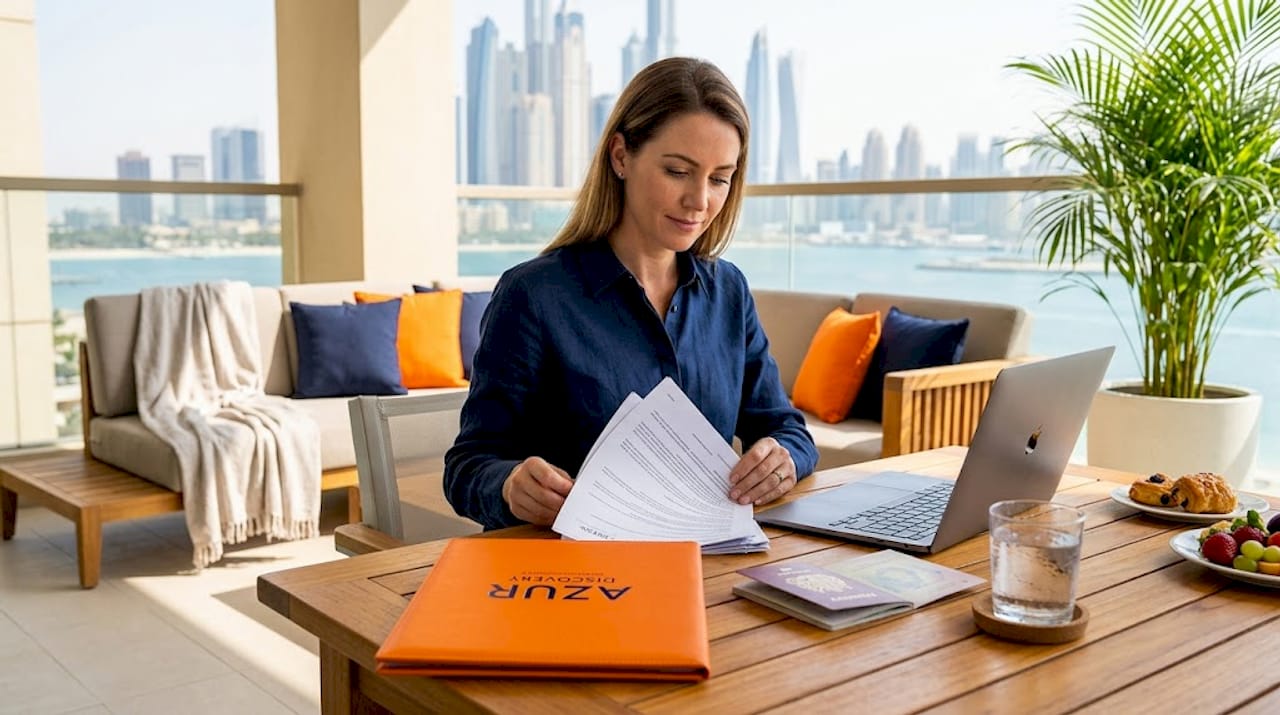
Dubai imposes remarkably few restrictions on foreign ownership. There is no minimum age threshold beyond the standard legal capacity to contract (typically 18), no nationality exclusions in freehold zones, and no residency requirement to purchase. Whether you are based in Paris, London, Singapore, or São Paulo, you may acquire property in your personal name, through a corporate structure, or via a trust arrangement.
Documentation checklist
The following documents are typically required by the seller, developer, or conveyancing lawyer:
- Valid passport (all pages, clearly legible)
- UAE residence visa, if applicable (non-residents may still purchase)
- Proof of residential address (utility bill or bank statement, issued within three months)
- Source of funds documentation (bank statements covering at least six months)
- Proof of income or net worth (audited accounts, investment portfolio statements, or equivalent)
- Know Your Customer (KYC) form completed with the developer or agent
- A completed Anti-Money Laundering (AML) declaration where required by the developer
Comparison: Resident vs. non-resident buyer requirements
| Requirement | UAE resident buyer | Non-resident buyer |
|---|---|---|
| Passport | Required | Required |
| UAE visa copy | Required | Not applicable |
| Local bank account | Strongly recommended | Strongly recommended |
| Source of funds evidence | Required | Required |
| KYC verification | Required | Required |
| Mortgage eligibility | Up to 80% LTV | Up to 50% LTV |
As outlined in this step-by-step buying guide, non-resident buyers face slightly more restricted mortgage terms, with lenders typically offering up to 50% loan-to-value. In practice, many of our high-net-worth clients purchase in cash, which accelerates the process considerably and strengthens their negotiating position with sellers.
Financial preparation extends beyond documentation. You will need to hold sufficient liquid funds to cover the purchase price, the 4% Dubai Land Department (DLD) transfer fee, a 2% agency commission, and miscellaneous registration and legal costs totalling approximately 1–2% of the purchase price. Understanding these Dubai property laws in advance prevents unwelcome surprises at the closing table.
Step-by-step process to buy in Dubai
With your dossier assembled, you are ready for the transaction phase itself. Dubai’s buying process is more streamlined than many European jurisdictions, but it follows a precise sequence that must be respected.
Property search and shortlisting: Work with a RERA-registered (Real Estate Regulatory Agency) agent whose mandate clearly covers the properties you are evaluating. Insist on viewing title deed copies and confirming freehold status before investing serious time in negotiation.
Negotiation and agreed terms: Once you identify your chosen property, negotiate price, payment schedule, and any inclusions (furniture, parking, service fee credits) directly. Verbal agreements carry no legal weight in Dubai; everything must be committed to writing.
Sign the Memorandum of Understanding (MoU): The MoU (also known as Form F) is the binding preliminary contract that records the agreed price, payment terms, and completion timeline. You will typically pay a deposit of 10% of the purchase price at this stage, held in trust by the agent or a conveyancing firm. This is the moment commitment becomes formal.
Obtain the No Objection Certificate (NOC): The seller applies to the developer for a No Objection Certificate confirming there are no outstanding service charges or developer restrictions on the transfer. Processing time is typically five to ten working days, though premium developers often expedite this for known clients.
Payment and funds transfer: Funds should be transferred in cleared form before the DLD appointment. Dubai mandates payment by manager’s cheque (a guaranteed bank draft) or bank transfer, both of which must be evidenced at the transfer. We increasingly see clients acquire Dubai property using cryptocurrency converted into dirhams ahead of the DLD appointment, a process we facilitate through our platform.
Title deed transfer at the Dubai Land Department: Both buyer and seller (or their authorised representatives via Power of Attorney) attend the DLD office or a registered trustee office. The 4% transfer fee is paid, and the new title deed is issued in the buyer’s name, typically on the same day.
“In Dubai, the transaction moves at the speed of preparation. The investors who complete smoothly are those who arrive with clean funds, clear documentation, and a trusted team around them. Speed is a luxury earned by those who plan.” — Living on the Côte d’Azur advisory team
Your property acquisition process benefits enormously from engaging an independent lawyer alongside your agent. The agent represents the deal; the lawyer represents you. Before listing your property for rental after acquisition, consider professional staging and presentation standards that consistently reduce vacancy periods by measurable margins.
Pro Tip: Request a Power of Attorney be prepared by your Dubai lawyer before you travel. If unforeseen circumstances prevent you from attending the DLD transfer in person, your representative can complete the process without delay.
Verification and post-purchase essentials
With the keys almost in hand, a final round of checks ensures your legacy investment is precisely as represented and positioned for maximum performance from day one.
Pre-transfer inspection checklist
Before attending the DLD for the title deed transfer, conduct a thorough snagging inspection of the property. For new builds and off-plan completions, this is especially critical.
- Inspect all fixtures, fittings, and appliances for damage or defects
- Test all electrical sockets, lighting circuits, and air conditioning systems (crucial in Dubai’s climate)
- Check water pressure and plumbing throughout
- Examine flooring, tiling, and paintwork for imperfections
- Confirm that all parking spaces, storage units, and amenity access rights are as specified in the contract
- Verify that service charge accounts are up to date and zero-balance before transfer
For resale properties, commission an independent structural survey from a UAE-certified engineer. This step, often bypassed in the excitement of acquisition, can reveal hidden maintenance liabilities that affect both your running costs and eventual resale value.
Title deed and registration
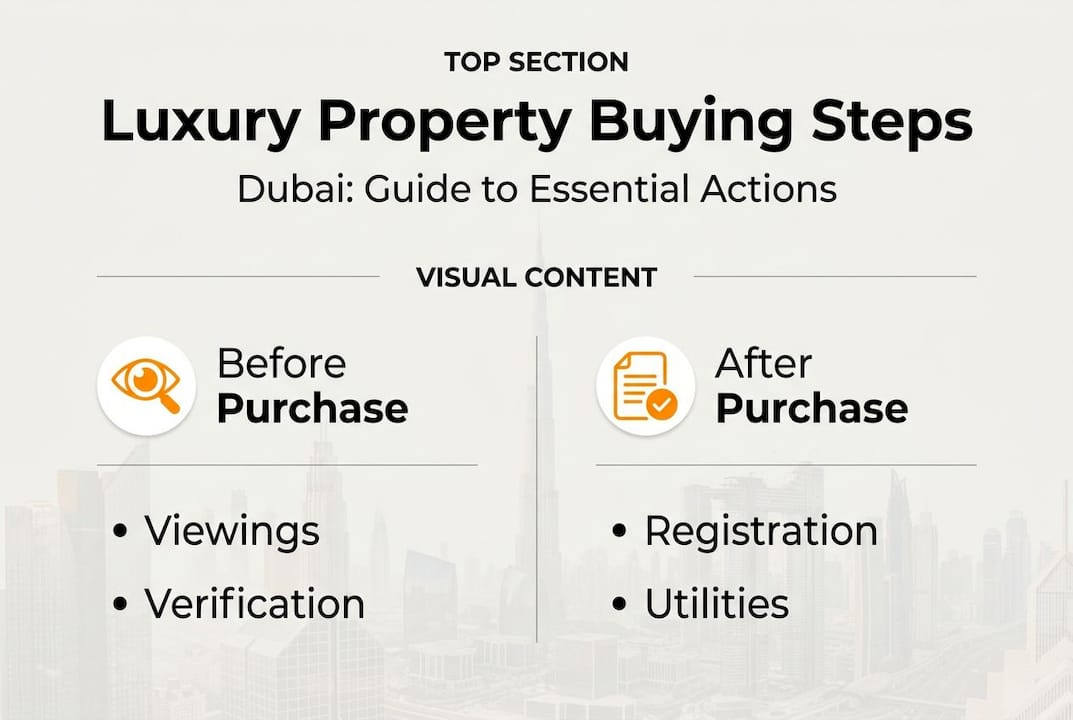
Once the DLD transfer is complete, you will receive a physical title deed bearing your name and property details. This document is the definitive proof of ownership under UAE law. Store it securely, and ensure your lawyer retains a certified copy. The title deed is also the instrument you will present when applying for your Golden Visa, if eligible.
| Post-purchase action | Timeline | Priority |
|---|---|---|
| Register for utility connections (DEWA) | Within 7 days of transfer | High |
| Appoint property management company | Within 30 days | High |
| Apply for Golden Visa (if eligible) | Within 60 days | Medium |
| Register with RERA for rental activity | Before first tenancy | High |
| Arrange landlord insurance | Before occupation | Medium |
As detailed in the buying process guidelines, property management in Dubai is a regulated activity. Choose a firm registered with RERA to handle tenancies, ensuring your rental income is collected and your obligations under the Tenancy Law (Law No. 26 of 2007) are fully met. For ongoing upkeep between tenancies, a rigorous post-purchase maintenance protocol protects both your asset value and your tenant satisfaction scores. Verify that your property complies with current legal requirements for rental registration, as non-compliance can void your insurance and expose you to regulatory penalties.
A seasoned investor’s perspective on buying in Dubai
We have watched many high-net-worth buyers arrive in Dubai seduced by the glossy renderings of a developer’s show apartment, only to overlook two factors that matter far more in the long run: the quality of the developer’s track record and the reality of annual service fees.
Service charges in premium Dubai developments range from AED 15 to AED 45 per square foot per year. On a 5,000 square foot villa, that is between AED 75,000 and AED 225,000 annually before you account for any special levies. This figure dramatically affects your net yield calculations, yet it rarely features prominently in a developer’s marketing materials.
Equally, we urge every client to treat their Dubai acquisition as part of a broader global portfolio rather than an isolated play. The investors we admire most are those who calibrate their Dubai holding alongside positions in the French Riviera, Portugal, or Bali, creating a constellation of assets that balances seasonal demand, currency exposure, and legacy transfer efficiency. Consider reading about steps to successful property buying across markets for a broader strategic perspective.
Dubai is exceptional. But exceptional rewards flow to those who approach it with rigour, patience, and a long horizon.
Explore more legacy luxury real estate opportunities
For those who view property not as a possession but as a promise to future generations, our portfolio at Living on the Côte d’Azur extends far beyond any single market. We curate opportunities across Dubai, the French Riviera, Ibiza, Bali, Italy, Portugal, and Mauritius, connecting discerning investors to off-market acquisitions that never appear on public platforms. Whether you are seeking a salt-kissed villa above the Mediterranean or a trophy penthouse above Dubai’s skyline, our team is positioned to guide you with the intimacy of a trusted adviser and the reach of a global network. Explore our dedicated section on real estate for high-net-worth buyers or discover the discreet world of invisible luxury real estate that we make accessible to our most valued clients.
Frequently asked questions
Can foreigners buy and own property outright in Dubai?
Yes, foreigners can buy freehold property in designated areas of Dubai, with full ownership rights and no age restrictions, meaning you hold the title to both the property and the land beneath it.
What are the main fees and taxes when buying property in Dubai?
Typical fees include the 4% Dubai Land Department transfer fee, a registration fee, a 2% agent commission, and 5% VAT on new properties, with total acquisition costs generally sitting between 6% and 8% of the purchase price.
How long does the property buying process take in Dubai?
The process generally takes between two and eight weeks from agreed terms to title deed, though having clean funds and complete documentation in place can allow experienced buyers to complete in under three weeks.
Is it necessary to hire a lawyer to buy in Dubai?
While not required by law, hiring an independent lawyer is highly recommended to review the MoU, verify title clarity, and protect your interests throughout the transfer process, particularly for non-resident buyers unfamiliar with UAE legal conventions.
Recommended
 //
//