
TL;DR:
- In 2026, French Riviera property values are increasingly driven by sustainability credentials and energy performance ratings. High-efficient homes with green features command premiums, while poorly rated assets face significant discounts or regulatory risks. Savvy investors prioritize eco-friendly legacy properties that combine prestige with responsible stewardship for long-term resilience.
The French Riviera has long seduced the world’s most discerning investors with its salt-kissed coastlines, lavender-laced hillsides, and an enduring promise of prestige. Yet in 2026, the rules have quietly shifted. Prestige alone no longer guarantees the returns it once did. A new force is reshaping valuations from Cap d’Antibes to the sun-drenched ramparts of Menton: sustainability credentials and energy performance ratings. For high-net-worth investors seeking legacy assets that reliably appreciate and elegantly transfer wealth to the next generation, understanding these shifts is no longer optional. It is essential.
Table of Contents
- Why sustainability and energy ratings are reshaping luxury property values
- Regional market shifts and new investment priorities for 2025
- Identifying sustainable legacy properties: key features and pitfalls
- Applying insights: practical strategies for 2026 acquisitions
- Why legacy investments must go beyond prestige in 2025
- Explore exclusive investment opportunities on the Côte d’Azur
- Frequently asked questions
Key Takeaways
| Point | Details |
|---|---|
| Energy rating drives value | French Riviera luxury property values in 2025 are strongly influenced by energy efficiency grades. |
| Sustainability is essential | Legacy investments must prioritise eco-features to secure long-term returns and resale appeal. |
| Regional differences matter | Each Riviera city offers distinct opportunities for price growth and sustainable asset selection. |
| Avoid low-rated assets | Worst-rated dwellings are typically discounted and far less competitive for resale and legacy purposes. |
| Strategic acquisition pays off | Verifying energy ratings and legacy credentials is crucial for optimal investment outcomes. |
Why sustainability and energy ratings are reshaping luxury property values
For years, investing in French Riviera real estate meant prioritizing sea views, proximity to Monaco, and architectural grandeur. These remain important. But the market trends for Côte d’Azur reveal an unmistakable new hierarchy forming around energy performance.
France’s Diagnostic de Performance Énergétique, or DPE, grades every dwelling from A (most efficient) to G (least efficient). What was once a bureaucratic footnote is now a financial lever. Energy-efficiency ratings can affect property prices by up to 25%, with the worst-rated G properties sitting at a striking 25% discount relative to the D benchmark, according to notaire data compiled by Connexion France.
“A property’s energy grade is no longer a compliance detail. It is a pricing signal. Buyers at the top of the market now treat a poor DPE the way they once treated a compromised sea view — as a reason to walk away.”
The per-letter premium and discount pattern is remarkably consistent. A-rated and B-rated villas command notable premiums, while E, F, and G-rated properties face deepening discounts. For luxury assets valued at €3M to €10M, this translates to hundreds of thousands of euros in real price variation. The luxury market insights across the Riviera confirm this trend is accelerating, not softening.
Eco-features have simultaneously become status symbols among the global elite. A Cannes villa with rooftop solar arrays, a geothermal heating system, and EV charging infrastructure signals something beyond green compliance. It signals forward-thinking stewardship. It signals a property built for the next generation, not merely the current season.
Key sustainability signals driving premium valuations now include:
- A or B DPE ratings as a baseline expectation for serious buyers
- Solar photovoltaic arrays with battery storage, reducing grid dependency
- Smart building management systems for remote climate and energy control
- EV charging infrastructure, reflecting the lifestyle reality of luxury car ownership
- Resource-efficient construction materials, particularly for new builds near Sainte-Maxime’s Nartelle shoreline and Nice’s Mont Boron heights
- Green certifications, such as HQE (Haute Qualité Environnementale), for new constructions
| DPE grade | Approximate price impact vs D benchmark |
|---|---|
| A | +10% to +15% |
| B | +5% to +10% |
| C | +2% to +4% |
| D | Baseline |
| E | -5% to -10% |
| F | -12% to -18% |
| G | Up to -25% |
Pro Tip: When evaluating any villa or apartment on the Riviera, request the full DPE report before engaging in price negotiations. A G-rated property may appear attractively priced, but factor in the full cost of retrofitting to a C or B grade before making any offer. Renovation budgets for energy upgrades on a large Riviera villa can reach €200,000 or more.
Regional market shifts and new investment priorities for 2025
The Côte d’Azur is not a single market. It is a constellation of micro-markets, each with its own character, growth trajectory, and legacy appeal. Reviewing the regional investment trends guide reveals just how differently each city is positioned for 2026.
Nice, where the Promenade des Anglais catches the afternoon light, and Cours Saleya erupts in color every morning market, remains one of the most liquid and internationally accessible Riviera markets. The city’s expanding tram network, rising demand for sustainably designed apartments on Mont Boron, and a growing digital-nomad and ultra-high-net-worth buyer base support steady 5% to 7% annual appreciation in premium segments.
Cannes, synonymous with the Festival de Cannes and the Croisette’s legendary yacht parade, commands exceptional rental yields during its famous festival calendar. Seasonal rental of a Croisette apartment during the film festival alone can generate yields that rival full-year lettings elsewhere. Securing annual returns above 5% is entirely achievable with the right asset and management strategy.
Monaco’s borders carry an almost mythic price premium. Properties in Beausoleil and Cap d’Ail sit within walking distance of the Principality yet remain under French tax jurisdiction, offering an elegant balance of prestige and fiscal efficiency.
Saint-Tropez, where Pampelonne’s turquoise shallows meet the Vieux Port’s unhurried fisherman traditions, caters to the most seasonal market on the Riviera. Legacy investors here look at total lifestyle value as much as yield, knowing that a perfectly positioned villa near Ramatuelle can hold its value through almost any economic cycle.
Here is a straightforward framework for evaluating city-specific investment potential:
- Assess the DPE profile of available stock in your target area before shortlisting properties.
- Research seasonal rental demand, particularly around local festivals (the Menton Lemon Festival, Cannes Film Festival, the Monaco Grand Prix, Nice Carnaval).
- Evaluate regeneration pipelines: new tram lines, marinas, and urban renewal projects signal long-term appreciation.
- Consult notaire transaction data for per-square-meter trends over the past 36 months.
- Verify infrastructure resilience, including flood zoning and proximity to protected natural areas.
| City | Average price per m² (prime) | Sustainability momentum | Legacy appeal |
|---|---|---|---|
| Monaco border | €18,000 to €25,000+ | High | Very high |
| Cannes | €8,000 to €14,000 | Growing | High |
| Nice | €6,000 to €11,000 | High | High |
| Saint-Tropez | €12,000 to €20,000 | Moderate | Very high |
| Antibes | €6,500 to €10,000 | Growing | High |
| Sainte-Maxime | €5,500 to €9,000 | Moderate | Moderate |
The broader second home trends for 2025 confirm that buyers are increasingly prioritising long-term value and sustainability credentials over headline luxury finishes alone. This is the market evolution that the most astute investors are already exploiting.
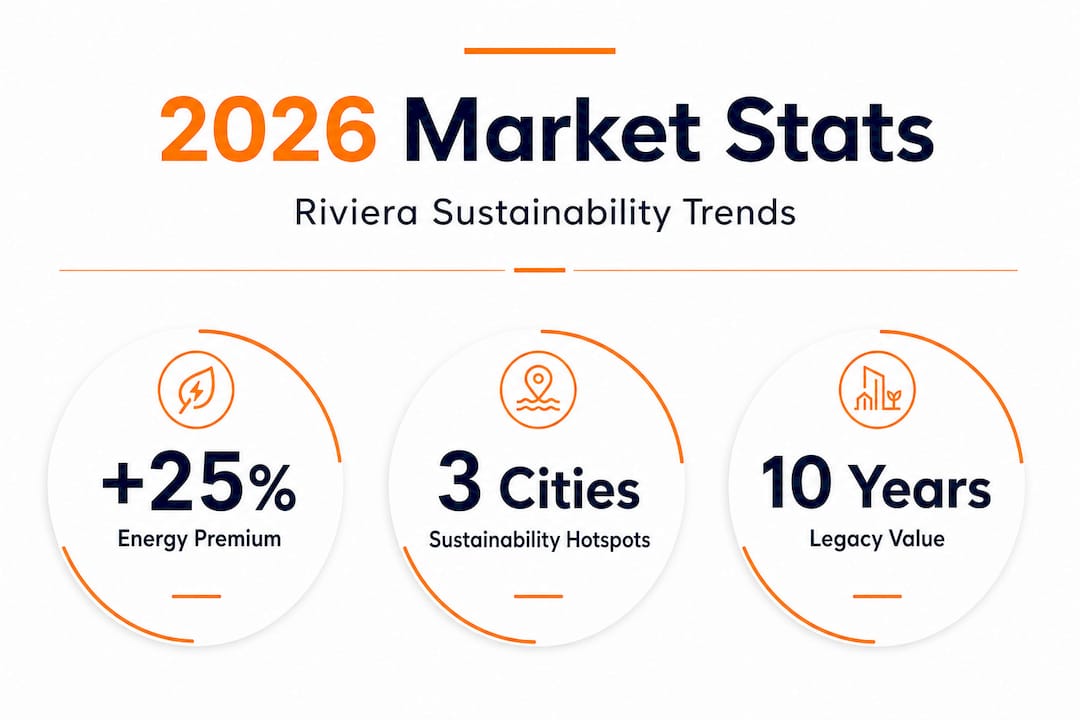
Pro Tip: Look beyond the headline price-per-square-metre figure. A slightly lower-priced villa in Cap d’Antibes with an A DPE rating, solar installations, and strong rental history will outperform a grander property with a G rating over a ten-year legacy horizon.
Identifying sustainable legacy properties: key features and pitfalls
Recognizing a genuinely sustainable legacy asset is not simply a matter of taking a developer’s word for it. The key features of French Riviera real estate that command long-term premium valuations share a consistent set of qualities.
True eco-luxury properties demonstrate:
- Solar photovoltaic arrays with battery storage, reducing annual energy costs substantially and insulating owners from grid price volatility
- Heat pump systems replacing gas-fired heating, aligning with France’s progressive decarbonization policy trajectory
- EV charging infrastructure is particularly relevant for buyers maintaining multiple luxury vehicles
- Smart energy management systems that monitor, optimize, and report consumption remotely
- Triple-glazed fenestration and high-performance thermal insulation, particularly important for Riviera properties designed for year-round habitation
- Rainwater harvesting and water recycling systems are increasingly valued, given Mediterranean drought patterns
- HQE or equivalent green certification, providing third-party validation of sustainability credentials
The price gap between a G-rated and a D-rated property of comparable size and location on the Riviera can now reach 25% according to French notaire data. On a €4M villa, that differential represents €1M in real value. This is not a marginal consideration. It is a defining investment variable.
Common pitfalls investors encounter include:
- Accepting developer sustainability claims without independent verification. Always request third-party documentation.
- Overlooking the cost of retrofitting older properties to meet current or forthcoming French energy regulations. France’s progressive tightening of rental restrictions on G and F-rated properties means these assets face growing income risk.
- Confusing aesthetic sustainability (visible solar panels, bamboo flooring) with structural energy efficiency. True efficiency is measured in certified consumption figures, not decorative choices.
- Underestimating planning restrictions in classified heritage zones along the Riviera, which can limit the extent of permissible retrofitting.
The strategies for lasting value in Riviera real estate consistently point to one truth: properties with robust eco-credentials are more liquid, more attractive to elite tenants, and more resilient through market corrections.
Pro Tip: Avoid any property rated E, F, or G unless you have a fully costed and architect-approved energy renovation plan with permits in place. France now restricts lettings of the worst-rated properties, and this regulation is tightening further.
Applying insights: practical strategies for 2026 acquisitions
Translating market intelligence into decisive, well-structured acquisitions requires a methodical approach. For legacy-focused investors, the French Riviera investment guide outlines a clear pathway.
Follow these acquisition steps for 2026:
- Define your legacy objective clearly. Is the primary purpose capital appreciation, elite seasonal rental income, intergenerational wealth transfer, or a combination of all three? This shapes every subsequent decision.
- Establish a shortlist by DPE grade first. Target A, B, or C-rated properties exclusively unless you have the budget and expertise to carry out a full energy renovation.
- Commission an independent technical survey covering structural integrity, energy systems, thermal performance, and compliance with current French building regulations.
- Conduct a full legal audit: title clarity, planning history, any outstanding charges, and the syndic records for copropriété (shared ownership) buildings.
- Model seasonal rental income based on actual comparable letting data for the neighbourhood, accounting for festival calendars and seasonal demand patterns.
- Engage a specialist notaire experienced in cross-border luxury transactions, particularly if you are acquiring via a holding structure or considering cryptocurrency-settled transactions.
- Plan the succession structure from day one, whether through a Société Civile Immobilière or another appropriate vehicle for tax-efficient legacy transfer.
Mistakes the majority of investors overlook include:
- Failing to verify DPE documents independently, as self-declared or outdated certificates are not uncommon
- Misinterpreting sustainability marketing claims from developers without checking against HQE or BREEAM certifications
- Neglecting the rental regulation timeline: France’s restrictions on letting G and F-rated homes are tightening progressively
- Underestimating notary fees and acquisition costs for resale versus new-build (VEFA) properties, where lower notary fees and ten-year structural warranties offer genuine financial advantages
- Ignoring the broader latest luxury trends shaping tenant expectations for sustainably managed properties
Pro Tip: Always verify the DPE and any green certifications through an independent diagnostiqueur before signing any avant-contrat. Request the full diagnostic file, not just the summary label. For off-plan acquisitions, confirm the projected DPE grade is contractually binding within the VEFA terms.
Why legacy investments must go beyond prestige in 2025

We have observed, across decades of Riviera transactions and global property cycles, that the investors who build the most enduring legacies share one distinguishing quality: they resist the seduction of prestige alone.
The conventional wisdom was clear and seemingly unshakeable. A Belle Époque villa on a palm-lined avenue in Cap d’Antibes, or a penthouse apartment overlooking Monaco’s harbor, would hold its value by virtue of address. Location, name, and architectural drama were the only variables that truly mattered.
That logic is now incomplete. The evidence from Côte d’Azur market trends is unambiguous: energy performance has become a co-equal factor in luxury valuations. A trophy address with a G-rated energy profile is increasingly a liability, not just in resale price but in tenant desirability, regulatory risk, and the values of the heirs who will ultimately inherit it.
We believe the most enduring legacy assets in 2026 are those that marry opulent finishes with genuine sustainability credentials. A villa near Èze’s clifftop gardens, built with solar independence, triple-glazed terraces opening to the Méditerranée, and smart building systems managed remotely from anywhere in the world, is not simply a luxury property. It is a statement of intergenerational responsibility.
This is the new grammar of legacy on the Côte d’Azur. Prestige of address remains essential. But it must now be paired with the prestige of stewardship.
Explore exclusive investment opportunities on the Côte d’Azur
We invite you to explore what we believe is the finest curated selection of sustainable luxury assets on the Riviera. From off-market villas and estates available exclusively through our network, to the most comprehensive smart regional investment guide covering every Riviera micro-market, we are positioned to guide your acquisition with the expertise and discretion your ambitions deserve. Whether you are seeking a sun-drenched villa above Antibes’ cobalt bay or a prestige apartment within reach of Monaco’s lights, browse our full portfolio of villas and penthouses for sale and begin your legacy conversation with our team. Cryptocurrency transactions are welcome.
Frequently asked questions
How much can energy rating impact French Riviera luxury property prices?
Energy ratings affect prices by up to 25%, with G-rated properties discounted substantially relative to the D benchmark and A/B-rated assets commanding meaningful premiums.
What are the most sought-after sustainability features for legacy properties in 2026?
Solar panels with battery storage, smart energy management systems, EV charging infrastructure, and resource-efficient design are now baseline expectations for elite buyers seeking long-term asset quality.
Which Côte d’Azur locations offer the best balance of price growth and legacy potential?
Legacy-focused investors consistently favor Cannes for rental yield, the Monaco border area for prestige and fiscal efficiency, and Nice for liquidity and strong year-on-year appreciation in prime segments.
How can I verify a property’s energy rating before acquiring?
Request the full DPE diagnostic file from an independent, certified diagnostiqueur and ensure any projected ratings for off-plan purchases are contractually guaranteed within the VEFA agreement.
Are sustainable properties easier to resell on the French Riviera?
Absolutely. Properties with A and B DPE grades command premiums of up to 15% above the market baseline, attract stronger elite tenant demand, and face significantly fewer regulatory headwinds as French energy legislation tightens through 2026 and beyond.
Where do I find the Best French Property Deals?
Anyone looking for a great real estate deal can now visit the new website Best Property Deals French Riviera. The platform features properties offered at significantly below-market prices.
Recommended
 //
//