
Real estate jargon explained for Côte d’Azur investors 2026
French inheritance law dictates that at least half of your Riviera estate must pass to direct heirs, regardless of your wishes. This forced heirship rule, one of many Côte d’Azur jargon terms, transforms investment decisions. Understanding local real estate terminology shields high net worth investors from costly errors, clarifies legal obligations, and unlocks confident legacy planning in France’s most prestigious market.
Table of Contents
- Legal And Inheritance Jargon Explained
- Luxury Real Estate Terminology Explained
- Financial And Tax Jargon Explained
- Due Diligence And Risk Mitigation Jargon Explained
- Common Misconceptions About Côte D’Azur Real Estate Jargon
- Practical Application: Using Real Estate Jargon To Enhance Investment Decisions
- Conclusion: Empowered Investing With Real Estate Jargon Mastery
- Explore Expert Support For Your Côte D’Azur Luxury Investments
Key takeaways
| Point | Details |
|---|---|
| Forced heirship limits estate planning | French law reserves minimum inheritance shares for direct heirs, impacting will flexibility. |
| VEFA contracts protect new build buyers | Stage payments and 10 year warranties shield investors from construction risks. |
| Luxury finishes boost value and yield | Premium materials increase resale by up to 25% and enhance rental returns. |
| Tax terminology drives net returns | Understanding cadastral value and yield metrics clarifies true profitability. |
| Due diligence reduces investment risk | Legal audits and technical surveys safeguard against structural and title defects. |
Legal and inheritance jargon explained
Côte d’Azur property ownership carries unique legal complexities that shape investment outcomes. Mastering legal jargon transforms opaque contracts into strategic tools.
Forced heirship mandates minimum inheritance shares to direct heirs, restricting testamentary freedom. With one child, half your estate passes automatically. Two children claim two thirds, three or more secure three quarters. This immovable rule affects real estate inheritance planning on the Côte d’Azur, requiring careful structuring to balance legacy intentions with legal constraints. You cannot disinherit direct descendants, so understanding forced heirship prevents family disputes and aligns wealth transfer with French law.
VEFA contracts, or Vente en l’État Futur d’Achèvement agreements, govern off plan luxury purchases. These instruments require staggered payment tied to construction milestones and provide 10 year warranties, shielding buyers from builder insolvency and structural defects. VEFA terms include completion guarantees, insurance backed warranties, and payment schedules that align with project progress. Investors benefit from zero interest payment plans and reduced notary fees, typically 2% to 3% versus 7% to 8% for resale properties. This legal framework for Côte d’Azur luxury real estate ensures transparency and financial security in new builds.
Local zoning regulations and environmental codes influence renovation scope and timelines. Coastal zones near Nice, Antibes, and Cannes impose strict building codes to preserve architectural heritage and ecological balance. Protected sites require special permits, extending approval periods but maintaining property appeal. Terms like PLU (Plan Local d’Urbanisme) and ABF (Architecte des Bâtiments de France) appear frequently in contracts, defining permissible modifications to historic villas and seafront estates.
Pro Tip: Engage bilingual notaires and legal advisors who specialise in cross border transactions. Their fluency in both Côte d’Azur jargon and international wealth structures streamlines acquisitions and mitigates misunderstandings.
Key legal terms every luxury investor should know:
- Acte de vente: Final deed of sale transferring ownership officially
- Compromis de vente: Preliminary sales agreement binding both parties
- Servitudes: Easements or restrictions affecting property use
- Cadastre: Official land registry documenting property boundaries and fiscal values
Luxury real estate terminology explained
Luxury finishes and legacy investment concepts shape valuation and long term wealth creation on the Riviera. Fluency in these terms refines acquisition strategies.
Luxury finishes encompass bespoke materials and craftsmanship that distinguish elite properties. Marble from Carrara, handcrafted cabinetry, smart home integration, infinity pools with Baie des Anges views, and sustainable energy systems define contemporary Riviera elegance. Data shows luxury finishes increase resale value by up to 25% and boost rental yields by 3%, translating aesthetic appeal into measurable returns. Investors prioritise finishes that resonate with international buyers: minimalist design, biophilic elements, and Mediterranean authenticity.
Legacy investment terminology centres on intergenerational wealth transfer. Properties function as tangible assets appreciating steadily while offering lifestyle enjoyment and rental income. Terms like “capital preservation,” “generational wealth,” and “heirloom estates” reflect this philosophy. Côte d’Azur real estate appreciates annually between 5% and 8%, driven by limited coastal inventory, global demand, and lifestyle prestige. Families channel inherited funds into Provençal mas or Monaco adjacent plots, securing tax efficient wealth transfer and 3% to 5% annual yields via elite seasonal lets.

Understanding factors driving luxury home prices on the Riviera empowers strategic positioning. Sea views command €2 million premiums. Proximity to marinas, golf courses, and cultural hubs amplifies desirability. Sustainability certifications and eco villas with solar arrays attract environmentally conscious heirs, future proofing investments.
Pro Tip: Prioritise properties combining legacy appeal with rental potential. Villas in Cap d’Antibes or Sainte Maxime balance family use with lucrative summer lets, maximising both lifestyle and financial returns.
| Luxury Finish | Typical Value Contribution | Rental Yield Impact |
|---|---|---|
| Sea view terraces | +15% to 25% resale | +2% to 3% yield |
| Smart home systems | +8% to 12% resale | +1% to 2% yield |
| Eco certifications | +10% to 15% resale | +1% to 2% yield |
| Bespoke interiors | +12% to 20% resale | +2% to 3% yield |
| Infinity pools | +10% to 18% resale | +1% to 2% yield |
Market appreciation rates vary by micro location. Saint Tropez penthouses and Cannes Croisette apartments outpace regional averages, while Menton and Èze offer value growth balanced with lifestyle charm. Demand for luxury apartments remains robust across all Riviera hotspots, sustained by global elite appetite for Mediterranean sanctuaries.
Financial and tax jargon explained
Taxation and financial metrics directly affect net returns and carrying costs. Mastering these terms clarifies true profitability in Côte d’Azur investments.
Cadastral value, or valeur locative cadastrale, forms the basis for property taxes. This administrative assessment reflects rental income potential and location desirability. Annual property taxes range from 0.5% to 1.5% of cadastral value, varying by commune. Antibes and Cannes levy higher rates due to premium services and infrastructure, while Menton offers comparative savings. Understanding cadastral value helps investors forecast annual carrying costs accurately.
Net yield measures rental income after deducting taxes, maintenance, and management fees. Côte d’Azur luxury properties typically deliver 3% to 5% net yields, with prime sea view villas commanding higher returns during peak summer months. Capital appreciation, the increase in property value over time, complements yield, creating total return profiles averaging 8% to 13% annually. Investors assess both metrics to gauge wealth accumulation potential.
Wealth tax, or Impôt sur la Fortune Immobilière (IFI), applies to French real estate holdings exceeding €1.3 million. Rates progress from 0.5% to 1.5% on net taxable value, impacting high net worth portfolios. Strategic structuring through SCIs (Sociétés Civiles Immobilières) or trusts mitigates exposure, highlighting the importance of understanding luxury real estate tax obligations.
Notary fees, or frais de notaire, represent transaction costs including transfer taxes, registration fees, and notary charges. Resale properties incur 7% to 8% fees, while new builds via VEFA contracts benefit from reduced 2% to 3% rates. This differential influences acquisition strategies, favouring off plan investments for cost efficiency.
Key financial terms for luxury investors:
- Taxe foncière: Annual property tax based on cadastral value
- Taxe d’habitation: Residence tax (recently abolished for primary homes, still applies to secondary properties)
- Plus value immobilière: Capital gains tax on property sales
- Charges de copropriété: Shared building maintenance costs in apartments
| Location | Avg Annual Property Tax | Cadastral Value Range | Net Yield Potential |
|---|---|---|---|
| Cannes | 1.2% to 1.5% | €800k to €3M | 3% to 4.5% |
| Antibes | 1.0% to 1.3% | €600k to €2.5M | 3.5% to 5% |
| Nice | 0.8% to 1.2% | €500k to €2M | 3% to 4% |
| Menton | 0.5% to 0.9% | €400k to €1.5M | 3.5% to 5% |
| Saint Tropez | 1.3% to 1.5% | €1M to €5M | 4% to 5.5% |
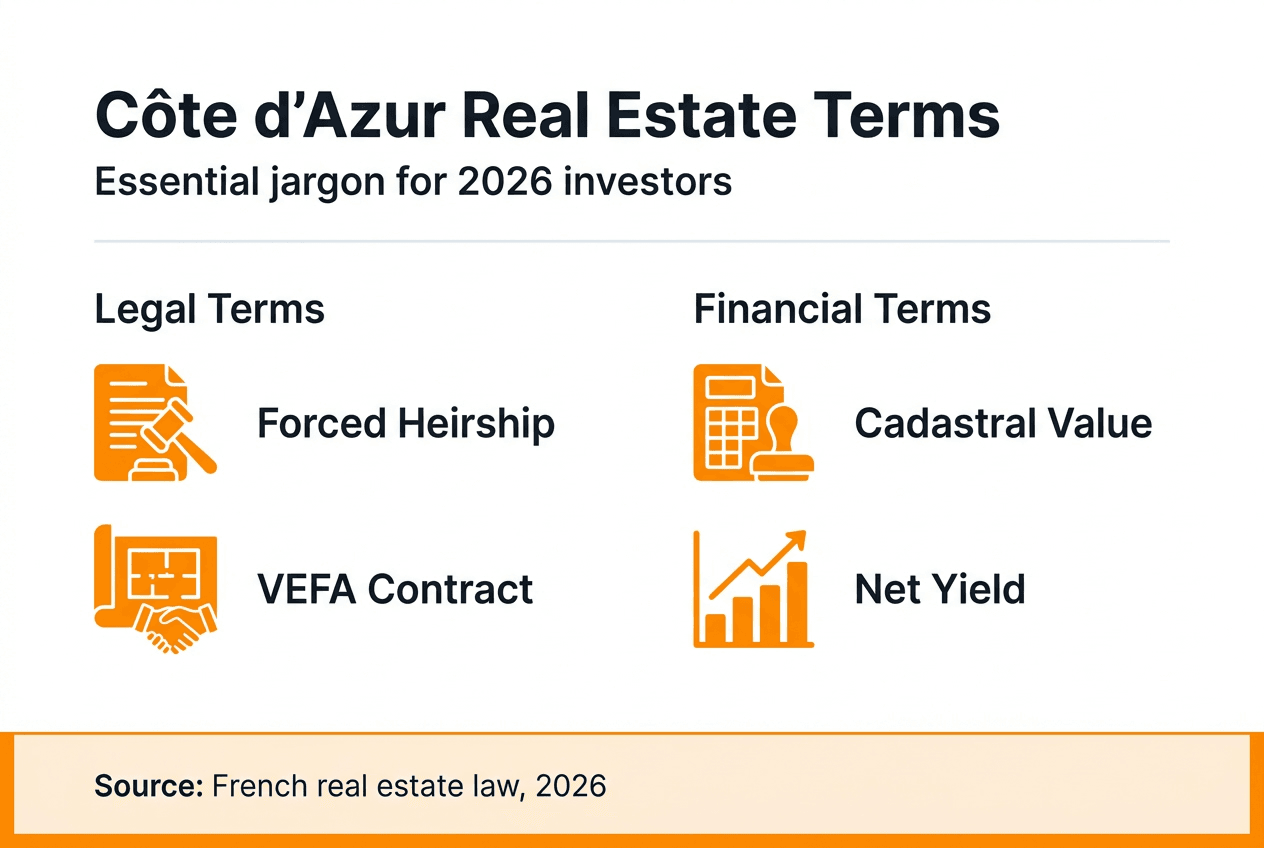
Understanding property terminology specific to Cannes and other Riviera communes refines tax planning. Each location presents distinct fiscal profiles, influencing portfolio diversification and regional real estate trends that savvy investors monitor continuously.
Due diligence and risk mitigation jargon explained
Thorough due diligence protects luxury investments from hidden defects and legal complications. Familiarity with inspection terminology ensures rigorous vetting.
Due diligence encompasses comprehensive investigations into property condition, title clarity, and regulatory compliance. Legal audits verify ownership chains, identify servitudes or liens, and confirm zoning permissions. Technical surveys, or diagnostics immobiliers, assess structural integrity, energy efficiency, asbestos presence, and termite risks. Due diligence procedures including legal audits and technical surveys reduce unforeseen risks in high value Côte d’Azur transactions, safeguarding capital and reputation.
Seismic resilience evaluations matter in coastal zones prone to geological activity. Engineers assess foundation stability, structural reinforcement, and compliance with seismic building codes. Properties meeting current standards command premiums and lower insurance costs. Structural integrity checks extend to roofing, plumbing, electrical systems, and facades, identifying repair needs before purchase.
Title insurance, rare in France but increasingly available, protects against undisclosed claims or ownership disputes. Investors accustomed to Anglo Saxon markets appreciate this layer of security. Pre acquisition site visits, architect consultations, and notaire reviews complete rigorous vetting processes.
Pro Tip: Retain independent surveyors with Côte d’Azur expertise rather than relying solely on seller provided reports. Local specialists identify region specific issues like coastal erosion or heritage restrictions that generic assessments might overlook.
Essential due diligence steps for Riviera luxury investments:
- Verify ownership history and title clarity through notaire searches
- Commission full diagnostics immobiliers covering energy, asbestos, lead, termites
- Assess structural integrity and seismic resilience with certified engineers
- Review local zoning regulations and renovation permissions
- Confirm property boundaries match cadastral records
- Evaluate environmental restrictions in coastal or protected zones
Risk mitigation extends beyond inspections to contractual safeguards. Suspensive clauses, or conditions suspensives, allow buyers to withdraw if financing falls through or inspections reveal defects. These clauses protect deposits and provide negotiation leverage. Understanding terms like “garantie décennale” (10 year builder warranty) and “garantie biennale” (2 year equipment warranty) clarifies post purchase protections, especially critical for new construction investments on the Côte d’Azur.
Common misconceptions about Côte d’Azur real estate jargon
Misunderstanding key terms leads to misinformed decisions. Clarifying these misconceptions sharpens investor acumen.
Many assume luxury finishes are purely aesthetic indulgences with negligible return impact. Data contradicts this belief. Premium materials and smart integrations demonstrably boost resale values by 15% to 25% and enhance rental yields by 2% to 3%. Finishes signal quality to discerning buyers, shortening sales cycles and commanding higher offers. They are strategic investments, not frivolous expenditures.
Forced heirship often appears as an impenetrable barrier to estate planning. While direct heirs receive mandatory shares, investors retain flexibility over the disposable portion, typically one quarter to one half of the estate. Strategic use of lifetime gifts, trusts, and asset structuring preserves significant testamentary freedom. The key lies in early planning with advisors fluent in both French succession law and international wealth structures.
VEFA contract protections are frequently underestimated. Buyers mistakenly view off plan purchases as riskier than resale acquisitions. In reality, VEFA agreements offer substantial buyer safeguards including staged payments tied to construction milestones, builder insolvency insurance, and decade long structural warranties. These protections often exceed those available in resale transactions, making new builds attractive for risk averse investors.
Some investors believe all Côte d’Azur locations share identical tax burdens. Tax rates and cadastral values vary significantly by commune. Menton offers lower property taxes than Cannes or Saint Tropez, while Nice balances moderate rates with robust infrastructure. Understanding municipal differences enables tax efficient portfolio construction.
Common jargon misunderstandings corrected:
- Misconception: Forced heirship eliminates estate planning flexibility
- Reality: Disposable portions and lifetime gifts preserve testamentary control
- Misconception: VEFA contracts expose buyers to construction risks
- Reality: Staged payments and 10 year warranties provide superior protection
- Misconception: Luxury finishes offer only aesthetic value
- Reality: Premium materials increase resale by 15% to 25% measurably
- Misconception: All Riviera locations have similar tax profiles
- Reality: Rates vary from 0.5% to 1.5%, significantly affecting returns
Practical application: using real estate jargon to enhance investment decisions
Translating jargon knowledge into actionable investment strategies maximises returns and mitigates risks. Follow these steps to apply terminology effectively.
- Audit contracts using jargon fluency: Review compromis de vente and acte de vente clauses for suspensive conditions, completion timelines, and warranty terms. Identify forced heirship implications and structure ownership to align with succession goals.
- Calculate net yields accurately: Factor cadastral value based property taxes, copropriété charges, and wealth tax exposure into return projections. Compare gross versus net yields to assess true profitability across locations.
- Prioritise VEFA protections in new builds: Verify builder guarantees, payment schedules tied to construction stages, and 10 year structural warranties. Negotiate lower notary fees and zero interest payment plans standard in off plan transactions.
- Commission comprehensive diagnostics: Insist on full technical surveys covering energy efficiency, structural integrity, seismic resilience, and environmental compliance. Use findings to negotiate price reductions or seller funded repairs.
- Engage bilingual specialists: Retain notaires, legal advisors, and surveyors fluent in both French real estate jargon and international investment terminology. Clear communication prevents costly misunderstandings.
- Assess luxury finishes strategically: Evaluate whether existing finishes justify asking prices or require upgrades. Budget for enhancements that deliver 15% to 25% resale premiums and 2% to 3% yield boosts.
- Structure ownership tax efficiently: Explore SCIs, trusts, or corporate vehicles to mitigate wealth tax and optimise succession planning within forced heirship constraints. Professional guidance ensures compliance and maximises benefits.
Pro Tip: Maintain a personal glossary of Côte d’Azur real estate terms encountered during your investment journey. Markets evolve, regulations shift, and new jargon emerges. Continuous learning sustains competitive advantage and investment confidence.
Applying jargon fluency transforms abstract concepts into concrete decision criteria. When evaluating a Cap d’Antibes villa, understanding forced heirship guides ownership structuring. Recognising VEFA protections clarifies new build advantages over resale alternatives. Calculating net yield using precise tax terminology reveals whether a Menton apartment outperforms a Cannes counterpart despite lower gross rent. Each jargon term becomes a lens through which due diligence processes and inheritance planning strategies gain clarity and precision.
Conclusion: empowered investing with real estate jargon mastery
Mastering Côte d’Azur real estate jargon equips high net worth investors with clarity and confidence. Understanding forced heirship, VEFA protections, luxury finish valuations, tax terminology, and due diligence processes reduces risk and enhances legacy wealth strategies. Fluency in local terminology transforms opaque contracts into strategic tools, enabling informed negotiations and optimised returns. As you navigate Riviera investments, let jargon knowledge illuminate pathways to heirloom estates that appreciate 5% to 8% annually while safeguarding family legacies across generations.
Explore expert support for your Côte d’Azur luxury investments
Living on the Côte d’Azur specialises in connecting discerning investors with exclusive off market properties across the French Riviera. Our bilingual team applies jargon fluency to every transaction, ensuring clear communication and strategic positioning. From tailored acquisition services to legacy focused portfolio construction, we transform real estate terminology into investment advantage. Explore our curated listings and discover investment strategies designed for generational wealth. Contact our experts today to secure your Riviera heirloom with confidence and precision.
FAQ
What is forced heirship and how does it affect my Côte d’Azur property investment?
Forced heirship reserves a fixed estate share for direct heirs, limiting testamentary freedom. With one child, half your property passes automatically; three or more children secure three quarters. This rule requires careful inheritance planning on the Côte d’Azur to balance legacy intentions with legal mandates, ensuring family harmony and wealth transfer efficiency.
What protections do VEFA contracts provide for new build luxury homes?
VEFA contracts mandate stage payments tied to construction milestones and include 10 year structural warranties, protecting buyers from builder insolvency and defects. They also offer zero interest payment plans and reduced notary fees of 2% to 3%, compared to 7% to 8% for resale properties. These safeguards make off plan investments particularly secure under Côte d’Azur luxury real estate regulations.
How can understanding luxury real estate jargon improve my investment returns?
Jargon fluency enables precise risk assessment, clearer contract negotiations, and strategic financial planning. Knowing terms like net yield, cadastral value, and forced heirship allows you to forecast costs accurately, structure ownership tax efficiently, and identify properties with superior appreciation potential. This knowledge cumulatively enhances portfolio returns and legacy wealth strategies across generations.
What key financial terms should I know when investing in Côte d’Azur properties?
Essential terms include cadastral value, which determines property tax liabilities ranging from 0.5% to 1.5% annually, and net yield, measuring rental income after expenses. Capital appreciation, typically 5% to 8% annually on the Riviera, complements yield for total return assessment. Understanding wealth tax (IFI) and notary fees clarifies carrying costs and transaction expenses. Mastering these concepts through resources like the luxury real estate tax guide sharpens investment decision making.
Recommended
- Guide to International Real Estate Investment in Côte d’Azur
- Côte d’Azur 2026 Real Estate Rules: 50% Forced Heirship Explained
- Property acquisition guide – Living on the Côte d’Azur
- 7 Essential Real Estate Investment Tips for Côte d’Azur
- Safari Lodge Terminology: Decoding The Luxury Experience – Namibia Luxury Safaris | Book Your 2025/2026 Adventure Today
 //
//