TL;DR:
- Côte d’Azur property serves as a lasting family legacy, embodying values, identity, and influence.
- Luxury real estate offers control, income, philanthropy, and sustainability benefits unmatched by other assets.
- Proper legal and family planning ensures a meaningful, flexible, and protected multi-generational inheritance.
Few assets carry the weight, warmth, and enduring prestige of a well-chosen property on the Côte d’Azur. Yet luxury real estate is persistently misunderstood as a trophy purchase rather than what it truly can be: a sophisticated, multi-generational legacy instrument that extends far beyond inheritance tax planning. For discerning families building wealth that lasts, the French Riviera offers something rare. It offers stone, sea views, and a legal and cultural framework that, when navigated with expertise, can protect fortunes, express values, and create impact for generations to come.
Table of Contents
- What does real estate as a legacy really mean?
- Key advantages of real estate for multi-generational stewardship
- French succession law and cross-border complexity
- Philanthropy, tax strategy, and sustainable legacy planning
- The uncomfortable truth most estate planners won’t mention
- Start building your Côte d’Azur legacy today
- Frequently asked questions
Key Takeaways
| Point | Details |
|---|---|
| Legacy goes beyond inheritance | Real estate can unify family, philanthropy, and sustainability across generations. |
| Unique tax and succession benefits | Strategic gifting and cross-border structuring can reduce tax burdens and enhance flexibility. |
| French law demands expertise | Succession, taxation and cross-border rules require specialist guidance. |
| Sustainable legacies increase impact | Eco-friendly property choices can amplify your long-term family and societal legacy. |
What does real estate as a legacy really mean?
Legacy, in the truest sense, is not simply the transfer of assets. It is the transmission of values, identity, and influence from one generation to the next. A sun-drenched villa above Èze, commanding eagle-eye vistas over pebbled coves and the shimmering Mediterranean, is not merely a property. It is a place where family stories are made, where children learn what beauty and excellence look like in tangible form.
What sets prime real estate apart from equities, bonds, or cash savings as a legacy vehicle is precisely this quality of permanence and meaning. As Wells Fargo spotlights, real estate can be deliberately used as a legacy vehicle for philanthropy and strategic tax outcomes, giving high-net-worth families a level of intentionality that liquid assets rarely afford. A share portfolio can be liquidated in a moment of crisis or impulse. A Provençal mas in the hills above Antibes, its terraces fragrant with lavender and rosemary, demands considered stewardship.
Consider what legacy real estate actually enables:
- Control and continuity: Families retain decision-making authority over the asset, its use, and its future for decades.
- Identity and narrative: The family home becomes part of your story, something heirs associate with belonging and shared history.
- Philanthropic power: Appreciated property can be donated to charitable causes, generating social impact alongside tax efficiency.
- Sustainable stewardship: Eco-renovated villas and heritage mas provide a platform for demonstrating environmental values to the next generation.
- Stable income: Elite seasonal rental on the Riviera generates 3 to 5% annual yields, funding the estate’s upkeep while the asset appreciates.
The essentials for legacy investors are distinct from those of a conventional buyer. Where a lifestyle purchaser seeks immediate enjoyment, the legacy investor thinks in decades, designing an asset that serves multiple purposes simultaneously.
“Real estate, unlike almost any other asset class, can be simultaneously enjoyed, rented, gifted, restored, and inherited. It is the only investment that feeds the soul as readily as it feeds the balance sheet.”
This is the power that most estate planning discussions overlook entirely, and it is precisely why the Côte d’Azur remains, in 2026, the Riviera of choice for families with generational ambitions.
Key advantages of real estate for multi-generational stewardship
Now that you see the distinct power of legacy property, let us examine the strategic advantages that make Riviera real estate so compelling for sustained, cross-generational benefit.
How luxury property compares to other legacy vehicles
| Legacy vehicle | Tangible value | Family use | Philanthropic use | Sustainable angle | Control retained |
|---|---|---|---|---|---|
| Côte d’Azur villa | Very high | Yes, direct | Yes, via donation | Strong, eco-retrofit | Full |
| Equity portfolio | High (volatile) | No | Via DAF or charity | Limited | Partial |
| Art collection | High (illiquid) | Limited | Yes, loans/gifts | Minimal | Full |
| Cash/bonds | Moderate | No | Yes, easy | None | Full |
| Commercial property | High | Rarely | Possible | Growing | Full |
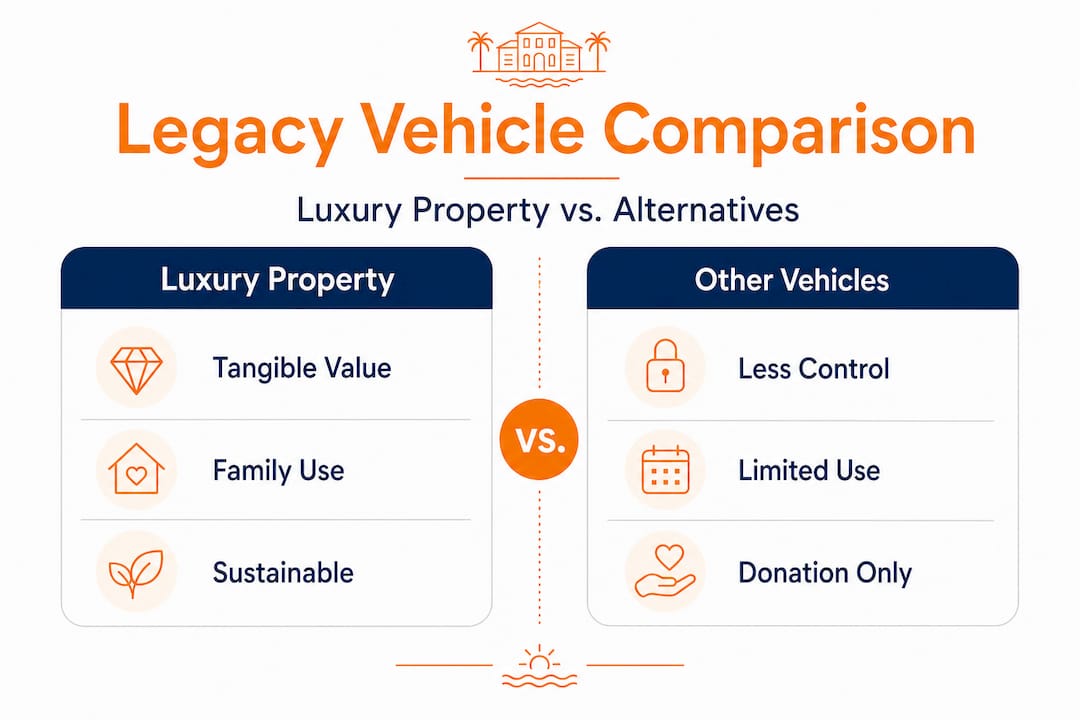
The picture is clear. Prime Côte d’Azur real estate is virtually unmatched in combining all five dimensions of a great legacy vehicle. Villas in Cap d’Antibes and Monaco-adjacent estates have demonstrated appreciation of 5 to 8% annually over the past decade, even through periods of global volatility.
Here are the principal advantages for legacy-minded families:
- Value retention through scarcity: The Riviera’s coastal geography is finite. Demand from global ultra-high-net-worth buyers continues to outpace supply, particularly for sea-view properties above Cannes and in the hills behind Menton, where the annual Lemon Festival brings thousands of visitors and sustains the area’s enduring cultural prestige.
- Seasonal income that preserves the estate: A well-positioned villa near Sainte-Maxime’s Nartelle beach or above Saint-Tropez’s Pampelonne shores can command exceptional seasonal rental income, funding maintenance costs without touching the capital base.
- Eco-renovation as future-proofing: 2026’s green-certified properties command premiums and align with tightening European energy regulations. Solar arrays, rainwater harvesting, and biophilic landscaping transform a legacy asset into one that heirs are proud to steward.
- Philanthropic leverage: Donating appreciated property can allow deduction of fair market value and avoidance of realised capital gain tax, making a Riviera villa one of the most tax-efficient charitable gifts available to a high-net-worth family.
- Emotional and cultural capital: There is no substitute for gathering three generations under the pergola of a heritage property overlooking the Baie des Anges, Nice spreading below in golden evening light.
Pro Tip: Begin your legacy structuring well before any transfer event. The Riviera legacy buying guide outlines how to align purchase structure with succession goals from the outset, avoiding costly restructuring later. Work with your advisors on capital gains exposure, SCI (Société Civile Immobilière) structures, and generational gifting allowances while building wealth through Riviera real estate to compound your advantage over time.
French succession law and cross-border complexity
With those stewardship advantages in mind, you must also navigate the legal realities, especially in the uniquely complex Franco-European context. France is not a jurisdiction where legacy planning can be improvised.
French succession law includes forced heirship protections for children, progressive inheritance tax by beneficiary, and the option to elect the law of your country of nationality under Brussels IV. This matters enormously for international families holding Côte d’Azur property.
Key succession facts for French real estate owners
| Beneficiary | Forced reserve (if applicable) | Tax-free allowance | Progressive tax rate |
|---|---|---|---|
| Spouse | None (exempt) | Full exemption | 0% |
| Child | Yes, 25 to 75% of estate | €100,000 per child | 5 to 45% progressive |
| Sibling | No forced reserve | €15,932 | 35 to 45% |
| Unrelated | No forced reserve | €1,594 | 55 to 60% |
Several critical points deserve your attention:
- Forced heirship: French law protects children’s rights to a reserved portion of the estate. One child receives at least 50%, two children at least 66%, and three or more children at least 75% collectively. This cannot be overridden by will for French-situated property, regardless of the testator’s nationality.
- Brussels IV election: Non-French nationals may elect for the law of their nationality to govern their overall succession, which can provide greater testamentary freedom. This election must be made explicitly, ideally in a properly drafted will, before any succession event occurs.
- SCI structures: Holding French property through an SCI can facilitate phased gifting, allow multiple heirs to hold shares rather than undivided co-ownership, and simplify management. It is widely used by sophisticated families across Monaco’s borders and the wider Riviera.
- Tax-free gifting intervals: French law permits tax-free gifts to children every 15 years up to the applicable allowance, making phased transfer a powerful tool when planned with sufficient foresight.
Safeguarding your Côte d’Azur legacy requires specialist local counsel who understands both French notarial law and international private law. We strongly recommend consulting a French notaire and an international succession specialist together, before you purchase, not after. Understand the full landscape of property transfer and legacy law before making any structural decisions.
Pro Tip: If you are a non-EU national, take particular care with Brussels IV planning. The election of foreign national law may affect forced heirship protections differently across jurisdictions. An internationally connected legal team is non-negotiable for safeguarding your Côte d’Azur legacy effectively.
Philanthropy, tax strategy, and sustainable legacy planning
Equipped with a legal understanding, you can now elevate your legacy impact, both for your family and for society, through strategic philanthropy and sustainability. This is where real estate legacy planning becomes genuinely transformative.
Donating appreciated real estate directly to a qualified public charity can allow donors to deduct fair market value and skip the capital gains entirely, a combination that no other asset class replicates so cleanly. For a family holding a Riviera property acquired decades ago at a fraction of its current value, this can represent a profoundly efficient philanthropic act.
Here is a practical framework for philanthropic legacy planning through property:
- Identify your charitable intent: Heritage preservation, environmental restoration, arts and culture, and education are all causes with strong institutional infrastructure in the south of France. The gardens of Val Rahmeh in Menton, a botanical sanctuary of international repute, exemplify how property stewardship can itself become a philanthropic act.
- Assess the appreciation position: The greater the unrealised gain, the more powerful the donation strategy. Properties held for 20 or more years in prime Riviera locations typically carry substantial embedded gains.
- Engage a specialist charitable vehicle: Structured giving through a foundation or donor-advised fund can maximise deductibility, enable a five-year carryforward of excess deductions, and maintain family involvement in the charitable mission.
- Consider partial gifting or conservation easements: Donating a façade easement on a heritage property, or placing a portion of a coastal estate into conservation, can generate immediate tax relief while preserving family enjoyment of the balance.
- Align with sustainability: Eco-restoration of a Provençal mas, converting it into a certified sustainable property and gifting it to an environmental foundation, creates a legacy that resonates with heirs who care as much about the planet as the portfolio.
“The most powerful legacies are not those that simply transfer wealth but those that transmit values. A restored farmhouse given to an environmental charity says more about a family’s convictions than any financial bequest ever could.”
The step-by-step investment in luxury property process, when approached with legacy and philanthropic intent from the outset, becomes an entirely different exercise. It is not about finding the best price per square metre. It is about finding the property that best serves the family’s full vision, financial, personal, and social, across generations.
The uncomfortable truth most estate planners won’t mention
We have spent years working with high-net-worth families on Riviera acquisitions, and we have observed a consistent pattern. Most estate planners approach legacy real estate as a technical problem to be solved: minimise tax, maximise allowances, document the structure correctly, and close the file. The human dimension is treated as an afterthought, if it is considered at all.
That is a significant mistake. The families whose legacies endure are not those with the most sophisticated legal structures. They are the families who have thought carefully about what the property means, who will care for it, how heirs will relate to each other through shared stewardship, and what story the estate tells about who they are.
We have seen impeccably structured SCI arrangements dissolve into family conflict because no one had discussed what would happen when one heir wanted to sell and another wanted to preserve. We have watched beautifully restored heritage properties fall into neglect because the second generation felt no emotional connection to a place they were never meaningfully invited into. The technical work matters enormously. But it is not sufficient on its own.
The property investment and legacy process that truly endures integrates financial strategy with family narrative. It asks: what do we want this property to say about us in fifty years? It designs for flexibility, because heirs’ lives cannot be predicted, while simultaneously investing in shared experiences that make the estate genuinely beloved. A family that gathers on the Croisette in Cannes every summer for the Film Festival, or kayaks to the Lérins Abbey from a Cannes marina villa, builds something that no legal document can replicate: a shared desire to preserve and cherish.
The best legacy properties are not those that are most efficiently owned. They are those that are most deeply loved.
Start building your Côte d’Azur legacy today
If this article has shifted your perspective on what a Riviera property can truly accomplish for your family, the next step is a conversation with advisors who understand both the extraordinary opportunities and the genuine complexities involved. At Living on the Côte d’Azur, we specialise in connecting discerning families with exclusive Côte d’Azur properties that are positioned for multi-generational stewardship, from eco-certified villas above Antibes to Monaco-adjacent estates and new-build sea-view residences in Nice’s Mont Boron. We also accept cryptocurrency, because we understand that today’s legacy builders operate across every dimension of modern wealth. Explore our legacy luxury and ROI insights and contact our team for a curated consultation tailored to your family’s vision.
Frequently asked questions
What is the main advantage of using real estate for family legacy?
Real estate combines tangible, appreciating value with direct family use, philanthropic potential, and sustainable stewardship, offering a breadth of legacy impact that liquid assets simply cannot match across generations.
How does France’s forced heirship impact legacy plans?
Forced heirship rules guarantee children a reserved share of any French-situated estate, with progressive succession tax applied per beneficiary, meaning non-French families must plan carefully to retain flexibility and minimise exposure.
Can gifting property directly to charity reduce tax?
Yes. Donating appreciated property to a qualified charity can allow deduction of current fair market value while entirely avoiding capital gains tax, subject to applicable annual income limits and five-year carryforward provisions.
Why is sustainability relevant in real estate legacy?
Sustainable, green-certified properties align with the values of environmentally conscious heirs, comply with tightening European energy regulations, and command growing premiums in the Riviera market, making them both financially and ethically sound legacy choices.
What if heirs live outside France?
Families with non-French heirs can sometimes elect the succession law of their nationality under Brussels IV provisions, but this must be done explicitly in a valid will, with specialist legal advice to manage the intersection of French tax law and foreign succession rules.
Recommended
 //
//