
The process of purchasing luxury property on the French Riviera with Bitcoin brings unique advantages but also vital responsibilities. For investors who value legacy and seek flexibility through cryptocurrency, confirming ownership and compliance is more than a formality. This guide outlines each step in the journey—highlighting how to prove your Bitcoin holdings, partner with crypto-compliant agencies, and protect your interests through anti-money laundering (AML) compliance and regulated conversion services—ensuring your Riviera investment stands on lawful, solid ground.
Table of Contents
- Step 1: Verify Your Bitcoin Holdings for Property Purchase
- Step 2: Select the Right Crypto-Compliant Estate Agency
- Step 3: Engage a Trusted Crypto-to-Fiat Service for Transaction
- Step 4: Complete Legal Due Diligence on Your Chosen Estate
- Step 5: Confirm Settlement and Secure Ownership Transfer
Quick Summary
| Key Message | Explanation |
|---|---|
| 1. Verify Bitcoin Ownership | Prove control of your Bitcoin with documented proof including private keys and transaction history. |
| 2. Choose a Crypto-Compliant Agency | Select an estate agency experienced in cryptocurrency transactions and familiar with local laws to facilitate the purchase. |
| 3. Use a Licensed Crypto-to-Fiat Service | Opt for a reputable service to convert Bitcoin to euros, ensuring compliance with financial regulations during the transaction. |
| 4. Conduct Thorough Legal Due Diligence | Investigate property legality, ownership history, and tax obligations, using specialised lawyers to protect your investment. |
| 5. Confirm Payment Settlement | Coordinate with your notary to verify payment and ensure proper registration of ownership following the purchase. |
Step 1: Verify Your Bitcoin Holdings for Property Purchase
Before you commit to purchasing luxury real estate on the Côte d’Azur with Bitcoin, you need to prove you actually own the Bitcoin you claim to hold. This verification step protects both you and the seller, ensuring the transaction proceeds without legal complications.
Start by understanding what Bitcoin ownership truly means. You own Bitcoin when you control the private cryptographic keys to your wallet address. Without those keys, you don’t control the funds, regardless of what any platform tells you. Your keys are your proof.
Gather your ownership evidence. You’ll need to demonstrate control over your Bitcoin holdings through several documents:
- Your wallet address and its complete transaction history
- Proof that you control the private keys to that address
- Bank statements showing transfers to regulated cryptocurrency exchanges
- Records from your crypto exchange account confirming your Bitcoin balance
- Screenshots or documentation of your wallet holdings dated within the last 30 days
Next, verify the source of your funds through anti-money laundering (AML) compliance. This means proving the origin of your Bitcoin investments by showing legitimate acquisition. Have bank statements ready that trace your initial deposits to regulated exchanges. This documentation establishes that your wealth came from lawful sources, not illicit activities.
Confirm your cryptocurrency exchange is regulated. Many jurisdictions require exchanges to hold proper licences and comply with financial regulations. Verify this through the exchange’s official website or regulatory databases in your country. A regulated exchange provides stronger legal footing for your transaction.
Use blockchain explorers to verify your actual Bitcoin balance. Tools like Blockchain.com or Etherscan allow you to enter your public wallet address and see exactly what Bitcoin sits in that account on the immutable ledger. This provides undisputable proof of ownership that anyone can independently verify.
The blockchain never lies. Your wallet address and transaction history are permanently recorded, creating an audit trail that satisfies even the most rigorous legal requirements.
When working with our team at Living on the Côte d’Azur, we’ll request these verification documents as part of our due diligence process. This isn’t bureaucracy—it’s protection for everyone involved. Once verified, your Bitcoin can move forward toward your dream Riviera property purchase.
Pro tip: Gather all verification documents at least two weeks before your property viewing, so there’s no delay when you’re ready to make an offer on your ideal Riviera residence.
Step 2: Select the Right Crypto-Compliant Estate Agency
Not all estate agencies understand cryptocurrency transactions. Finding one that specialises in crypto-compliant property purchases is crucial to your success on the Côte d’Azur. The right agency bridges the gap between digital assets and luxury real estate seamlessly.
Start by identifying agencies with proven experience in cryptocurrency transactions. Look for firms that have successfully completed Bitcoin or stablecoin property deals. Ask prospective agents about their previous crypto transactions and request references from past clients. A track record speaks volumes.
Verify that the agency works with licensed intermediaries and developers who accept cryptocurrency payments. Many boutique agencies partner with crypto payment processors or specialised financial partners to handle the technical aspects. These partnerships ensure compliance with anti-money laundering regulations whilst keeping transactions moving.
Seek out agencies knowledgeable about local regulations. Your agency should understand both French real estate law and cryptocurrency legal requirements. They’ll guide you through regulatory frameworks that protect your investment and ensure legitimacy throughout the purchase process.
Evaluate their expertise in wallet verification and blockchain documentation. Your chosen agency must be comfortable reviewing blockchain records, understanding private key security, and verifying fund sources. They should ask the right questions about your Bitcoin holdings without making you feel scrutinised.
Check for AML and KYC compliance capabilities. Any reputable crypto-compliant agency will conduct Know Your Customer checks and anti-money laundering verification. This protects everyone involved and prevents legal complications down the road. Don’t avoid agencies that insist on these checks; embrace them.
The best crypto-compliant agencies treat compliance as a feature, not a burden. They streamline verification whilst maintaining the security and discretion you expect from luxury real estate professionals.
During your initial consultations, ask about their experience with verifying cryptocurrency asset transactions. Their answers will reveal whether they truly understand crypto or are simply experimenting with it.
At Living on the Côte d’Azur, we’ve built our entire platform around crypto-compliant transactions. Our team understands the nuances of Bitcoin payments, blockchain verification, and international compliance requirements. We work with established payment partners to ensure your transaction flows smoothly from wallet to deed.
Pro tip: Request a consultation with multiple agencies and compare their specific experience with crypto transactions—ask for timelines and their exact process for handling Bitcoin payments before committing.
Step 3: Engage a Trusted Crypto-to-Fiat Service for Transaction
Your Bitcoin must eventually convert to euros to complete the property purchase. Selecting a trusted crypto-to-fiat service is the bridge between your digital wealth and the traditional banking system required by French law. This step demands careful attention to legitimacy and compliance.
Understand why conversion is necessary. Most sellers, notaries, and developers require payment in euros rather than Bitcoin. Regulatory frameworks across France mandate fiat currency for official property transfers. A reliable conversion service handles this technically while maintaining full compliance with financial regulations.
Identify services with proper licensing and regulatory approval. Search for crypto-to-fiat providers registered with financial authorities in your jurisdiction. Legitimate services display their licencing information prominently. Never use unlicenced converters, regardless of how competitive their rates appear.
Verify KYC and AML compliance requirements. Any trustworthy service will ask detailed questions about your identity, fund sources, and transaction purpose. This isn’t intrusive bureaucracy—it’s legal protection for everyone involved. Services that skip these checks are operating illegally.
Evaluate their track record and reputation. Research reviews from other property buyers who’ve used their services. Ask your estate agency for recommendations based on their experience. Word-of-mouth referrals from trusted professionals matter more than marketing claims.
Compare conversion fees and exchange rates across multiple providers. Rates vary considerably, and smaller differences compound on large transactions. Request quotes for your specific amount and timeline before committing. Transparency about all fees is non-negotiable.
Check their integration with traditional banking. The service should facilitate smooth transfers directly into the notary’s escrow account or your designated French bank. Understand their settlement timeline—typically two to five business days.
Trust is earned through transparency. A crypto-to-fiat service that explains every step and answers your questions thoroughly deserves your business more than one offering slightly better rates.
When selecting your provider, prioritise services experienced with converting cryptocurrency for real estate transactions. Their expertise in this specific use case means fewer complications and faster processing.
Our partnerships at Living on the Côte d’Azur include established crypto-to-fiat providers who understand Riviera property transactions. We coordinate directly with these services to ensure seamless conversion and timely fund arrival at closing.
Pro tip: Begin your crypto-to-fiat conversion process at least three weeks before your scheduled closing date to account for verification delays and banking transfer times.
For a quick comparison, see how crypto-to-fiat converters differ from exchanges:
| Factor | Crypto-to-Fiat Converter | Standard Crypto Exchange |
|---|---|---|
| Regulation | Always strictly regulated | Varies, some unregulated |
| AML/KYC Process | Detailed due diligence | Sometimes lighter verification |
| Purpose | Property purchases, large sums | General trading, personal use |
| Euro Settlement | Direct to notary or bank | May require extra bank transfer |
Step 4: Complete Legal Due Diligence on Your Chosen Estate
Before you commit your Bitcoin to purchase, you must thoroughly investigate the property legally. Due diligence protects you from inheriting hidden liabilities, ownership disputes, or regulatory violations. This step separates savvy investors from those who learn expensive lessons too late.
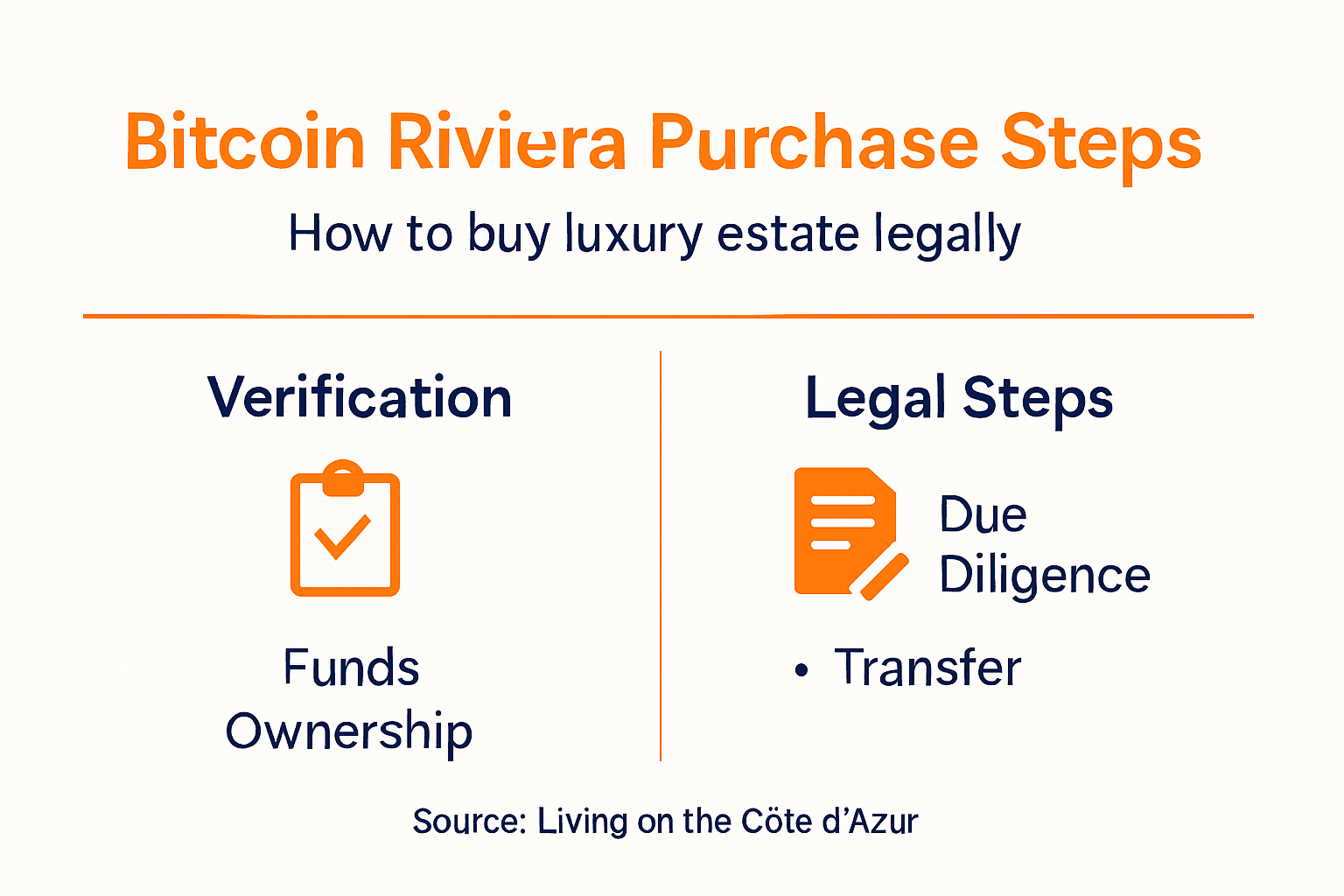
Start with a comprehensive title search. Your lawyer should verify the seller genuinely owns the property with clear, unencumbered rights. Check for liens, mortgages, or claims against the estate that could complicate your ownership. French property registries provide official documentation of ownership history.
Verify compliance with local property laws and regulations. Properties must meet building codes, planning permissions, and environmental standards. Some Côte d’Azur estates have historical designations requiring special approval for modifications. Your lawyer identifies these restrictions before you purchase.
Engage lawyers specialised in both cryptocurrency and real estate law. They understand the unique complexities of Bitcoin transactions whilst protecting your legal interests. Their expertise proves invaluable when drafting contracts that address cryptocurrency risks like price volatility and timing.
Undertake a thorough anti-money laundering compliance review. Your legal team verifies that the property sale doesn’t breach AML regulations and that fund sources align with the transaction legitimately. This protects you from inadvertently participating in financial crime.
Understand tax implications of your purchase. Property acquisition in France carries specific tax obligations, including transfer duties and ongoing property taxes. Inheritance considerations matter too, particularly for legacy-focused buyers. Your lawyer explains these costs clearly before closing.
Review property condition and technical surveys. Engage independent surveyors to assess structural integrity, seismic resilience, and systems functionality. Riviera properties face specific environmental concerns including coastal erosion and Mediterranean weather patterns.
Legal diligence isn’t bureaucratic burden—it’s your investment insurance. A thorough review today prevents costly problems years from now.
Request a notarisation timeline from your lawyer. The French notary coordinates final title verification, contract execution, and registration. Understanding this process ensures closing happens smoothly without surprises.
Our team at Living on the Côte d’Azur works alongside your chosen legal professionals to streamline due diligence. We facilitate communication between your lawyer, the estate agency, and all parties involved to keep momentum moving toward closing.
Pro tip: Budget approximately 6-8 weeks for complete legal due diligence before signing final contracts, allowing time for thorough investigation and negotiation adjustments.
Step 5: Confirm Settlement and Secure Ownership Transfer
You’ve verified your Bitcoin, selected your agency, converted your funds, and completed due diligence. Now comes the final critical step: confirming payment settlement and transferring legal ownership into your name. This is where your dream Riviera estate becomes legally yours.
Review the final purchase contract with your lawyer before signing. The contract should include special clauses addressing Bitcoin volatility if you’re settling in cryptocurrency, or confirmation of fiat conversion amounts and timing if converting to euros. Every detail matters at this stage.
Coordinate payment settlement with your crypto-to-fiat service and the notary. Confirm that funds will arrive in the notary’s escrow account on the agreed date. The notary holds these funds in trust until all conditions are satisfied and ownership transfers complete.
Understand the notarisation process. The French notary acts as an impartial official who verifies all parties’ identities, confirms fund availability, and registers the ownership transfer with local authorities. This process typically takes one to two weeks after contract signing.
Ensure proper documentation of the transaction for compliance with property law and anti-money laundering regulations. Your legal team must verify lawful fund sourcing and complete final due diligence before the notary releases funds.
Register your ownership title in French land registries. This registration proves your legal ownership and protects your rights against any future claims. The notary handles this registration automatically as part of the conveyancing process.
Receive your official deed of ownership. Once the notary completes registration, you’ll receive the acte de vente, the official French property deed. Keep this document safely—it proves you own your Côte d’Azur estate.
Settlement day is when digital wealth becomes tangible legacy. Your Bitcoin’s journey from wallet to deed is complete, and your Riviera investment is now legally protected.
Arrange final property inspections and utilities transfers. Before taking possession, confirm that all systems function properly and arrange for utilities to transfer to your name. This ensures seamless transition to ownership.
Our team at Living on the Côte d’Azur coordinates closely with your notary and legal representatives to ensure every detail aligns perfectly. We guide you through each milestone until you hold the keys to your new home.
Here’s how key players contribute during a Bitcoin property purchase:
| Role | Responsibility | When Involved |
|---|---|---|
| Buyer | Provides verified Bitcoin funds and identity | Throughout |
| Estate Agency | Ensures crypto compliance and transaction support | Property search to offer |
| Crypto-to-Fiat Service | Converts Bitcoin to euros securely | After offer, before payment |
| Lawyer | Handles legal checks and contract drafting | Due diligence to settlement |
| Notary | Registers ownership and holds escrow funds | Final settlement and closing |
Pro tip: Schedule your notary appointment for settlement at least two weeks in advance to secure your preferred date, and plan your move logistics once the registration is complete.
Secure Your Luxury Riviera Real Estate Purchase with Trusted Crypto Expertise
Buying high-end property on the Côte d’Azur with Bitcoin involves navigating unique challenges such as verifying your crypto ownership, ensuring legal compliance, and converting digital assets into euros for settlement. You need a partner who understands the intricacies of blockchain verification, crypto-to-fiat services, and French real estate law. Living on the Côte d’Azur offers a seamless gateway to this process through our dedicated expertise in crypto-compliant luxury real estate transactions.
Our platform connects visionary investors with exclusive properties while providing critical support for legacy investment strategies and due diligence essentials from title audits to contract negotiations. With us, your Bitcoin holdings transform into tangible heritage in prestigious locations like Cap d’Antibes and Monaco borders, where value appreciates steadily and lifestyle meets legacy.
Discover how to turn your digital wealth into an enduring Riviera estate through personalised guidance and trusted partners. Start your journey with a personal consultation at Living on the Côte d’Azur, explore our expertise in crypto-compliant property purchases, and benefit from a tailored approach that protects your investment every step of the way.
Don’t let complex cryptocurrency rules or legal hurdles delay your dream home acquisition. Contact us today to unlock Riviera real estate potential designed exclusively for digital millionaires seeking a legacy beyond the blockchain.
Frequently Asked Questions
How can I verify my Bitcoin ownership before buying luxury real estate?
To verify your Bitcoin ownership, gather evidence such as your wallet address, transaction history, and proof of control over your private keys. Begin this process at least two weeks before your property viewing to ensure all documentation is ready for your agent.
What are the legal requirements for purchasing property with Bitcoin?
The legal requirements include compliance with anti-money laundering regulations and proper verification of your funds’ origins. Consult with a lawyer experienced in cryptocurrency transactions to ensure all necessary checks are conducted prior to making an offer.
Why is it necessary to convert Bitcoin to euros for a property purchase?
Most sellers, notaries, and developers require payment in euros due to regulatory frameworks that mandate fiat currency for official property transfers. Choose a reputable crypto-to-fiat service to facilitate this conversion before finalising your purchase.
What steps should I take to ensure my property purchase due diligence is complete?
Conduct a thorough title search, verify compliance with local property laws, and engage specialised legal professionals to review the property. Aim to finish your due diligence approximately 6–8 weeks before signing any contracts to allow for comprehensive checks and adjustments.
How does the final ownership transfer process work when buying property with Bitcoin?
The final ownership transfer involves reviewing the purchase contract, coordinating payment settlement with your crypto-to-fiat service, and working with a notary to ensure all legal requirements are met. Schedule your notary appointment at least two weeks in advance to facilitate a smooth settlement process.
Recommended
 //
//