Think you can craft a pristine estate plan for your Côte d’Azur villa and bypass French inheritance law? Many high-net-worth international investors discover too late that forced heirship mandates at least 50% of estate assets must pass to direct heirs, regardless of wills or trusts. Understanding the intricate French legal frameworks governing luxury property ownership, taxation, and legacy protection is essential for securing your Riviera investment and safeguarding your family’s future wealth in 2026.
Table of Contents
- Introduction To Côte D’Azur Luxury Real Estate Regulations
- French National Laws Governing Property Purchases
- Inheritance And Legacy Planning Under French Law
- Tax Regulations Affecting Foreign Luxury Property Owners
- Local Municipality And Environmental Regulations
- VEFA Contracts And Protections For New Construction Buyers
- Due Diligence And Risk Mitigation For Luxury Property Investments
- Common Misconceptions On Côte D’Azur Property Regulations
- Conclusion And Practical Next Steps For Investors
- Explore Expert Services For Côte D’Azur Luxury Real Estate
Key Takeaways
| Point | Details |
|---|---|
| Forced Heirship Impact | French law mandates approximately 50% minimum estate inheritance to direct heirs, restricting will-based planning. |
| VEFA Contract Benefits | Off-plan purchases include 10-year warranties and staged payments, reducing financial and construction risks. |
| Property Tax Obligations | Annual luxury property tax ranges from 0.5% to 1.5% of cadastral value, directly affecting investment returns. |
| Local Regulatory Complexity | Coastal zoning and environmental protections impose strict permits and sustainability requirements on renovations. |
| Due Diligence Priority | Comprehensive legal audits and technical surveys are critical to secure clear title and protect legacy investments. |
Introduction to Côte d’Azur Luxury Real Estate Regulations
The Côte d’Azur luxury real estate market reached unprecedented heights in 2026, with sea-view villas commanding premiums exceeding €2 million beyond comparable inland properties. International buyers now represent over 40% of transactions above €3 million, drawn by the Riviera’s timeless elegance and appreciation rates consistently hovering between 5% and 8% annually. Yet this golden investment opportunity comes wrapped in layers of French national law and hyper-local municipal regulations that can confound even sophisticated global investors.
Why does regulatory complexity matter so profoundly here? The French legal system differs fundamentally from Anglo-Saxon common law traditions, particularly around property ownership structures, inheritance protocols, and tax obligations. A villa purchase in Cap d’Antibes operates under entirely different succession rules than a comparable estate acquisition in London or Miami. These distinctions directly impact your ability to transfer wealth across generations, a cornerstone of luxury real estate buying strategies for families seeking heirloom properties rather than transient investments.
For high-net-worth individuals focused on legacy protection, understanding both national frameworks and local Provençal traditions is non-negotiable. Your investment isn’t merely real estate; it’s a family sanctuary designed to weather market volatility while appreciating steadily. The regulatory landscape shapes everything from initial purchase mechanics to long-term wealth preservation:
- National laws govern ownership structures, notarial requirements, and forced heirship rules
- Municipal codes dictate building permits, environmental compliance, and coastal protection standards
- Tax frameworks at multiple levels affect annual carrying costs and estate transfer efficiency
- Contractual protections like VEFA agreements shield off-plan buyers from construction overruns
Mastering these regulatory dimensions transforms uncertainty into strategic advantage, enabling you to secure Riviera properties that serve your family for generations while optimizing fiscal outcomes.
French National Laws Governing Property Purchases
Every French property transaction revolves around the notaire, a state-appointed legal officer whose role is mandatory for authenticating property transactions ensuring legal clarity. Unlike estate agents or solicitors in other jurisdictions, notaires serve as impartial guarantees of contract validity and title transfer legitimacy. They conduct exhaustive title searches, verify seller ownership, calculate precise tax obligations, and register the deed with land registry authorities. For luxury acquisitions often involving complex ownership structures or cross-border elements, the notaire becomes your regulatory anchor point, ensuring compliance across all dimensions.
French purchase contracts follow a distinctive two-stage structure that protects buyers while maintaining transaction certainty. The preliminary contract, or compromis de vente, commits both parties and typically includes a 10-day cooling-off period for buyers. During this window, you retain full withdrawal rights without penalty, providing space for final due diligence reviews. The second stage, the acte de vente, represents the definitive sale executed before the notaire, transferring legal ownership and triggering tax payments.
Key contractual elements under French law include precise property descriptions referencing cadastral records, clear price specifications, detailed condition disclosures, and explicit timelines for completion. Unlike jurisdictions where buyers negotiate directly with sellers, French protocols mandate notarial oversight at every stage, reducing scope for disputes but requiring patience with formal procedures.
Navigating these mechanics successfully demands methodical attention:
- Engage bilingual legal counsel familiar with cross-border transactions before signing preliminary agreements.
- Verify notaire credentials and request detailed fee breakdowns, as costs typically range from 7% to 8% of purchase price for resale properties.
- Arrange financing pre-approval, since French banks require extensive documentation for foreign buyers seeking mortgages.
- Schedule comprehensive property surveys covering structural integrity, energy efficiency ratings, and compliance with current building codes.
- Review all title documents with your attorney, confirming absence of liens, easements, or historical claims that could cloud ownership.
Pro Tip: Budget an additional 2% to 3% beyond notaire fees for expert advisory services, technical inspections, and translation costs. These expenditures protect investments worth millions and prevent costly surprises during closing.
Inheritance and Legacy Planning under French Law
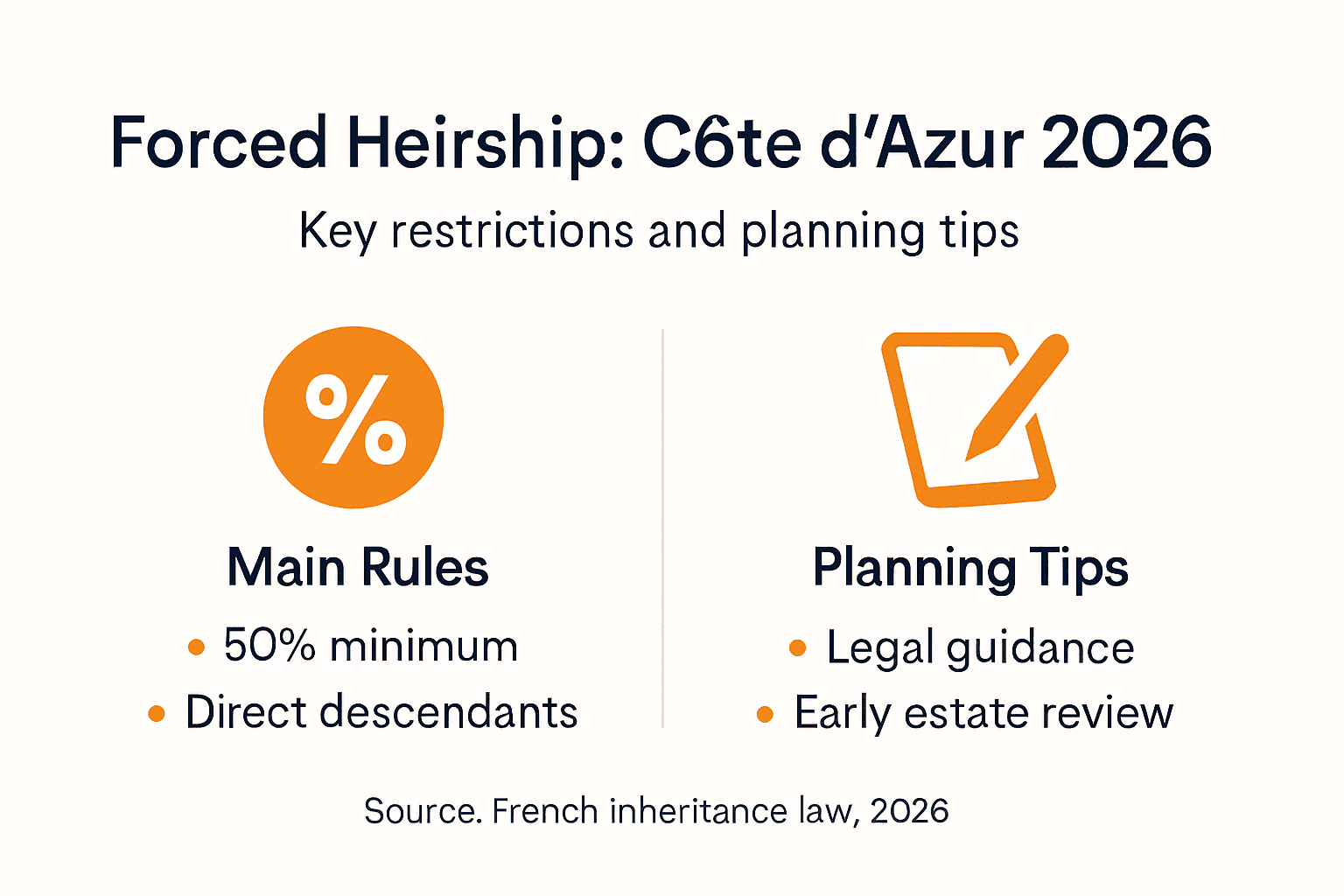
Forced heirship represents the most striking departure from Anglo-Saxon estate planning norms, and it directly constrains how you transfer Côte d’Azur property to future generations. French civil law guarantees direct descendants a reserved portion of your estate, typically ranging from 50% for one child to 75% for three or more. This forced heirship law mandates approximately 50% minimum inheritance to heirs regardless of wills, fundamentally limiting testamentary freedom.

Contrast this with will-based systems where property owners enjoy near-total discretion over asset distribution. In France, you cannot disinherit children or allocate your entire estate to charity, a spouse, or favored heirs. The reserved portion passes by operation of law, not by choice. Only the quotité disponible, the freely disposable portion, remains subject to your preferences. For a single child, you control just half your estate; for two children, only one-third.
| System | Testamentary Freedom | Heir Protections | Planning Flexibility |
|---|---|---|---|
| Forced Heirship (France) | Restricted to 25-50% | Strong statutory guarantees | Limited; requires creative structuring |
| Will-Based (US/UK) | Near-complete discretion | Minimal; depends on jurisdiction | Extensive; full asset allocation control |
Inheritance tax rates escalate steeply based on beneficiary relationship proximity. Spouses and PACS partners benefit from full exemptions. Direct descendants face progressive rates from 5% on amounts below €8,072 to 45% above €1,805,677, after applying a €100,000 per-child allowance. Siblings, nieces, nephews, and unrelated beneficiaries encounter rates reaching 60%, making strategic planning essential for wealth preservation.
Optimizing legacy transfer within these constraints requires sophisticated strategies:
- Establish SCI structures (Société Civile Immobilière) to hold property, enabling gradual gifting of shares across years to maximize allowances
- Utilize démembrement de propriété, separating usufruct and bare ownership to reduce taxable estate value while retaining property use rights
- Consider tontine clauses for married couples, allowing survivor to retain full property ownership outside estate calculations
- Coordinate with tax-efficient jurisdictions if you maintain residency outside France, potentially reducing exposure
Pro Tip: Expert legal guidance is essential for crafting legacy strategies compliant with forced heirship rules. Engage advisors with dual expertise in French succession law and international tax treaties to navigate cross-border complexities.
These regulations aren’t obstacles; they’re parameters within which strategic families build enduring wealth structures that honor both legal requirements and personal values.
Tax Regulations Affecting Foreign Luxury Property Owners
Beyond inheritance levies, Côte d’Azur property ownership triggers annual fiscal obligations that directly impact investment returns and long-term holding strategies. Property tax can range from 0.5% to 1.5% annually on luxury estate cadastral values, with actual rates determined by municipal budgets and property classifications. Villas in exclusive enclaves like Cap d’Antibes or Saint-Jean-Cap-Ferrat typically face the upper end of this spectrum due to premium locations and enhanced municipal services.
Cadastral values, the basis for property tax calculations, often lag significantly behind market values, providing modest relief. However, luxury properties benefit less from this discount than modest homes, since recent constructions and major renovations trigger reassessments at contemporary valuations. Factor these annual costs into your real estate investment tips analysis, as they compound over holding periods measured in decades.
Wealth tax considerations add another layer for high-net-worth owners. While France abolished its general wealth tax in 2018, it retained the Impôt sur la Fortune Immobilière (IFI) targeting real estate assets exceeding €1.3 million. Rates graduate from 0.5% to 1.5% based on total real estate wealth, with your worldwide property portfolio potentially included if you qualify as a French tax resident. Foreign owners maintaining non-resident status face IFI only on French properties, creating strategic residence planning opportunities.
Estate transfer taxes, detailed in the previous section, vary dramatically by beneficiary relationship:
- Spouses and civil partners: 0% (full exemption)
- Children and direct descendants: 5% to 45% after €100,000 allowance per child
- Siblings: 35% to 45% after €15,932 allowance
- Other relatives and unrelated beneficiaries: 55% to 60%
Optimizing your tax position requires proactive planning well before succession events. Consider establishing holding structures that distribute ownership across family members during your lifetime, utilizing annual gift allowances to progressively transfer assets while minimizing tax incidence. French law permits tax-free gifts of €100,000 per parent to each child every 15 years, providing powerful wealth transfer mechanisms when deployed systematically.
For properties generating rental income, particularly through seasonal luxury lettings common along the Riviera, income tax obligations apply according to your residency status and rental activity classification. Non-professional landlords face progressive income tax rates up to 45%, plus social charges of 17.2%, on net rental proceeds. Professional landlords may access different regimes with distinct tax treatments and deduction rules.
These fiscal realities don’t diminish the Côte d’Azur’s investment appeal; they simply demand informed navigation to preserve returns and optimize generational wealth transfer.
Local Municipality and Environmental Regulations
Beyond national frameworks, each Côte d’Azur municipality enforces zoning codes, building permits, and environmental protections that profoundly shape property development possibilities. Coastal communes face particularly strict oversight designed to preserve the Riviera’s iconic landscapes from overdevelopment. Environmental protections around Cap d’Antibes restrict modifications to preserve natural heritage, limiting everything from exterior color palettes to vegetation removal.
Plan Local d’Urbanisme (PLU) documents govern what you can build, renovate, or modify on any given parcel. These comprehensive zoning plans specify permitted uses, maximum building heights, setback requirements from property lines, and architectural style guidelines. In historic districts like Vieux Nice or Èze’s medieval village, regulations become even more granular, often requiring traditional materials and construction methods to maintain aesthetic continuity.
Obtaining building permits for significant renovations or new construction involves navigating a multi-stage bureaucratic process:
- Submit detailed architectural plans, structural engineering reports, and environmental impact assessments to the local maire (mayor’s office)
- Await initial review, typically requiring 1 to 3 months for straightforward projects but extending to 6+ months for complex developments
- Address any objections or modification requests from municipal planning departments or neighboring property owners
- Secure final permit approval before commencing work, with violations risking demolition orders and substantial fines
Environmental regulations impose additional constraints aimed at protecting the Mediterranean coastline’s fragile ecosystems. Loi Littoral (Coastal Law) prohibits construction within 100 meters of the shoreline in most circumstances, severely limiting new beachfront development. Existing properties benefit from grandfather provisions but face strict rules for renovations that might increase building footprints or alter coastal views.
Sustainability mandates reflect 2026’s heightened environmental consciousness. New constructions must achieve minimum energy efficiency ratings, typically RT 2020 or equivalent standards, incorporating solar panels, advanced insulation, and water conservation systems. Renovations triggering permits often require upgrades to contemporary environmental performance levels, adding costs but enhancing long-term property values and rental appeal to eco-conscious luxury tenants.
Pro Tip: Engage local architects with established municipal relationships early in your planning process. Their familiarity with specific commune requirements and personal connections with planning officials can streamline approvals and prevent costly redesigns.
Navigating these eco-luxury property regulations successfully transforms regulatory requirements into competitive advantages, positioning your property at the intersection of heritage preservation and contemporary sustainability values that define 2026’s luxury market.
VEFA Contracts and Protections for New Construction Buyers
Purchasing off-plan properties through VEFA (Vente en l’État Futur d’Achèvement) contracts offers compelling advantages for investors seeking modern luxury residences with minimal construction risk. These specialized agreements include a mandatory 10-year warranty and staged payments, significantly reducing buyer exposure compared to traditional resale acquisitions or unregulated development purchases.
VEFA contracts operate under strict legal frameworks established by French civil code, providing buyers with robust protections. Developers cannot demand full payment upfront; instead, payments follow construction milestones. Typically, you pay 5% upon reservation, 30% upon foundation completion, additional tranches as structure and exterior finish, with the bulk released only upon final delivery and keys handover. This staged approach aligns financial risk with tangible construction progress, protecting you if developers encounter difficulties.
The 10-year structural warranty (garantie décennale) represents the cornerstone buyer protection, covering major defects affecting building integrity or habitability. Separate shorter-term warranties address non-structural issues and aesthetic finishes. For luxury buyers investing €2 million or more in new Sainte-Maxime apartments or Mont Boron penthouses, these guarantees provide peace of mind unmatched in resale markets.
| Feature | VEFA New Construction | Resale Property |
|---|---|---|
| Purchase Price | Often 10-15% below equivalent resale | Market rate |
| Notaire Fees | ~2-3% (reduced rate) | ~7-8% (standard rate) |
| Structural Warranty | 10 years mandatory | None (as-is basis) |
| Payment Structure | Staged by milestones | Lump sum at closing |
| Customization Options | Extensive (finishes, layouts) | Limited to post-purchase renovation |
Beyond risk mitigation, VEFA purchases unlock financial advantages:
- Lower notaire fees, since reduced-rate calculations apply to new construction transactions
- Zero-interest payment plans during construction, effectively financing part of your acquisition without debt costs
- Customization opportunities to specify finishes, fixtures, and sometimes layout modifications before construction completion
- Immediate appreciation potential as construction completes and market values reflect finished property rather than plans
Properties acquired through VEFA also align perfectly with 2026’s sustainability priorities. New developments incorporate cutting-edge energy efficiency, smart home technologies, and biophilic design elements that command rental premiums and attract environmentally conscious luxury tenants. These residences aren’t merely investments; they’re launchpads for Riviera lifestyles encompassing yacht excursions from Antibes’ Port Vauban or afternoon gallery strolls through Cannes’ Suquet district.
When evaluating VEFA buyer protections, verify developer financial stability, review insurance coverage documentation, and confirm construction timelines include buffer periods for weather delays. These due diligence steps ensure your off-plan acquisition delivers the promised luxury experience without surprises.
Due Diligence and Risk Mitigation for Luxury Property Investments
No matter how attractive a Côte d’Azur property appears, skipping rigorous due diligence exposes you to risks that can undermine investment returns and legacy planning objectives. Comprehensive legal audits and technical surveys are crucial to secure clear titles and structural safety, protecting your substantial capital commitment.
Execute these essential due diligence steps systematically:
- Verify legal title through notaire records, confirming seller ownership is absolute and unencumbered by liens, mortgages, or historical claims.
- Review all servitudes (easements) recorded against the property, understanding rights of way, utility access, or view protections that might limit future development.
- Commission structural engineering surveys examining foundations, load-bearing walls, roofing systems, and drainage infrastructure for defects or deferred maintenance.
- Assess energy efficiency ratings and environmental compliance, particularly for older properties requiring costly upgrades to meet rental standards.
- Analyze local market comparables, verifying asking price aligns with recent transactions for similar properties in the micromarket.
- Forecast financial performance across multiple scenarios, incorporating property taxes, maintenance reserves, potential rental income, and appreciation assumptions.
- Engage tax advisors to model ownership structures optimizing fiscal outcomes based on your residency, citizenship, and estate planning goals.
- Confirm zoning compliance and future development rights, ensuring your intended property use aligns with PLU designations.
For waterfront properties or hilltop estates, additional technical considerations emerge. Coastal erosion assessments verify shoreline stability over decades. Slope stability analyses for properties on dramatic terrain like Èze’s cliffs ensure foundations remain secure despite seismic activity or soil movement. These specialized surveys cost thousands of euros but prevent million-euro mistakes.
Financial forecasting must account for 2026’s evolving market dynamics. Interest rate trends, following years of increases, show signs of stabilization, potentially enhancing borrowing affordability for leveraged acquisitions. However, economic uncertainty in global markets creates cautious buyer sentiment that could moderate near-term appreciation rates. Conservative projections assuming 3% to 5% annual growth provide buffer against disappointment while capturing the Riviera’s long-term upward trajectory.
Engaging expert advisors with deep Côte d’Azur market knowledge accelerates due diligence while improving quality. Local attorneys understand municipal quirks that generic legal counsel might miss. Specialized surveyors familiar with Provençal construction techniques identify issues invisible to generalists. These relationships, cultivated over years, become invaluable assets in your investment toolkit.
Risk mitigation isn’t about paranoia; it’s about informed confidence. Thorough due diligence transforms uncertainty into clarity, enabling you to proceed with acquisitions backed by comprehensive understanding rather than hopeful assumptions.
Common Misconceptions on Côte d’Azur Property Regulations
Despite extensive information availability, persistent myths about French property law continue tripping up international luxury investors, sometimes with expensive consequences. Debunking these misconceptions equips you with accurate knowledge essential for sound decision-making.
The most dangerous misunderstanding concerns forced heirship. Many foreign investors incorrectly believe forced heirship can be overridden by wills, but it is legally binding regardless of testamentary documents. You cannot simply draft a will allocating your entire Riviera estate to a favorite charity or second spouse while disinheriting children from a first marriage. French law guarantees direct descendants their reserved portion, period. Attempts to circumvent these rules through complex offshore structures often fail under judicial scrutiny, triggering costly litigation and family conflicts.
| Misconception | Reality |
|---|---|
| Wills override forced heirship | Forced heirship is mandatory; wills control only the freely disposable portion |
| VEFA contracts increase risk | VEFA provides superior protections through staged payments and 10-year warranties |
| Inheritance tax rates are uniform | Rates vary dramatically from 0% for spouses to 60% for distant relatives |
| Coastal properties face no restrictions | Loi Littoral imposes strict building limitations within 100 meters of shoreline |
VEFA contracts suffer from misplaced skepticism. Some investors perceive off-plan purchases as inherently riskier than acquiring completed properties, fearing developer bankruptcies or construction delays. Yet VEFA’s structured payment schedules and mandatory insurance protections actually reduce financial exposure compared to lump-sum resale purchases. The staged approach ensures you’ve paid only for work completed at each milestone, while developer insurance guarantees project completion even if the original builder fails.
Inheritance tax rates create confusion because they depend entirely on beneficiary relationships rather than estate size alone. Investors mistakenly assume flat rates apply universally, leading to nasty surprises when distant relatives or unrelated beneficiaries face 60% levies. Proper planning accounts for these variations, structuring transfers to maximize allowances and minimize tax incidence.
Environmental regulations on inheritance misconceptions catch buyers off guard. Purchasers often assume property ownership grants unlimited renovation rights, only to discover that historic district designations or Loi Littoral constraints severely restrict modifications. Due diligence must include thorough review of applicable zoning overlays and environmental protections before assuming development potential.
Common errors include:
- Assuming Anglo-Saxon legal concepts translate directly to French civil law
- Neglecting to budget for annual property taxes when calculating investment returns
- Overlooking municipal permit requirements for seemingly minor renovations
- Failing to coordinate estate planning across multiple jurisdictions for tax-efficient outcomes
Correcting these misconceptions isn’t pedantic; it’s essential protection for your investment capital and legacy objectives. Knowledge transforms regulatory complexity from threatening obstacle into navigable terrain.
Conclusion and Practical Next Steps for Investors
Navigating Côte d’Azur luxury real estate regulations demands patience, expert guidance, and systematic attention to French legal frameworks that differ fundamentally from Anglo-Saxon traditions. Yet mastery of these rules unlocks investment opportunities combining lifestyle enchantment with solid financial returns and multi-generational wealth preservation. Properties appreciating 5% to 8% annually while serving as family gathering places epitomize legacy investments that honor both financial prudence and emotional values.
Your practical path forward begins with assembling a trusted advisory team before initiating property searches. Engage bilingual attorneys specializing in international real estate transactions, tax advisors with cross-border expertise, and local notaires recommended by experienced expatriate investors. These relationships provide the foundation for confident decision-making throughout your acquisition journey.
Key action steps include:
- Research target municipalities, understanding specific PLU requirements and lifestyle offerings that align with your family’s preferences
- Establish financial parameters incorporating all costs: purchase price, notaire fees, annual property taxes, maintenance reserves, and potential renovation budgets
- Develop preliminary estate planning strategies addressing forced heirship constraints and tax optimization opportunities
- Visit properties personally, experiencing neighborhoods at different times to assess fit with your lifestyle vision
- Commission comprehensive due diligence for shortlisted properties before committing through preliminary contracts
The Côte d’Azur’s appeal transcends investment returns. Your property becomes the backdrop for sun-drenched family summers, the setting where grandchildren learn to sail in Antibes’ turquoise waters or hike Èze’s Nietzsche path discovering Mediterranean vistas. These experiential dimensions, combined with sound financial fundamentals and regulatory compliance, create the heirloom investments that define legacy real estate.
Approach your acquisition with the confidence that comes from thorough preparation. The regulations exist to protect property rights and preserve the Riviera’s timeless character. By embracing rather than resisting these frameworks, you position yourself to secure not merely real estate, but a piece of paradise that serves your family’s dreams for generations ahead.
Explore Expert Services for Côte d’Azur Luxury Real Estate
Navigating French property regulations and securing your ideal Riviera estate requires specialized expertise and exclusive market access. Living on the Côte d’Azur connects international investors with comprehensive advisory services covering legal compliance, tax optimization, and luxury real estate features that define the region’s most coveted properties. Our platform provides curated access to off-market listings, from Cap d’Antibes waterfront villas to Sainte-Maxime’s newest sustainable developments, each vetted for regulatory compliance and investment potential.
Our luxury property acquisition services guide you through every transaction stage, from initial due diligence through final notarial closing, while our legacy planning specialists craft real estate investment strategies optimizing wealth transfer within forced heirship constraints. Whether you seek a family sanctuary appreciating steadily or a high-yield rental property, our team transforms complex regulations into strategic advantages. Explore our portfolio today and discover properties that become heirlooms.
FAQ
What is forced heirship and how does it affects foreign investors?
Forced heirship mandates that approximately 50% to 75% of your estate must pass to direct descendants regardless of will provisions. Foreign investors cannot override this by simply creating wills, requiring strategic planning through ownership structures and lifetime gifting to optimize legacy outcomes within legal constraints.
How do VEFA contracts protect buyers of new builds on the Côte d’Azur?
VEFA contracts enforce staged payments aligned with construction milestones, ensuring you pay only for completed work at each phase. They include a mandatory 10-year structural warranty covering major defects, plus developer insurance guaranteeing project completion even if the original builder encounters financial difficulties, significantly reducing your investment risk.
What local environmental rules impact luxury property renovations?
Coastal zones face strict Loi Littoral restrictions prohibiting most construction within 100 meters of shoreline and requiring extensive permits for modifications to preserve natural heritage. Renovations typically require sustainability upgrades meeting contemporary energy efficiency standards, municipal architectural approvals, and sometimes environmental impact assessments depending on project scope and location.
Recommended
 //
//