
TL;DR:
- The Côte d’Azur luxury market is undergoing a structural shift driven by legacy wealth, sustainability, and digital assets.
- Off-market properties and new-build estates are increasingly preferred for privacy, sustainability, and investment advantages.
- Long-term, patient investors focusing on legal clarity, sustainability, and diversification outperform in this cyclical market.
Many high-net-worth investors assume the Côte d’Azur luxury property market moves at the unhurried pace of a Provençal afternoon. That assumption is quietly costing fortunes. The French Riviera is experiencing a profound structural shift in 2026, driven by legacy-focused capital, sustainability mandates, and a new generation of digital wealth seeking stones that appreciate rather than screens that depreciate. From Menton’s lemon-scented hillsides to the yacht-dotted waters off Antibes, the signals are unmistakable. This article maps four defining trends reshaping the market, offering you the intelligence to act with precision, confidence, and generational vision.
Table of Contents
- Context: The evolution of luxury property in 2025
- Trend 1: Rising demand for new-build luxury and sustainable estates
- Trend 2: Off-market and invisible luxury properties
- Trend 3: Legacy investments and multi-generational estate planning
- Trend 4: Navigating volatility and emerging risk factors
- Unlocking real value: What elite investors miss in Côte d’Azur trends
- Get bespoke insight and access to Côte d’Azur luxury investments
- Frequently asked questions
Key Takeaways
| Point | Details |
|---|---|
| Legacy drives demand | Multi-generational estate planning is increasingly central to luxury buying decisions on the Côte d’Azur. |
| Off-market access matters | Invisible luxury listings offer privacy and exclusivity but require trusted networks to secure. |
| New-builds see surging interest | Sustainable and newly built estates are outperforming historic villas in investor appeal and ROI. |
| Volatility requires strategy | Côte d’Azur luxury market cycles are more turbulent, making risk management essential for wealthy investors. |
Context: The evolution of luxury property in 2025
The Côte d’Azur has always attracted the world’s most discerning buyers, yet the forces shaping demand today are unlike anything seen in previous decades. Since 2020, a confluence of remote-work freedom, post-pandemic wealth consolidation, and easing European interest rates has redirected extraordinary capital toward tangible, legacy-grade assets. The sun-drenched terraces of Cap d’Antibes and the clifftop villages above Èze are no longer simply holiday destinations. They are portfolio cornerstones.
Historically, luxury market cycles last 7 to 15 years and carry roughly 20% higher volatility than mainstream prime markets. Understanding this rhythm is the first advantage an informed investor holds over a reactive one. The Riviera entered its current growth phase around 2021, meaning the window for optimal entry remains open but is narrowing for the most sought-after micro-locations.
Buyer demographics have shifted considerably. Ultra-high-net-worth individuals from the Gulf, Southeast Asia, and the Americas now sit alongside traditional European buyers, all competing for a finite supply of prestige addresses. We track these movements closely through our 2026 luxury market insight resources, which reveal accelerating demand in Monaco-border communes and the hillside villages above Nice.
| Buyer origin | Share of inquiries 2022 | Share of inquiries 2026 |
|---|---|---|
| European | 58% | 44% |
| Middle East and Gulf | 14% | 22% |
| Americas | 16% | 19% |
| Asia Pacific | 12% | 15% |
Key shifts defining the current cycle include:
- Legacy intent: Buyers increasingly purchase for generational transfer, not short-term gain
- Cryptocurrency adoption: Digital-asset wealth is flowing directly into stone, with crypto-friendly portals accelerating transactions
- Yield consciousness: Elite seasonal rental yields of 3 to 5% are attracting portfolio diversifiers
- Eco-premium: Green certifications now command measurable price premiums across the emerging luxury market
This is not a market standing still. It is a market rewriting its own rules.
Trend 1: Rising demand for new-build luxury and sustainable estates
The first trend reshaping investor choices is the remarkable surge in appetite for newly constructed, sustainability-led properties. Demand for new houses on the Côte d’Azur has climbed by 15%, driven by buyers who want the prestige of the Riviera without the maintenance burden of a century-old mas. New construction in the South of France is rising steadily, with developers in Sainte-Maxime, Nice’s Mont Boron district, and the hills above Cannes delivering projects that blend biophilic design with serious investment credentials.

The financial case is compelling. New-builds purchased under VEFA contracts offer a ten-year structural warranty, lower notary fees of approximately 2 to 3% versus the 7 to 8% typical of resale, and staged payment plans that preserve liquidity. For investors managing complex portfolios, these structural advantages are not trivial.
| Feature | Historic villa | New-build estate |
|---|---|---|
| Notary fees | 7 to 8% | 2 to 3% |
| Structural warranty | None | Ten years |
| Energy rating | Often D or E | A or B |
| Seasonal rental appeal | High prestige | High yield |
| Legacy transfer ease | Complex | Streamlined |
Sustainability is no longer a niche preference. It is a core pricing driver. Solar arrays, rainwater harvesting, and green certifications now feature in the most sought-after new houses demand surge projects. Heirs who inherit these properties benefit from lower running costs and stronger resale positioning in a market where eco-credentials will only grow in importance.
Seasonal rental performance is another decisive factor. A new-build villa steps from Sainte-Maxime’s Nartelle beach, with a ferry ride to Saint-Tropez’s Pampelonne shores, commands premium summer rates from a clientele that expects modern infrastructure. Older properties, however charming, increasingly struggle to match those yields without significant capital investment.
Pro Tip: When evaluating a new-build, request the developer’s VEFA contract and verify the ten-year Dommage-Ouvrage insurance is in place before signing. This single document protects your investment from structural defects and is non-negotiable for serious legacy buyers. Review second home trends to understand which locations are generating the strongest off-plan demand right now.
Trend 2: Off-market and invisible luxury properties
Beyond new-builds, privacy-driven acquisitions are disrupting the traditional property market in ways that rarely appear in public data. The most extraordinary Riviera estates never reach a listing portal. They move silently between trusted networks, exchanged in conversations held over lunch at a Cannes Croisette terrace or during a private viewing in an Antibes fortified garden.
Off-market luxury properties grant exclusive access to investors with the right relationships. These invisible listings represent some of the finest addresses on the Riviera, from sprawling Cap d’Antibes estates with private sea access to Monaco-adjacent penthouses with panoramic views over the principality’s glittering harbour.
Why do sellers choose discretion? The reasons are consistent across our experience:
- Privacy protection: Ultra-high-net-worth families avoid publicising their asset movements
- Price integrity: Off-market transactions prevent speculative bidding that distorts valuations
- Speed and certainty: Vetted buyers transact faster with fewer complications
- Legacy sensitivity: Estate disposals tied to succession planning require absolute confidentiality
For buyers, the opportunity is real but the barrier to entry is trust. Agents who operate in this space do not advertise their most sensitive mandates. They protect them.
“The finest properties on the Côte d’Azur are never found; they are introduced. Your network is your most valuable asset in this market.”
Understanding elite buyer trends reveals that the most active acquirers in 2026 are not browsing portals. They are cultivating relationships with agents who hold discreet mandates across Menton, Èze, and the hills above Nice.
Pro Tip: Before approaching an off-market acquisition, commission an independent legal audit to verify title clarity and confirm there are no servitudes or planning restrictions attached to the land. A luxury penthouse or clifftop estate that appears flawless on first viewing may carry legal complexities that only a thorough due-diligence process will surface.
Trend 3: Legacy investments and multi-generational estate planning
Privacy and exclusivity are just the beginning. The most sophisticated investors arriving on the Côte d’Azur in 2026 are not simply buying property. They are architecting family wealth structures designed to endure across generations. Legacy investors seek multi-generational security and diversified portfolios that balance capital appreciation with tax-efficient wealth transfer.
The Riviera is uniquely suited to this ambition. French property held through a Société Civile Immobilière structure allows phased gifting of shares to heirs, reducing inheritance tax exposure whilst retaining family control of the asset. A restored Provençal mas near Menton or a Monaco-adjacent plot becomes not merely a home but a financial instrument etched in stone.
Structuring a legacy acquisition typically follows these steps:
- Define the generational objective: Capital preservation, rental income, or lifestyle use?
- Select the legal ownership structure: Personal ownership, SCI, or international holding company
- Commission technical and legal due diligence: Title clarity, seismic resilience, planning permissions
- Assess rental yield potential: Elite seasonal lets on the Riviera generate 3 to 5% annually
- Plan the succession mechanism: Phased share gifting, trust structures, or direct inheritance
| Approach | Capital growth | Yield | Tax efficiency | Generational transfer |
|---|---|---|---|---|
| Single-owner investment | High | Moderate | Limited | Complex |
| SCI family structure | High | Moderate | Strong | Streamlined |
| Multi-property portfolio | Very high | Strong | Variable | Flexible |
Review the full property acquisition steps before committing capital, and explore the top markets for investment to identify which Riviera communes offer the strongest combination of appreciation and yield. For broader context, our investment strategies guide maps the full spectrum of approaches available to discerning buyers.
Pro Tip: Properties appreciating at 5 to 8% annually in prime Riviera micro-locations can double in value within a generation. The compounding effect of location prestige, scarcity, and global demand makes early acquisition the most powerful legacy decision you can make.
Trend 4: Navigating volatility and emerging risk factors
With legacy strategies taking centre stage, savvy investors must still navigate heightened volatility and risk with clear eyes. The Côte d’Azur is not immune to macro forces. Luxury property markets experience cycles of 7 to 15 years, with volatility running approximately 20% above mainstream prime markets. Knowing where you stand in the cycle is not optional intelligence. It is foundational.
Emerging risk factors in 2026 include:
- Geopolitical capital flows: Sanctions and currency controls can redirect or restrict buyer pools rapidly
- Climate and insurance risk: Coastal properties face rising insurance premiums as climate assessments tighten
- Regulatory change: French property tax reforms and rental regulation updates require ongoing legal monitoring
- Liquidity risk: Ultra-prime assets can take 12 to 24 months to transact at full value in a cooling cycle
| Risk category | 2020 severity | 2026 severity | Mitigation |
|---|---|---|---|
| Geopolitical | Low | Moderate | Portfolio diversification |
| Climate and insurance | Low | Moderate to high | Coastal survey and insurance audit |
| Regulatory | Moderate | Moderate | Local legal counsel |
| Liquidity | Low | Low to moderate | Long-term holding horizon |
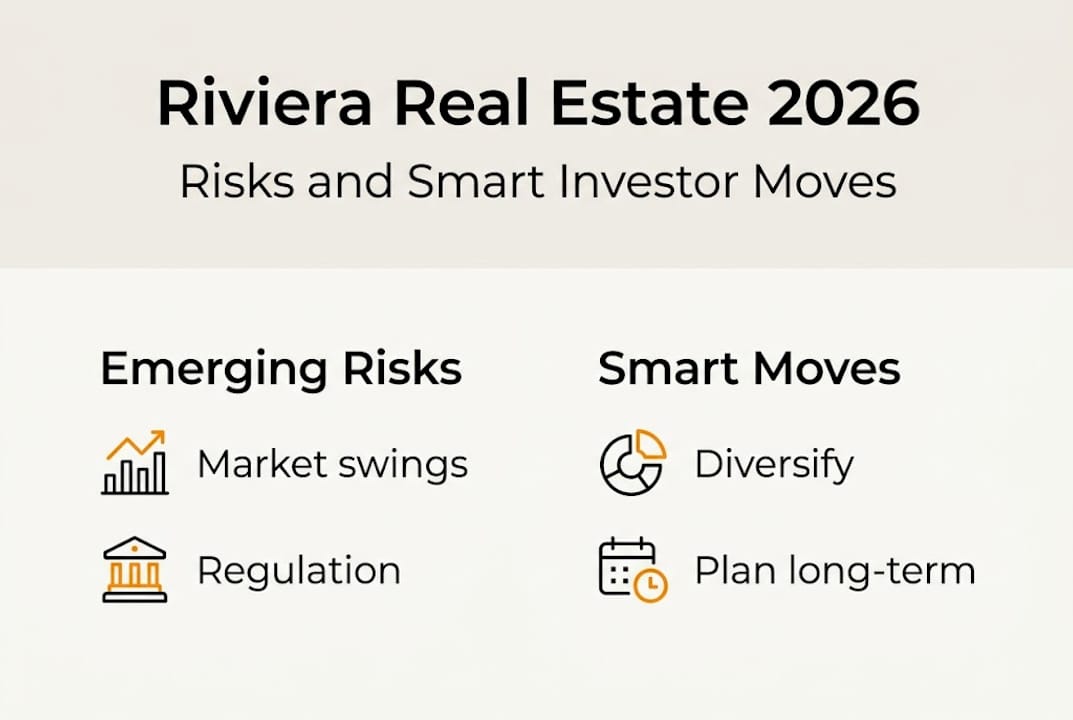
The most resilient portfolios we observe are those positioned across multiple Riviera micro-markets. A combination of a Cannes Croisette-adjacent apartment, a Menton hillside villa, and an off-plan Sainte-Maxime estate creates natural diversification across lifestyle, yield, and appreciation profiles. Our market cycles for 2026 analysis and emerging markets overview provide the granular data needed to position intelligently within this cycle.
Risk management on the Riviera is ultimately about time horizon. Investors who hold prime assets through a full cycle consistently outperform those who attempt to time micro-corrections.
Unlocking real value: What elite investors miss in Côte d’Azur trends
Here is what years of working with the world’s most discerning buyers has taught us: the investors who achieve the most enduring returns are rarely the most aggressive. They are the most patient and the most networked. Conventional wisdom says buy the best location and wait. We say that is necessary but insufficient.
What separates a legacy estate from a depreciating asset is the intelligence gathered before the offer is made. Too many buyers focus on the view from the terrace and overlook the legal architecture beneath the title. Too many chase the visible market and miss the invisible one, where the finest properties in Èze, Antibes, and Cap Ferrat change hands quietly, years before any public listing could capture them.
We also observe that sustainability credentials are systematically underweighted in buyer due diligence. An eco-certified villa in Menton with solar infrastructure and a strong energy rating is not merely a greener choice. It is a structurally superior asset for the next generation. Explore buyer trend examples to see how the most informed investors are repositioning their portfolios around these realities right now.
Get bespoke insight and access to Côte d’Azur luxury investments
If these trends have sharpened your thinking, we invite you to go further. At Living on the Côte d’Azur, we connect discerning investors with curated opportunities that never reach the open market. Our team holds discreet mandates across the Riviera’s most prestigious addresses, and we accept cryptocurrency payments for clients who prefer seamless, modern transactions. Whether you are seeking to access invisible luxury properties, understand the full spectrum of luxury real estate features, or explore all available investment options on the Côte d’Azur, our expertise is your most valuable asset. Reach out today and let us introduce you to your family’s next heirloom.
Frequently asked questions
What makes the Côte d’Azur property market unique for legacy investors?
The Côte d’Azur offers rare privacy, multi-generational appeal, and consistent global demand, making it ideal for estate planning. Legacy investors benefit from a finite supply of prestige addresses that appreciate reliably across full market cycles.
How do investors access off-market Côte d’Azur luxury properties?
Off-market properties are available exclusively to investors with trusted agent relationships and vetted networks, bypassing public listings entirely. Building those relationships before you need them is the single most important step.
Are new-builds a better investment than historic villas?
New-builds attract sustainability-focused buyers and offer lower entry costs through reduced notary fees and ten-year warranties. Historic villas carry unmatched prestige, but new construction rising across the Riviera is closing the yield gap rapidly.
How volatile is the Côte d’Azur luxury market compared to others?
The luxury sector operates on 7 to 15-year cycles with approximately 20% higher volatility than mainstream prime markets, rewarding investors who hold through complete cycles rather than reacting to short-term corrections.
Recommended
 //
//