
TL;DR:
- Effective luxury property deals focus on structuring fees, timing, and legal setup rather than just price.
- Separating agency fees from the purchase price reduces notary fees, property taxes, and long-term costs.
- Building relationships with local agents, understanding market nuances, and early structuring maximize long-term value.
Seasoned investors know that the finest properties on the French Riviera are not simply purchased. They are orchestrated. From a clifftop villa above Èze where the Nietzsche trail winds below, to a discreet maison on the sun-drenched fringes of Cap d’Antibes, every transaction carries layers of financial complexity that go far beyond the headline price. The assumption that a sharp offer wins the day is, frankly, incomplete. The most sophisticated buyers we work with understand that structuring a deal intelligently, particularly around fee separation and tax positioning, delivers lasting value that price haggling alone never could. What follows is the insider’s guide to doing exactly that.
Table of Contents
- Understanding the true cost of luxury property purchases
- Expert negotiation tactics for luxury real estate deals
- Minimising long-term property taxes and ownership costs
- Applying negotiation strategies in exclusive markets
- A fresh perspective on luxury property negotiation
- Discover premium property solutions on the French Riviera
- Frequently asked questions
Key Takeaways
| Point | Details |
|---|---|
| Agency fee separation | Splitting agency fees from the purchase price can significantly reduce notary fees and long-term property taxes. |
| Strategic negotiation tactics | Expert strategies focus on structuring deals to optimise tax efficiency and ownership costs, not just price. |
| Exclusive market nuance | Negotiation approaches on the French Riviera differ from standard practices due to unique local regulations. |
| Practical application | Applying expert negotiation advice allows luxury buyers to unlock hidden savings and benefits from their transactions. |
Understanding the true cost of luxury property purchases
Most buyers arrive at the negotiating table focused entirely on the purchase price. That focus, while natural, misses the broader financial picture. A luxury property purchase on the French Riviera involves several distinct cost layers, and understanding each one gives you far greater control over your final outlay.
The headline costs break down as follows:
- Purchase price: The agreed value between buyer and seller, which sets the commercial tone of the transaction.
- Agency fees: Typically 3% to 6% of the purchase price, depending on the mandate arrangement. These can be structured separately from the purchase price.
- Notary fees: In France, notary fees (frais de notaire) range between 7% and 8% of the taxable purchase base. These fees cover registration taxes, land registry costs, and the notary’s own remuneration.
- Annual property taxes: The taxe foncière, which is calculated based on the registered cadastral value of the property.
- Wealth tax (IFI): The Impôt sur la Fortune Immobilière applies to net real estate assets exceeding €1.3 million held in France, making strategic structuring essential for high-value acquisitions.
Here is where the crucial distinction lies. If agency fees are folded into the purchase price, the notary calculates fees and taxes on the full combined sum. If agency fees are treated as a separate line item paid directly by the buyer, the notary bases calculations on the reduced property value alone. On a €1 million property carrying €60,000 in agency fees, basing notary fees on €940,000 rather than €1,000,000 saves approximately €5,000 immediately. That is not a rounding error. That is real capital preserved.
| Cost component | Approximate rate | Calculated on |
|---|---|---|
| Notary fees | 7% to 8% | Taxable purchase base |
| Agency fees | 3% to 6% | Purchase price or separate |
| Taxe foncière | Variable by commune | Cadastral value |
| IFI wealth tax | 0.5% to 1.5% | Net real estate assets |
Exploring luxury property investment trends reveals just how significantly these cost differentials compound over time, particularly when properties appreciate at 5% to 8% annually as Riviera estates consistently do. Understanding market value insights for each specific micromarket, whether Cannes, Nice’s Mont Boron quarter, or the Monaco borderlands, sharpens your ability to benchmark a fair price before any negotiation begins.
Pro Tip: Request a full written breakdown of all fees from your notary and agent before signing the compromis de vente. A clear fee schedule is not merely courteous; it is the foundation of every smart negotiation.
The compound effect of these savings extends beyond closing day. A lower registered purchase base reduces annual property tax liabilities and, in many cases, recalibrates the IFI assessment. Early structuring is not an afterthought. It is the deal itself.
Expert negotiation tactics for luxury real estate deals
With costs clearly mapped, the negotiation itself becomes a precise instrument rather than a blunt conversation about price. The most effective luxury buyers we advise approach Riviera transactions using a layered strategy that addresses price, fee structure, timing, and relationship simultaneously.
Here is a practical sequence used by experienced investors:
- Commission your own market analysis first. Before presenting any offer, establish the property’s true value independently. Agents, however skilled, represent sellers. Your own data, drawn from comparable recent transactions in Antibes or Sainte-Maxime, gives you authority at the table.
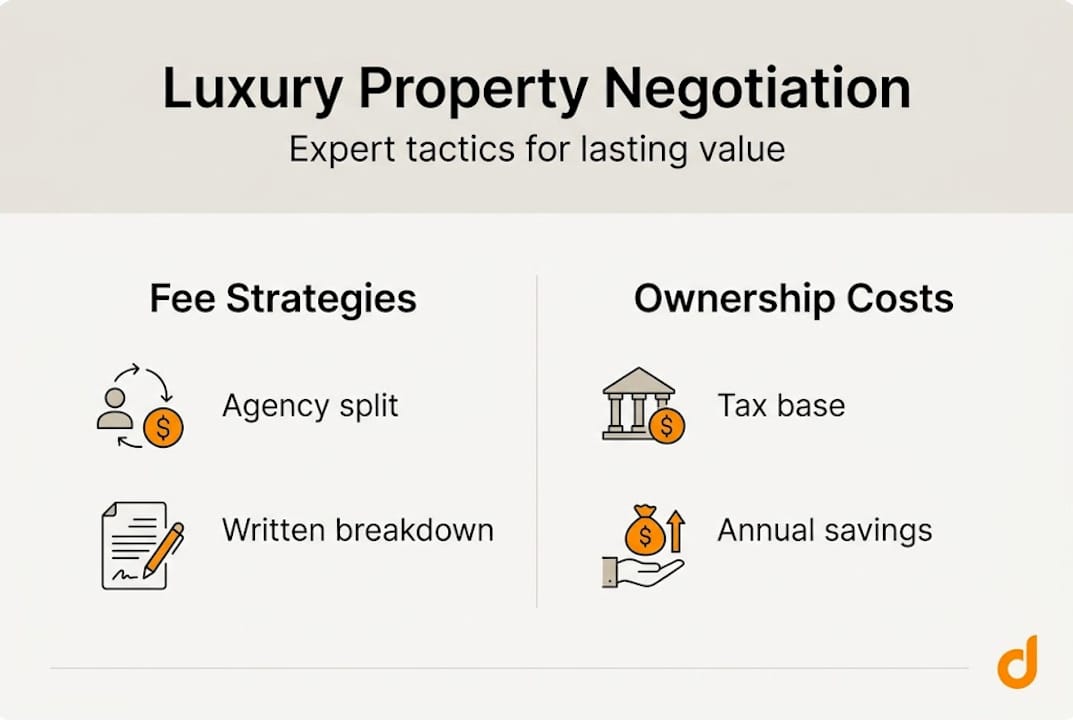
- Separate the agency fee in writing from the outset. Make this a condition of your offer letter. By establishing early that agency fees are a distinct buyer-paid cost rather than embedded in the purchase price, you set the notary’s calculation base correctly from day one.
- Time your offer strategically. Properties listed before the summer season, when sellers anticipate peak rental income, command premium prices. Offers submitted in late autumn or early winter, after the Cannes Film Festival energy dissipates and the Croisette empties, often encounter more motivated sellers and greater flexibility.
- Negotiate inclusions and extras to offset price. Furnishings, yachting berth rights, pool maintenance contracts, and existing rental management agreements all carry real monetary value. Folding these into the deal rather than reducing the headline price preserves the seller’s face while improving your total value received.
- Use financing as leverage. A buyer with pre-arranged luxury property financing moves more quickly than a buyer who needs approval. Sellers of prime properties value certainty. Demonstrating financial readiness can be worth a 2% to 3% concession in itself.
“The cleverest buyers are not the ones who argue hardest about the price. They are the ones who restructure the entire deal so the headline figure becomes almost secondary.”
| Conventional approach | Expert approach |
|---|---|
| Negotiate purely on headline price | Negotiate price, fee structure, inclusions, and timing together |
| Accept agency fees within purchase price | Separate agency fees to reduce notary base |
| Submit offer without market data | Present comparative market analysis with offer |
| Ignore seasonal timing | Target autumn and winter for motivated sellers |
| Overlook legal structuring | Consider SCI or corporate entity for long-term ownership |
The step-by-step investment guide we curate for serious buyers illustrates how these tactics interact. No single lever works in isolation. The art lies in applying all of them simultaneously, with the confidence of someone who has done it before.
Pro Tip: When negotiating on properties above €2 million, ask your notary whether the purchase can be structured via a Société Civile Immobilière (SCI). This French property holding company can offer significant inheritance and tax planning advantages for international buyers.
Minimising long-term property taxes and ownership costs
The purchase negotiation shapes not only what you pay on closing day but what you pay for decades thereafter. This is a dimension that many buyers, even experienced investors, underestimate until their first taxe foncière bill arrives.
The key mechanisms for minimising long-term tax costs are closely connected to the decisions made during negotiation:
- Registered purchase base: The lower the taxable base (achieved partly through fee separation), the lower the cadastral recalculation for annual property taxes.
- SCI structure: Holding a French luxury property through an SCI can facilitate tax-efficient transfer to heirs, reduce IFI exposure, and, in some configurations, allow deduction of debt against the property’s IFI valuation.
- Furnished rental status (LMNP): Properties let furnished to short-term guests under the Loueur en Meublé Non Professionnel regime benefit from favourable depreciation allowances, which can significantly offset taxable rental income.
- Green certification and eco-renovation: Properties with certified energy performance improvements may qualify for reduced local taxes in certain communes. The 2026 wave of eco-villas with solar arrays across the Riviera is not merely an aesthetic choice; it carries measurable fiscal advantage.
On a €2 million villa in the hills above Menton, where the lemon-scented terraces cascade toward the Italian border, the IFI liability alone could reach €15,000 annually if poorly structured. That same property, held within an appropriately geared SCI with a partial mortgage, could see notary fee savings at acquisition and a substantially reduced ongoing IFI burden. The difference, compounded over a ten-year hold, exceeds the sum most buyers spend negotiating the purchase price down.
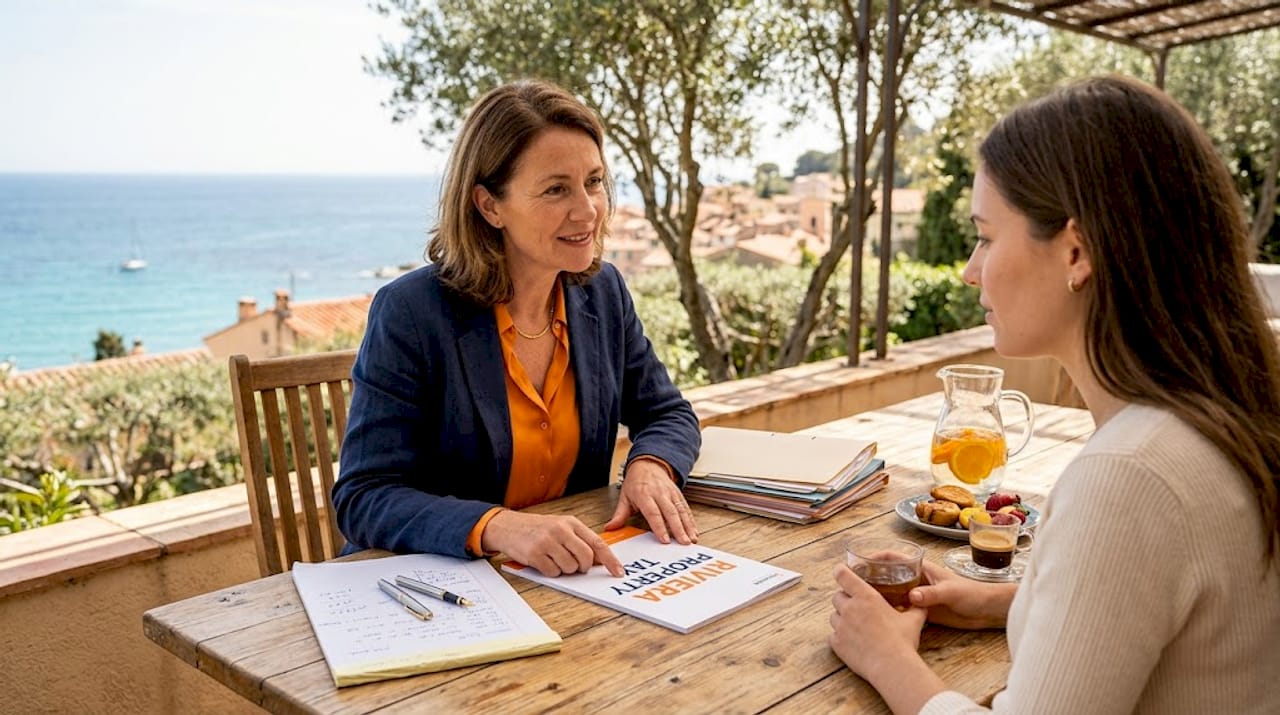
Consulting our French Riviera property tax guide before signing any preliminary agreement is one of the most valuable steps any international buyer can take. French tax law rewards those who plan early and penalises those who restructure after acquisition, when options narrow considerably.
Pro Tip: Engage a French tax adviser (conseiller fiscal) who specialises in non-resident property owners. International buyers face a distinct set of rules around withholding taxes on rental income, capital gains on eventual sale, and treaty interactions with their home jurisdiction. General advice from a non-specialist carries real financial risk at this level.
Browsing our curated portfolio of Riviera luxury homes gives you a tangible sense of how different property types, from penthouse residences in Nice overlooking the Baie des Anges to private estates near Antibes, carry different tax profiles from the outset.
Applying negotiation strategies in exclusive markets
The principles above are universal in theory. In practice, each Riviera micromarket has its own cadence, its own seller psychology, and its own timing rhythms that reward the prepared buyer.
Here is a clear process for applying these strategies in the field:
- Research comparable sales data for your chosen area. Saint-Tropez’s Pampelonne hinterland sells differently from Antibes’ Cap properties. Understand what factors drive luxury home prices locally, including sea view premiums, proximity to private beaches, and walk-to-village desirability.
- Engage a specialist agent with exclusive mandates. Many of the finest properties on the Côte d’Azur never reach the open market. A trusted agent with deep local relationships is your gateway to these invisible transactions.
- Prepare your fee separation request in writing before viewing. When you express serious interest in a property, confirm in your initial written communication that agency fees will be invoiced separately from the purchase price. Establishing this early prevents complications at the notary stage.
- Conduct full due diligence before submitting an offer. Commission a technical survey for structural integrity, a legal title audit to confirm ownership clarity, and a review of any planning restrictions (servitudes) affecting the land.
- Present a clean, conditional offer with a financing proof attached. Sellers of prestige properties in Èze, Cannes, and Monaco’s surrounding communes respond to seriousness. An offer with pre-approved financing, clear conditions, and a professionally drafted letter of intent signals that you are not a speculative enquiry.
Specific market considerations to bear in mind:
- Sainte-Maxime: Ferry-accessible from Saint-Tropez and increasingly sought-after for its Nartelle beach sunsets and golf residences, this market has seen consistent price growth from buyers priced out of Saint-Tropez itself. Off-plan opportunities here, from €1.2 million, attract buyers who value agency fee structures applied correctly from the VEFA (off-plan) contract stage.
- Nice’s Mont Boron: A quietly prestigious neighbourhood where buyers ascend above the Promenade des Anglais to find sea-view residences with relative privacy. Timing negotiations for late autumn, after the summer crowds dissolve, consistently yields better outcomes.
- Cap d’Antibes: Perhaps the most discreet address on the entire coastline. Sellers here are rarely motivated by urgency, which means relationship-building with the right agent is more valuable than any single negotiation tactic.
Pro Tip: Build a genuine long-term relationship with two or three specialist agents on the Riviera. The best off-market deals reach buyers who are known, trusted, and ready to act. A transactional approach to agents almost always means arriving too late or paying too much.
A fresh perspective on luxury property negotiation
We have observed, across hundreds of transactions on the Riviera and beyond, a persistent pattern among buyers who focus almost exclusively on reducing the headline price. They feel they have won when the seller accepts €50,000 less than asking. But if agency fees remain embedded in the purchase price and notary calculations apply to the full sum, a significant portion of that “saving” simply redistributes to the French tax authorities.
The uncomfortable truth is that price negotiation, while satisfying, is the most visible and therefore the most contested part of any deal. The structural decisions, how fees are invoiced, how the acquisition vehicle is configured, and how the cadastral base is established, are less visible and therefore more negotiable. Sellers are not emotionally attached to your notary bill.
This is where the most enduring value lives. A buyer who saves €5,000 in notary fees at acquisition, reduces annual property taxes, and structures an efficient IFI position outperforms the price-focused buyer over any meaningful hold period. Explore our investment property guide to see how this philosophy applies across property types and markets. True negotiation mastery on the Côte d’Azur is not about being the most aggressive voice in the room. It is about being the most informed one.
Discover premium property solutions on the French Riviera
At Living on the Côte d’Azur, we connect discerning global buyers with properties that transcend the ordinary. From invisible luxury properties that never appear on public portals, to legacy estates designed to shelter family wealth across generations, our curated portfolio reflects the full depth of what the Riviera offers. We accept cryptocurrency payments and work alongside trusted legal and tax advisers to ensure every acquisition is structured for maximum long-term value. Discover what luxury real estate truly means at this level, and explore our bespoke approach to high-net-worth legacy investment on the world’s most coveted coastline.
Frequently asked questions
How does separating agency fees from the purchase price affect my tax burden?
Separating agency fees reduces the taxable base used to calculate notary fees and property taxes, potentially saving thousands on a single luxury acquisition and lowering ongoing annual tax liabilities tied to the registered property value.
What is the typical notary fee percentage on the French Riviera?
Notary fees in France typically range between 7% and 8% of the taxable purchase price, covering registration taxes, land registry costs, and the notary’s professional fees.
What negotiation tip delivers the most value in luxury property deals?
Structuring agency fees separately from the purchase price consistently delivers immediate savings on notary fees and generates compounding long-term benefits through lower annual property taxes and a more favourable IFI position.
Are negotiation strategies different in exclusive markets like the French Riviera?
Yes, entirely. Local legal structures such as the SCI, commune-specific tax rules, seasonal market dynamics, and access to off-market properties all require tailored negotiation tactics that differ substantially from standard residential market approaches.
Recommended
 //
//