
The French Riviera seduces with salt-kissed light, Croisette glamour, and estates that appreciate like fine art. Yet beneath that azure allure lies a property tax landscape that surprises even the most seasoned international investors. Riviera surcharges can push annual tax bills up by 60% in luxury hotspots, a figure that reshapes acquisition budgets and long-term yield calculations. From taxe foncière to the IFI wealth tax, understanding each layer is not optional for high-net-worth buyers. It is the difference between a legacy asset and an expensive oversight.
Table of Contents
- The main property taxes in France explained
- French Riviera nuances: surcharges, VLC, and luxury territory
- IFI: Real estate wealth tax mechanics and optimisation
- Capital gains tax, SCI vehicles, and inheritance solutions
- Uncomfortable truths: How Riviera taxes reshape luxury investment strategy
- Next steps: Secure your Riviera property legacy
- Frequently asked questions
Key Takeaways
| Point | Details |
|---|---|
| Key taxes to watch | Taxe foncière, taxe d’habitation, and IFI affect luxury owners, with surcharges sharply rising in Riviera hotspots. |
| Local value impact | Luxury property valuations and local surcharges can increase annual tax bills by over €1,000 compared to national averages. |
| IFI strategy matters | Optimising IFI requires careful structuring, debt leverage, and sometimes donation offsets, but penalties apply for misuse. |
| Hold for exemption | Holding property over 22 years can fully exempt income from capital gains taxes for non-residents. |
| Seek expert advice | Simulation tools and specialist guidance are essential before acquiring luxury assets to avoid costly mistakes. |
The main property taxes in France explained
France levies several distinct property taxes, and each one carries its own logic, scope, and cost. Knowing precisely which applies to your situation is the foundation of any credible investment strategy on the Côte d’Azur. We have built our luxury real estate tax guide around this exact need.
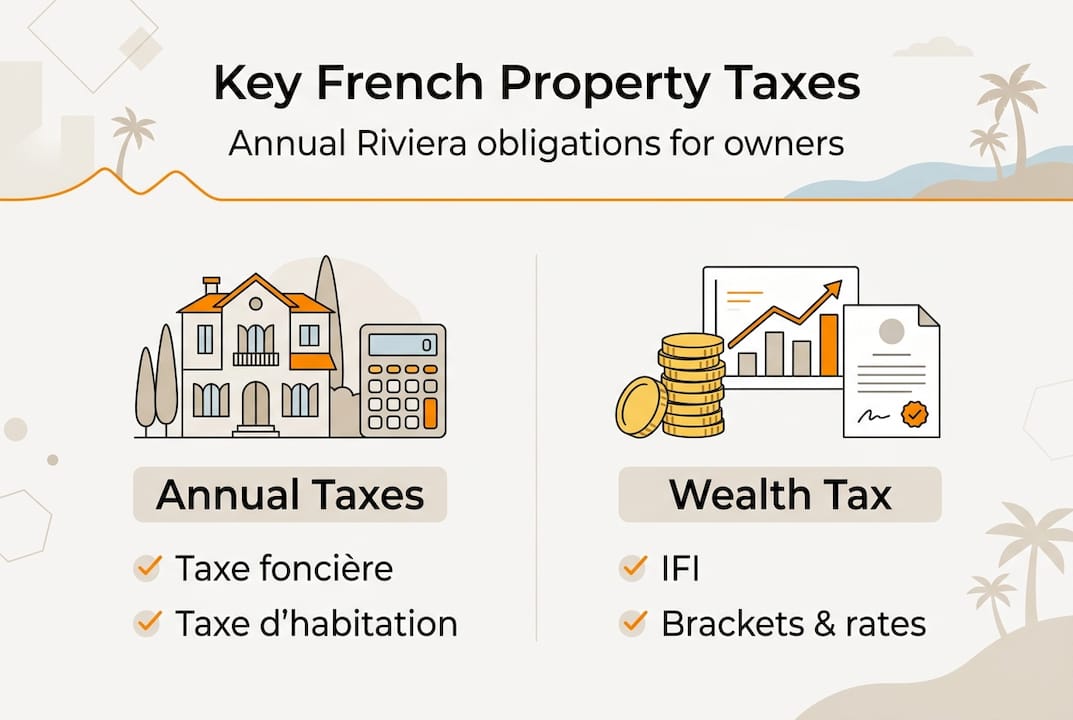
Taxe foncière is the annual property ownership tax, paid by whoever holds the title on 1 January each year. It is calculated on the valeur locative cadastrale (VLC), a notional rental value assigned by the French tax authority. For taxe foncière details, the VLC is multiplied by local authority coefficients, which vary considerably across the Riviera. A villa in Cap d’Antibes will carry a substantially higher VLC than a comparable property inland.
Taxe d’habitation was abolished for primary residences but remains firmly in place for second homes. In so-called zones tendues (high-demand areas), local authorities can apply surcharges up to 60% on top of the base rate. The PACA region alone encompasses 327 such communes, meaning most Riviera second-home owners face this elevated charge.
IFI (Impôt sur la Fortune Immobilière) is the real estate wealth tax. It applies to net real estate assets over €1.3M, calculated on 1 January each year. Non-residents are only taxed on French property, not global assets. This distinction matters enormously for international portfolio holders.
| Tax | Who pays | Basis | Typical annual cost |
|---|---|---|---|
| Taxe foncière | All owners | VLC x local rate | €1,500–€6,000+ |
| Taxe d’habitation | Second-home owners | VLC x local rate + surcharge | €1,000–€4,000+ |
| IFI | Owners above €1.3M threshold | Net real estate assets | Progressive, 0.5%–1.5% |
Who pays what at a glance:
- Taxe foncière: all property owners, regardless of residency status
- Taxe d’habitation: second-home owners in designated zones, including non-residents
- IFI: individuals or couples whose French real estate net value exceeds €1.3M
- Non-residents: exempt from IFI on overseas assets, but fully liable on French holdings
For owners of a luxury second home on the Riviera, the combination of taxe foncière and a surcharged taxe d’habitation can easily exceed €5,000 annually before IFI is even considered.
French Riviera nuances: surcharges, VLC, and luxury territory
The Riviera is not a single tax zone. It is a mosaic of micro-markets, each with its own surcharge appetite and VLC profile. Understanding this geography is essential before signing any acte authentique.
Nice, Cannes, and Saint-Tropez sit firmly in the highest surcharge bracket. Second-home surcharges up to 60% are now standard across these communes, with average vacation-home bills running between €1,000 and €3,000 per year for taxe d’habitation alone. Add taxe foncière, and the combined annual charge for a prestige villa can reach well into five figures.

The VLC is the engine driving these figures. In luxury areas, high VLC values reflect the desirability of the location, not simply the physical structure. A panoramic sea-view apartment on Nice’s Mont Boron carries a VLC that bears little resemblance to a similar floor plan in a less coveted postcode.
| Location | Approx. taxe d’habitation surcharge | Estimated combined annual bill |
|---|---|---|
| National average | 0%–20% | €800–€1,500 |
| Nice | Up to 60% | €2,500–€5,000+ |
| Cannes | Up to 60% | €2,500–€6,000+ |
| Saint-Tropez | Up to 60% | €3,000–€7,000+ |
“Surcharges have pushed some owners to reconsider their Riviera footprint entirely, with Monaco and northern Italy emerging as credible alternatives where annual property taxes are effectively nil.”
Areas most affected by elevated tax exposure:
- Nice, Cannes, Antibes, Saint-Tropez, Menton, and Èze
- Any commune designated as a zone tendue under French housing law
- Coastal properties with elevated VLC due to sea-view premiums
Possible mitigation strategies include registering the property as a primary residence where genuinely applicable, structuring ownership through an SCI, or consulting our second home Riviera guide for jurisdiction-specific options. Staying informed on second home trends is equally important, as surcharge levels are reviewed annually. You can also explore the types of luxury second homes that may carry different VLC profiles. For a deeper review of IFI exposure, the IFI benefits analysis is worth reading before acquisition.
IFI: Real estate wealth tax mechanics and optimisation
IFI is where international investors most frequently miscalculate. The tax applies progressively across brackets, and the difference between a well-structured acquisition and a poorly advised one can amount to tens of thousands of euros annually.
The IFI brackets and abatement work as follows: assets between €800,000 and €1.3M are assessed at 0% (below the threshold), rising to 0.5% from €1.3M to €2.57M, then 0.7%, 1%, and finally 1.5% above €10M. Your principal residence benefits from a 30% abatement on its assessed value. Debt secured against qualifying assets is deductible, but caution applies: where total assets exceed €5M and debt exceeds 60% of asset value, deductions are capped.
Donations to approved causes offer a meaningful offset: up to 75% of IFI liability can be offset through qualifying donations, capped at €50,000 per year. Anti-abuse rules apply, so donations must be genuine and structured correctly. Tax treaties between France and your country of residence may also reduce or eliminate double taxation on IFI, particularly for investors based in the UK, Switzerland, or the UAE.
IFI exemption and reduction tactics, in order of practical impact:
- Apply the 30% abatement on your principal residence where eligible
- Deduct all qualifying mortgage debt from the taxable base
- Structure ownership through an SCI to facilitate debt deduction and share-value discounts
- Make qualifying donations to offset up to 75% of IFI, capped at €50,000
- Review applicable tax treaties to avoid double taxation on French assets
- Use the official IFI guide simulation tool before filing
Pro Tip: Holding property through an SCI and maintaining a qualifying mortgage simultaneously can reduce IFI exposure significantly. Consult our wealth preservation tips and review private real estate sales structures before committing to any acquisition vehicle.
Capital gains tax, SCI vehicles, and inheritance solutions
The annual tax picture is only part of the story. When you eventually sell, gift, or pass on a Riviera estate, a separate set of rules governs the transaction. For international buyers, these rules are both consequential and navigable with the right preparation.
Capital gains tax for non-residents stands at 19%, with an additional 17.2% in social charges, bringing the headline rate to 36.2%. However, taper relief begins after five years of ownership, reducing the taxable gain progressively. Full exemption from capital gains applies at 22 years, and full exemption from social charges at 30 years. Holding a Riviera villa for the long term is not merely a lifestyle choice. It is a tax strategy.
The SCI (Société Civile Immobilière) is the vehicle of choice for many high-net-worth buyers. SCI ownership allows debt deduction for IFI purposes and preserves CGT taper relief, while enabling share-by-share gifting to heirs, which can reduce inheritance tax exposure considerably. The IS (corporate tax) regime within an SCI permits depreciation of the asset, reducing annual income tax on rental yields. The trade-off is a harsher capital gains calculation on resale, as depreciation is clawed back. The IR (income tax) regime avoids this but offers less flexibility on rental income.
Actionable strategies for structuring, valuation, and legacy planning:
- Hold property through an SCI for flexible inheritance and IFI debt deduction
- Use progressive share gifting to transfer wealth to heirs tax-efficiently over time
- Apply for liquidity discounts on SCI share valuations, typically 10%–20%
- Leverage applicable tax treaties to avoid double taxation on capital gains
- Explore capital gain tax info specific to your residency and holding structure
- Seek specialist advice on cross-border estate planning before acquisition
Pro Tip: Donations structured correctly can offset both IFI and inheritance tax simultaneously. Combining long-hold strategy with an SCI and a qualifying mortgage is the most tax-efficient approach for legacy-focused investors on the Riviera.
Uncomfortable truths: How Riviera taxes reshape luxury investment strategy
We have accompanied enough discerning buyers through Riviera acquisitions to say this plainly: the tax burden here is real, it is rising, and it rewards those who plan ahead. Surging surcharges and IFI are genuinely driving some investors towards Monaco or northern Italy, where annual property taxes are effectively zero. That migration is not irrational. It is a rational response to a system that penalises passive ownership.
Yet the Riviera still wins for most. The 5%–8% annual appreciation, the elite rental yields during Cannes Film Festival or Saint-Tropez’s summer regattas, and the irreplaceable lifestyle value cannot be replicated in a Monaco studio. The answer is not to avoid France. It is to structure intelligently. Debt leverage and SCI vehicles can optimise the tax position considerably, but they also attract scrutiny. Aggressive debt structures above the 60% threshold invite audit. Transparency and proper documentation are non-negotiable.
Our strongest counsel: run multiple tax simulations before you acquire, not after. The official tools exist. Use them. Challenge every assumption about what your luxury tax burden will actually be, and revisit our wealth preservation tips alongside specialist IFI advice before committing.
Next steps: Secure your Riviera property legacy
The Côte d’Azur rewards those who arrive prepared. Whether you are drawn to a sun-drenched villa above Èze’s medieval lanes, a contemporary penthouse overlooking Cannes’ Croisette, or an off-plan residence steps from Sainte-Maxime’s Nartelle sands, the tax landscape need not be a barrier. It can be a strategic advantage. Explore our curated portfolio of French Riviera villas for sale, follow our step-by-step property acquisition guide, and connect with our luxury asset advisory team for bespoke structuring counsel. Legacy begins with the right foundation.

Frequently asked questions
How is taxe foncière calculated for luxury properties on the Riviera?
Taxe foncière is based on the VLC and surcharges assigned to each property; luxury homes in prime Riviera locations carry a much higher VLC, resulting in annual bills from €1,000 to €3,000 or more before any additional local levies.
What is the IFI and who must pay it?
IFI mechanics and thresholds apply to anyone whose French real estate net assets exceed €1.3M, including non-residents; a 30% abatement applies to a principal residence, reducing the taxable base meaningfully.
How do capital gains taxes work for non-residents selling French property?
CGT rates for non-residents stand at 19% plus 17.2% social charges; taper relief begins after five years of ownership, with full capital gains exemption reached at 22 years and full social charge exemption at 30 years.
What strategies can reduce annual property taxes for luxury investors?
Structuring ownership via SCI, maintaining qualifying mortgage debt, and making donation offsets to approved causes can each reduce IFI liability, though specialist advice and official simulation tools are essential before implementing any strategy.
Do tax treaties protect international investors from double taxation?
Many bilateral treaties limit double taxation on IFI and capital gains, but the protection available depends on your country of residence and the SCI tax advantages of the structure you choose; professional cross-border advice is strongly recommended.
Recommended
- Finding the perfect French Riviera luxury investment property
- How to Invest in French Riviera Real Estate for 2025 Gains – Living on the Côte d’Azur
- Luxury property financing on the French Riviera: 5 key tips
- Benefits of property investment on French Riviera 2026
- Как выбрать недвижимость у моря: критерии для инвесторов – SunliteBG
 //
//