
TL;DR:
- Portugal’s luxury property market is driven mainly by domestic demand and genuine lifestyle appeal.
- Acquisition requires obtaining a Portuguese tax ID (NIF), legal due diligence, and engaging experienced local advisors.
- The market offers stable, high-quality locations with strong rental yields, emphasizing long-term legacy and strategic planning.
Portugal’s luxury property market is one of Europe’s most quietly compelling stages for high-net-worth investors. Whilst other Mediterranean destinations have become saturated with speculation, Portugal endures as a market of substance, resilience, and genuine lifestyle reward. Contrary to popular narratives, foreigners represent roughly 5% of 2025 transactions, meaning the market is primarily driven by domestic demand and genuine long-term value. For those seeking properties that function as both personal sanctuaries and generational assets, Portugal offers a singular opportunity that few destinations can rival in 2026.
Table of Contents
- Understanding the Portuguese luxury property market
- Preparing for your purchase: requirements and strategies
- Step-by-step buying process in Portugal
- Maximising value: legacy and income strategies
- A fresh perspective: what most luxury investors overlook in Portugal
- Connect with luxury property experts for your next investment
- Frequently asked questions
Key Takeaways
| Point | Details |
|---|---|
| Market stability | Portugal’s luxury property market remains resilient, especially in Lisbon, Algarve, and Cascais. |
| Clear buying steps | Foreign buyers must follow legal and financial requirements for successful property acquisition. |
| Legacy and income focus | Investors can optimise for rental income and legacy planning through smart strategies. |
| Expert support | Local professional advice streamlines the buying process and protects investments. |
Understanding the Portuguese luxury property market
Portugal is no longer simply a well-priced alternative to the French Riviera or the Italian coast. It has matured into a destination of true prestige, attracting buyers who arrive not merely to diversify their portfolio, but to embed themselves in a culture of warmth, history, and extraordinary natural beauty. Lisbon’s clifftop palaces, the Algarve’s sea-kissed villas, and Cascais’s Belle Époque grandeur each offer a distinct texture of luxury living that appeals to discerning international buyers across generations.
The current landscape reflects a market that has absorbed the post-pandemic surge with admirable composure. Prime locations such as Lisbon’s Chiado and Príncipe Real neighbourhoods, the Algarve’s Golden Triangle (Quinta do Lago, Vale do Lobo, and Vilamoura), and Cascais along the Estoril Line continue to command premium pricing, with high-end properties ranging from €1.5 million to well above €10 million for architecturally significant estates. Crucially, this pricing resilience is underpinned by genuine lifestyle demand, not speculative fever.
| Location | Typical luxury price range | Key appeal |
|---|---|---|
| Lisbon (Príncipe Real, Chiado) | €1.5M to €5M+ | Culture, walkability, prestige address |
| Algarve (Golden Triangle) | €2M to €12M+ | Golf, beach, year-round sunshine |
| Cascais / Estoril | €1.8M to €7M+ | Atlantic grandeur, proximity to Lisbon |
| Comporta | €1.2M to €4M+ | Natural beauty, privacy, emerging prestige |
What distinguishes property investment in Portugal from comparable European markets is the harmony of lifestyle value and investment returns. Luxury villas in the Algarve, for instance, achieve seasonal rental yields that can reach 5 to 7% annually when professionally managed, whilst simultaneously appreciating in capital value over the medium term. Comporta, Portugal’s answer to a wilder, more elemental luxury, is attracting buyers who want privacy on the scale of a nature reserve rather than a resort.
Key characteristics of the current market:
- Stable demand in prime locations, even as broader Portuguese market volumes normalise
- International buyers accounting for a smaller share than public perception suggests, preserving market integrity
- Rental income potential highest in the Algarve and Lisbon during peak seasons
- Emerging prestige in locations such as Comporta, Melides, and the Silver Coast
“The most sophisticated buyers we work with are not chasing transactions. They are choosing chapters. Portugal, for them, is the chapter that combines Atlantic light with genuine peace of mind.”
We invite you to browse new properties for sale in Portugal and discover how the country’s finest addresses translate into enduring wealth. For a broader view of curated luxury listings in Portugal, our portfolio spans the full spectrum of architectural ambition and lifestyle aspiration.
Building on the market overview, discover how to prepare for your luxury purchase in Portugal with confidence and clarity.
Preparing for your purchase: requirements and strategies
The path to owning luxury property in Portugal is more accessible than many international buyers anticipate, but it rewards preparation. Before you commit to a property search, several legal and financial prerequisites must be in place, each of which shapes the efficiency and security of your transaction.

The NIF (Número de Identificação Fiscal) is Portugal’s tax identification number, and it is the first document every buyer must secure. Non-residents can obtain a NIF at any Portuguese tax office or through a legal representative in Portugal. Without it, no property transaction can proceed. The process is straightforward, typically completed within a single visit, but engaging a local solicitor to act on your behalf adds a layer of professional oversight that we always recommend.
Fund verification and Anti-Money Laundering (AML) compliance are rigorous in Portugal’s luxury segment. Buyers should prepare to demonstrate the provenance of funds, whether through traditional banking, corporate structures, or, increasingly, cryptocurrency holdings. We accept cryptocurrency payments across our portfolio, a facility that an increasing number of digital-wealth investors find indispensable.
| Purchase strategy | Best suited for | Expected yield | Key consideration |
|---|---|---|---|
| Primary or secondary residence | Lifestyle buyers, legacy planning | Capital appreciation 4 to 7% | Long-term hold horizon |
| Short-term luxury rental | Income-focused investors | Gross yield 5 to 7% | Professional management essential |
| Golden Visa qualifying investment | Residency and global mobility | Variable | Specific fund or business routes apply |
| Off-plan new build | Capital growth seekers | Potential 10 to 15% on completion | VEFA contract protection advised |
The Golden Visa programme (Autorização de Residência para Atividade de Investimento) has evolved considerably in recent years. As of 2024 and into 2026, direct real estate purchases in high-density areas no longer qualify for the Golden Visa. However, investment funds, job creation, and certain low-density property investments remain valid pathways. For those seeking European residency as part of their investment rationale, understanding the current Golden Visa Portugal framework is essential before structuring any acquisition.
Key documents to prepare before beginning your search:
- Portuguese NIF (tax identification number)
- Proof of identity and residency
- Verified source of funds documentation
- Power of attorney if purchasing remotely
- Bank account in Portugal or a nominated international account for fund transfers
Pro Tip: Engage a bilingual Portuguese solicitor and a local property advisor simultaneously, before you identify a specific property. This allows your legal framework to be in place the moment you wish to act on an opportunity, which in the luxury segment often means moving swiftly.
Once you know what is required, the next step is mastering the buying process itself, and doing so with the precision that a significant investment demands.
Step-by-step buying process in Portugal
Understanding the sequence of a Portuguese luxury property transaction protects your investment and removes the anxiety that often accompanies unfamiliar markets. We walk every client through this process with the same methodical care we would apply to a Riviera estate acquisition.
Define your brief with precision. Articulate clearly whether you are seeking a primary residence, a seasonal retreat, an income-generating asset, or a legacy property for future generations. Each objective shapes location, property type, and legal structure differently.
Engage your advisory team. Appoint a local solicitor, a trusted property consultant, and, where relevant, a tax adviser with expertise in cross-border wealth. Attempting to navigate the Portuguese market without local professional support is the single most common error we observe from international buyers.
Conduct a curated property search. In the luxury segment, the most compelling properties rarely appear on public portals. Access to off-market inventory, developer relationships, and distressed estate opportunities comes through investing in Portugal real estate via established networks rather than open listings.
Make a formal offer and negotiate terms. Once a property is selected, your consultant presents a formal offer in writing. Price negotiation in Portugal’s luxury market is nuanced. Vendors of prestige properties rarely discount substantially on price alone, but terms such as completion timelines, furnishings, and structural conditions are often negotiable.
Execute the Promissory Contract (CPCV). The Contrato Promessa de Compra e Venda is a binding preliminary agreement signed by both parties. A deposit, typically 10 to 30% of the purchase price, is paid at this stage. Should the vendor withdraw, they must return double the deposit. Should the buyer withdraw, the deposit is forfeited.
Complete legal and structural due diligence. Your solicitor conducts a title search to confirm clear ownership, verifies the property’s registration with the land registry, checks for debts or encumbrances, and confirms planning compliance. An independent structural survey is strongly advised for older properties and period estates.
Sign the Escritura Pública (deed of purchase). Completion takes place before a notary. The remaining balance, property transfer tax (IMT), and stamp duty are paid. Ownership is transferred and registered in your name.
Key statistic: With foreigners representing around 5% of 2025 property transactions, Portugal’s luxury market operates with the integrity of a fundamentally domestic, demand-led economy, offering international buyers a stable foundation rather than a speculative one.
Pro Tip: Prioritise properties with both strong lifestyle credentials and demonstrable rental demand. A villa near Quinta do Lago that photographs beautifully and sits within minutes of championship golf courses will serve your income objectives and your personal enjoyment with equal generosity.
Having completed your purchase, it is important to understand how to maximise the value and legacy of your investment across both time and generations.
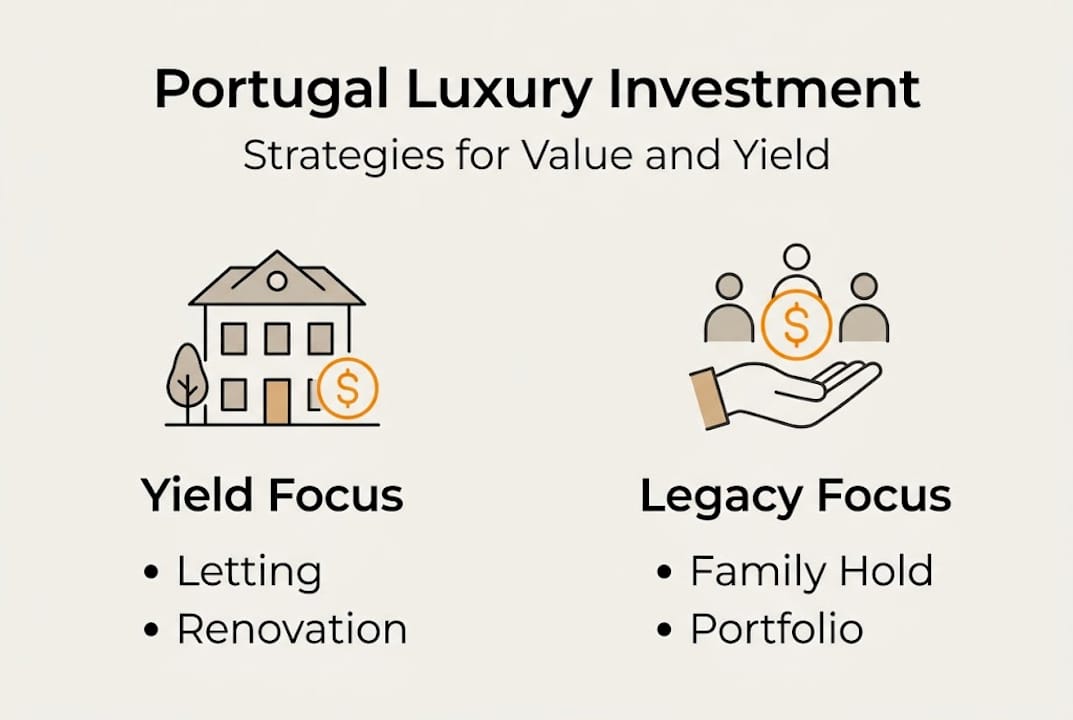
Maximising value: legacy and income strategies
Owning a luxury property in Portugal is only the beginning of the story. The most rewarding returns, financial and personal, come from deliberate stewardship of an asset that has the capacity to grow, generate income, and pass seamlessly to the next generation.
Rental income best practices:
- Engage a specialist luxury property management company rather than a general letting agent. The difference in nightly rates achieved and tenant quality is significant.
- Position your property for the premium seasonal market. The Algarve commands its highest yields from May through September, whilst Lisbon’s luxury rental market benefits from year-round corporate and cultural tourism.
- Invest in high-quality photography, virtual tours, and professional listing management. In the luxury short-let market, presentation is pricing.
- Ensure your property holds an Alojamento Local (local accommodation) licence if you intend to let on a short-term basis. Regulations around these licences have tightened in urban areas, making early compliance essential.
Legacy protection and succession planning:
- Structuring ownership through a Portuguese or international holding company can offer meaningful inheritance tax efficiency, particularly for non-resident buyers. Portuguese inheritance tax between direct relatives is effectively zero, a significant advantage for wealth transfer.
- Consider a usufruct structure, which separates the right to use and benefit from the property (usufruct) from bare ownership, allowing assets to be transferred to heirs whilst the original owner retains full enjoyment during their lifetime.
- Establish a clear succession mandate within your estate plan that addresses the Portuguese property specifically, in parallel with your broader wealth management strategy.
Optimising for lifestyle:
- Allocate a dedicated personal-use period each year, typically the shoulder seasons of April to May and October to November, when the Portuguese climate is at its most seductive and the properties are between peak rental periods.
- Secure luxury growth in Portugal by focusing acquisitions on locations with proven capital appreciation and lifestyle depth, rather than emerging markets that carry greater uncertainty.
| Strategy | Benefit | Time horizon |
|---|---|---|
| Professional luxury letting | 5 to 7% gross annual yield | Immediate to short-term |
| Inheritance tax optimisation | Zero tax between direct relatives | Estate planning horizon |
| Capital appreciation hold | 4 to 7% annual growth in prime areas | Medium to long-term |
| Off-plan acquisition | 10 to 15% uplift on completion | 2 to 4 years |
Global monthly house price growth data continues to reinforce Portugal’s standing as a market where patient, well-advised investors are consistently rewarded. The country’s luxury segment, insulated from the volatility that affects mass-market property, behaves more like a curated collection than a commodity trade.
A fresh perspective: what most luxury investors overlook in Portugal
We have accompanied enough high-net-worth buyers through the Portuguese market to know that the most common misconception is also the most costly: the belief that market stability is uniform across regions and property types. It is not.
The resilience that analysts report for Lisbon, Algarve, and Cascais does not extend automatically to every coastal village or inland town that presents itself as “the next emerging hotspot.” We have seen investors, capable and well-resourced, purchase in locations that looked compelling on a trend report but lacked the infrastructure, international connectivity, and lifestyle ecosystem that sustain long-term value.
Our counsel is this: prestige in Portugal is hyperlocal. A villa three kilometres inland in the Algarve can yield dramatically different rental performance and capital growth compared to one within the Golden Triangle. The difference is invisible on a map and obvious only to those who know the market intimately.
Long-term legacy thinking also demands that buyers resist the temptation of short-term yield optimisation at the expense of property condition and character. The estates that hold generational meaning, and generational value, are those maintained with genuine stewardship. For those wanting to explore Portugal’s luxury homes with expert guidance, we are here to help mitigate risk and amplify reward at every stage of your journey.
Connect with luxury property experts for your next investment
For investors who understand that the finest properties are rarely listed and never rushed, we offer something beyond a portal: a curated relationship with Portugal’s most distinguished real estate landscape. Whether you are acquiring your first European estate or adding to a global portfolio that spans Ibiza, Bali, and Mauritius, our advisory team brings the local intelligence and international perspective that complex acquisitions demand. We work across the full spectrum of high-net-worth real estate, from architecturally significant residences to income-generating trophy assets. If you are new to the market, our guide to luxury real estate fundamentals is an excellent place to begin. Reach out, and let us design your Portugal chapter with the precision it deserves.
Frequently asked questions
Do foreign investors face restrictions when buying property in Portugal?
Foreign investors face very few restrictions in Portugal, but must obtain a Portuguese tax identification number (NIF) and comply with local AML regulations before any purchase can proceed.
Which regions in Portugal offer the most attractive luxury property options?
Lisbon, the Algarve, and Cascais remain the most resilient and sought-after regions for luxury buyers, combining prestige addresses with strong lifestyle credentials and proven investment performance.
Is the Portuguese luxury market still a secure investment in 2026?
Yes, the luxury segment remains notably stable, with prime locations demonstrating consistent capital appreciation and rental demand, supported by ongoing market resilience in Portugal’s most prestigious postcodes.
What are the key legal requirements for luxury property buyers in Portugal?
Buyers must hold a Portuguese NIF, provide verified source-of-funds documentation, and complete thorough legal due diligence through a qualified solicitor before signing any binding agreement.
Recommended
 //
//