
TL;DR:
- Regulatory changes, rising taxes, and environmental laws are reshaping luxury real estate investments in 2026.
- Market volatility of 10-15% requires diversification and careful long-term planning.
- Understanding local legal, environmental, and ownership complexities is essential for sustainable legacy-building.
The French Riviera shimmers with a certain myth: that a villa perched above the azure Mediterranean is as close to a guaranteed investment as wealth can buy. Salt-kissed terraces, lavender-laced breezes rolling in from Provence, and the eternal glamour of Cannes and Saint-Tropez create an almost irresistible narrative. Yet even the most discerning investors occasionally allow that narrative to eclipse sober analysis. Regulatory shifts, market swings, and tightening environmental legislation are reshaping the landscape in 2026. Understanding these forces is not a reason to step back; it is precisely the intelligence that separates legacy-building from mere speculation.
Table of Contents
- Regulatory and tax risks in French Riviera luxury real estate
- Market volatility and economic uncertainty
- Environmental and sustainability challenges
- Ownership complexities for international buyers
- What most guides miss about risk management on the French Riviera
- Next steps for safe luxury investment on the French Riviera
- Frequently asked questions
Key Takeaways
| Point | Details |
|---|---|
| Regulation and taxes matter | Stringent rules and rising taxes pose real challenges for luxury property investors. |
| Market volatility affects returns | Significant price swings and inflation influence confidence and legacy planning. |
| Sustainability is strategic | Eco-conscious investments future-proof your portfolio against shifting regulations. |
| Foreign ownership is complex | International buyers face multilayered legal hurdles and succession planning requirements. |
| Expert advice reduces risk | Partnering with specialists helps you anticipate and manage risks more effectively. |
Regulatory and tax risks in French Riviera luxury real estate
Regulation is the invisible architecture behind every Riviera estate. It determines what you may build, how you may use your property, and how much of your return the state will reclaim. For international buyers, that architecture can feel labyrinthine, and the consequences of misreading it are measured in hundreds of thousands of euros.
The most immediate pressure point is taxation. According to France luxury real estate and villas market research, property taxes are expected to rise by 6%, with stringent zoning laws limiting development opportunities, particularly for foreign buyers navigating complex ownership regulations. A 6% uplift on taxe foncière across a portfolio of Côte d’Azur estates is not an abstraction; it is a concrete reduction in net rental yield and, over a decade, a material drag on capital appreciation.
Our Riviera property tax guide explores these mechanisms in detail, but the key regulatory hurdles every investor should map before signing include:
- Taxe foncière increases driven by municipal budget pressures in high-demand communes such as Antibes and Beaulieu-sur-Mer
- Plan Local d’Urbanisme (PLU) restrictions that govern height, footprint, and façade materials, often preventing the contemporary eco-luxury renovations buyers desire
- Zones de protection du patrimoine architectural (heritage protection zones) prevalent in Menton’s citadel quarter and Èze’s medieval village, where even sympathetic restoration requires multi-agency approval
- Non-resident ownership structures that attract wealth tax scrutiny under the Impôt sur la Fortune Immobilière (IFI), calculated on net property assets above €1.3 million
- SCI (Société Civile Immobilière) regulations that, while useful for succession planning, carry reporting obligations that trip up investors unfamiliar with French corporate governance
The picture is complicated further by regional inconsistency. A plot in Cap d’Antibes may sit within one planning zone, while an estate fifty metres away falls under entirely different restrictions. This granularity rewards expertise and punishes assumptions.
| Regulatory risk | Potential impact | Mitigation |
|---|---|---|
| 6% property tax rise | Reduced cash flow | Stress-test yield projections |
| PLU zoning limits | Blocked renovations | Pre-purchase planning audit |
| IFI wealth tax | Annual capital charge | Optimised ownership structure |
| Heritage zone rules | Extended timelines | Specialist architect briefing |
Understanding luxury real estate tax risks before committing capital is not merely prudent; it is the foundation of every successful legacy investment we guide our clients through.
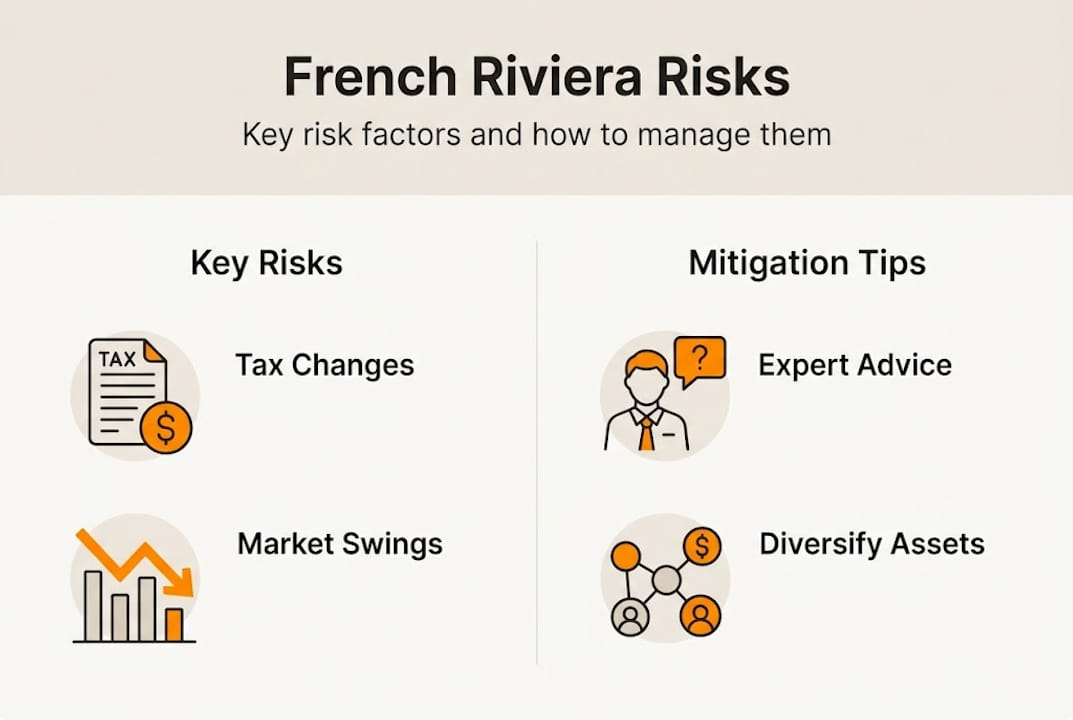
Pro Tip: Retain a bilingual notaire and a specialist tax adviser who works exclusively with international property investors in France. Their combined insight into local PLU nuances and cross-border IFI planning will pay for itself many times over on a single transaction.
Market volatility and economic uncertainty
Even the most beautifully curated estate on the Croisette cannot insulate its owner from macroeconomic forces. The French Riviera luxury segment is enviably resilient, but resilient is not synonymous with immune. Understanding where volatility originates, and how it manifests in pricing, is essential for investors whose horizons span generations rather than market cycles.

The French luxury real estate market is valued at EUR 30 billion, with the Côte d’Azur accounting for a commanding share. Yet within that prestige, price swings of 10 to 15% in Provence and along the broader Riviera corridor have been recorded during periods of economic stress, while inflation running at 3.8% quietly erodes real returns for investors holding assets in euros.
Consider what a 15% downswing means in practice. A villa acquired for €4.5 million near the Monaco border, bought partly as a legacy asset for the next generation, could temporarily be valued at €3.8 million on paper. That is not necessarily a crisis if the holding structure is sound and the rental income continues. But for investors who have borrowed against the asset or who need liquidity within a short window, the pressure is acute.
Economic events that have historically triggered volatility in the Riviera market include:
- Global financial contractions (2008 and 2020 both produced sharp short-term corrections before rapid recovery)
- Currency fluctuations affecting purchasing power for British, American, and Middle Eastern buyers, whose appetite drives significant transaction volume
- Interest rate cycles influencing both mortgage accessibility and the opportunity cost of capital deployed into property
- Geopolitical disruptions redirecting ultra-high-net-worth capital flows away from Europe temporarily
- Seasonal rental market softening in years when major festivals such as the Cannes Film Festival or Monaco Grand Prix draw reduced international attendance
We track luxury market trends 2026 closely, and the current environment reflects a nuanced picture. Easing interest rates are beginning to restore confidence, while demand for sea-view properties with eco-luxury finishes continues to outpace supply in prestige locations.
| Property type | Typical annual yield | Volatility exposure | Legacy suitability |
|---|---|---|---|
| Cap d’Antibes villa | 3.5 to 4.5% | Moderate | Excellent |
| Monaco-border apartment | 2.5 to 3.5% | Low | High |
| Sainte-Maxime off-plan | 4.0 to 5.5% | Moderate to high | Good |
| Provence mas (farmhouse) | 3.0 to 4.0% | Low | Excellent |
The annual growth in Riviera real estate of 5 to 8% in prime locations underscores why patient capital consistently rewards its custodians.
Pro Tip: Diversify your holding structure across at least two distinct micro-markets on the Riviera: pair a Monaco-adjacent prestige asset with a lifestyle property in Sainte-Maxime or Antibes. This blend balances prestige premium with higher rental yield potential, softening the impact of localised price corrections.
Environmental and sustainability challenges
The Riviera’s extraordinary natural beauty is precisely what investors are acquiring. It is also precisely what regulators are increasingly determined to protect. In 2026, environmental compliance is not a peripheral concern; it is central to both planning permission and long-term asset value.
Stringent zoning laws and regulatory requirements are tightening alongside environmental mandates, creating a landscape where even well-resourced investors can find development ambitions stalled. Coastal construction restrictions have been reinforced under France’s Loi Littoral, limiting what may be built or extended within a defined distance of the shoreline. For buyers eyeing beachside plots near Pampelonne in Saint-Tropez or Nartelle Beach in Sainte-Maxime, this legislation is not an abstraction; it is the boundary within which all creative vision must operate.
Sustainability is reshaping what it means to hold a trophy asset. The key features of French Riviera real estate that commanded premiums a decade ago, namely size and spectacle alone, are now complemented by solar arrays, energy performance certificates (DPE ratings), and biophilic design credentials. Estates that fail to meet evolving DPE thresholds face restrictions on rental income generation, a risk that strikes directly at legacy investors relying on elite lets to generate yield.
Practical steps for ensuring environmental compliance and futureproofing your investment:
- Commission a full DPE audit before acquisition, not after. A Grade E or below can restrict rental activity and suppress resale value significantly.
- Integrate solar and thermal systems during any renovation phase; these are not mere lifestyle additions but financial instruments that improve DPE ratings and reduce operating costs.
- Engage with a certified environmental architect familiar with Riviera coastal regulations to identify permitted works before submitting planning applications.
- Pursue recognised green certifications such as HQE (Haute Qualité Environnementale) or BREEAM, which add measurable premium to resale value and signal future-readiness to discerning buyers.
- Monitor the Schéma de Cohérence Territoriale (SCOT) for your commune, as it governs long-term land use decisions that can affect the development potential of neighbouring parcels.
- Budget for green retrofitting in acquisition projections; the cost of bringing a stone bastide in the hills above Èze up to contemporary environmental standards can reach 8 to 12% of acquisition price.
Sustainable property investment is no longer a values statement; it is a financial imperative. The 15% forecast demand spike for sustainable builds on the Côte d’Azur in 2026 confirms that the market is voting with its capital.
Pro Tip: Prioritise eco-certifications during the acquisition negotiation itself. A seller who holds HQE or BREEAM accreditation is offering more than a property; they are delivering a pre-validated compliance position that reduces your regulatory exposure from day one.
Ownership complexities for international buyers
Owning a Riviera estate as a foreign national is a privilege that comes wrapped in considerable legal complexity. The romance of a sun-drenched bastide above Menton’s lemon groves or a Belle Époque villa near Cannes’ Lérins Abbey does not dissolve the paperwork; it simply makes navigating it worthwhile.
The most revealing insight from France luxury real estate market research is that complex ownership regulations consistently surprise even experienced overseas investors. Common ownership challenges include:
- Succession law under EU Regulation 650/2012, which allows non-French nationals to elect for their home country’s inheritance law to apply, but requires explicit drafting in the will and property deeds
- SCI governance obligations, including annual accounts, registered offices, and shareholder meeting minutes, which, if neglected, can expose the structure to legal challenge
- Mortgage accessibility limitations for non-EU nationals, with French banks applying additional due diligence and sometimes declining to lend without significant collateral held in France
- Notaire neutrality: unlike Anglo-Saxon conveyancing solicitors, the French notaire acts for the transaction rather than either party, making independent legal counsel for the buyer essential
- SAFER pre-emption rights on rural agricultural land, which can allow the state to requisition rural estate purchases, an issue relevant for buyers acquiring Provençal mas or vineyard estates
Reviewing regional luxury estate trends reveals how ownership complexity varies meaningfully by location. Coastal communes apply different municipal rules to inland areas; Monaco-adjacent Roquebrune-Cap-Martin operates under distinct planning frameworks compared to a hillside property in Saint-Paul-de-Vence.
“The proportion of luxury estates above €2 million that require formal succession planning through specialised cross-border legal counsel now exceeds 60% of all international transactions. The complexity is not incidental; it is structural, woven into French property and inheritance law in ways that reward preparation and punish haste.”
The French Riviera tax guide for 2026 outlines how buyers from the United Kingdom, the United States, the Gulf states, and Asia-Pacific each face subtly different regulatory entry points. Understanding selling property with legal challenges in complex regulatory environments underscores a universal truth: the exit strategy must be planned at the moment of entry.
What most guides miss about risk management on the French Riviera
Most risk management guides focus on data. They present tax tables, price indices, and regulatory checklists, and these are genuinely valuable. But in our experience, the investors who build the most enduring Riviera legacies are those who pair data literacy with something quieter: relationship capital.
Knowing which maire’s office holds influence over a particular commune’s PLU review, or which local architect has built trust with the Architectes des Bâtiments de France, is intelligence that no index captures. We have seen impeccably structured transactions falter because the buyer relied on international advisers with no genuine presence on the ground in Antibes or Nice. We have equally seen buyers investing in the Riviera with conviction and clarity because they built their team from local expertise outward.
The uncomfortable truth is this: the Riviera rewards patient, well-advised investors who treat complexity as a competitive advantage rather than a deterrent. Every regulatory hurdle that discourages an underprepared buyer is a moat protecting the value of your carefully acquired estate.
Next steps for safe luxury investment on the French Riviera

Understanding risk transforms it from obstacle into opportunity. At Living on the Côte d’Azur, we guide visionary investors through every dimension of Riviera acquisition: from identifying off-market luxury property that never reaches public listing, to structuring ownership for seamless intergenerational wealth transfer. Our curated portfolio spans the full spectrum of investment options on the Côte d’Azur, from Monaco-adjacent prestige apartments to biophilic eco-villas in Sainte-Maxime. Discover how our expertise converts regulatory complexity into a foundation for legacy luxury ROI that endures across generations. We accept cryptocurrency payments, reflecting our commitment to the forward-thinking investors who shape tomorrow’s Riviera.
Frequently asked questions
What are the main regulatory risks facing overseas buyers in French Riviera luxury real estate?
The main risks are rising property taxes, strict zoning laws, and complex ownership rules for foreign buyers, including IFI wealth tax obligations and SCI governance requirements.
How does price volatility impact luxury real estate investments?
Market swings of 10 to 15% reduce the predictability of returns and make long-term legacy planning considerably more demanding, particularly for investors relying on short-term liquidity.
Are sustainable or eco-focused properties less prone to risk?
Eco-certified properties may face stricter development regulations initially, but they offer superior long-term security as environmental compliance shapes future resale values, rental eligibility, and legacy asset appeal.
What is the best way to minimise ownership complexity as a foreign investor?
Engage specialised bilingual legal advisers before any offer is made and ensure your property structure addresses both French inheritance regulations and your home country’s succession requirements from the outset.
Recommended
 //
//