
Many affluent buyers assume that owning a slice of the Côte d’Azur, a Cap d’Antibes villa with salt-kissed terraces or a Cannes penthouse above the Croisette, requires full acquisition and the full price tag to match. That assumption leaves extraordinary opportunities on the table. Luxury fractional real estate has quietly reshaped how the world’s most discerning families access premier properties, combining genuine deeded ownership with curated services, flexible use, and shared costs. In this guide, we clarify exactly what the model means, how it works in practice, and why it is becoming the preferred route for high-net-worth individuals seeking both lifestyle and legacy in the world’s most coveted addresses.
Table of Contents
- Defining luxury fractional real estate
- How luxury fractional ownership works
- Luxury fractional versus timeshare: Key differences
- Who should consider luxury fractional real estate
- The real value: More than a cost-saving measure
- Explore luxury opportunities on the Côte d’Azur
- Frequently asked questions
Key Takeaways
| Point | Details |
|---|---|
| True co-ownership | Luxury fractional real estate offers genuine property co-ownership with legal rights, not just periodic use. |
| Premium experiences | Owners access multi-bedroom luxury homes and services far beyond typical holiday accommodation. |
| Flexible investment | Fractional models deliver lifestyle flexibility, lower upfront cost, and easier cross-border ownership. |
| High-income threshold | Qualifying for luxury fractional ownership generally requires a minimum annual income of US $150,000. |
| Distinct from timeshare | Fractional properties offer more time, control, and resale options than classic timeshare models. |
Defining luxury fractional real estate
Luxury fractional real estate is, at its core, a form of co-ownership. A single high-end property is divided among a small group of buyers, typically between six and twelve, each of whom holds a legally deeded share. That share entitles you to exclusive use of the property for a defined number of weeks each year, along with proportional ownership rights and a stake in any future appreciation.
Understanding what defines luxury real estate is the natural starting point, because not every co-owned property qualifies as fractional in the true sense. The properties in question are genuinely premium: three to five bedroom residences with architectural distinction, panoramic sea views, private pools, and hotel-level services. Think of a sun-drenched villa above Èze’s medieval ramparts, or a contemporary residence steps from Sainte-Maxime’s Nartelle beach. These are not holiday apartments; they are curated estates.
The contrast with the timeshare model is significant and worth stating clearly. Timeshares typically offer a right-to-use arrangement rather than actual ownership, involve far larger groups of buyers, and are associated with resort-style developments rather than bespoke private residences. Fractional ownership is a fundamentally different proposition, both legally and experientially.
Key features that distinguish luxury fractional real estate include:
- Ownership structure: Each buyer holds a deeded legal share, not merely a usage right
- Group size: 6 to 12 owners per property, keeping the experience exclusive
- Annual use: Typically 5 or more weeks per year, compared to just 1 to 2 weeks in a timeshare
- Property standard: Three to five bedroom luxury homes with concierge, housekeeping, and maintenance included
- Qualifying profile: Buyers typically have an annual income of US $150,000 or above, versus $75,000 for timeshare buyers
- Exit options: Shares can be sold, gifted, or bequeathed as with any real estate asset
“Fractional ownership is not a compromise on luxury. It is a precision instrument for those who want the finest properties, on their terms, without the weight of sole ownership.”
Pro Tip: Always verify that the fractional structure involves a deeded title registered with the relevant land authority. This is the clearest legal distinction between genuine fractional ownership and a right-to-use arrangement.
How luxury fractional ownership works
Now that we have defined what luxury fractional real estate is, let us look in detail at how fractional ownership functions for you as an investor.
The process is more straightforward than many expect. A specialist developer or management company identifies a premium property, structures the co-ownership legally, and invites a curated group of buyers to acquire shares. Each owner’s steps for buying luxury property follow a clear sequence:
- Selection: You review available fractional properties and choose a share size aligned with your desired usage and budget
- Legal acquisition: You purchase your deeded share through a notarised transaction, with full title registration
- Usage scheduling: The management company coordinates an annual calendar, allocating your weeks fairly and flexibly, including peak season slots
- Enjoying the property: You arrive to a fully serviced residence, with concierge, housekeeping, and any bespoke arrangements prepared in advance
- Ongoing management: All maintenance, insurance, and operational costs are handled professionally and shared proportionally among owners
- Resale or transfer: When you choose to exit, you sell, gift, or bequeath your share independently
Professional management is the cornerstone of the fractional model’s appeal. A reputable management company ensures the property is maintained to the highest standard year-round, that scheduling disputes are resolved gracefully, and that every owner’s arrival feels like a five-star welcome. This is not a self-managed arrangement; it is a fully staffed, hotel-grade experience in a private home.

| Feature | Fractional ownership | Full ownership | Timeshare |
|---|---|---|---|
| Annual use | 5+ weeks | Unlimited | 1 to 2 weeks |
| Capital required | Fraction of full price | Full purchase price | Low upfront cost |
| Legal title | Deeded share | Full title | Right-to-use |
| Management | Professional, shared | Owner’s responsibility | Resort-managed |
| Exit flexibility | Sell or bequeath share | Full sale | Limited, often restricted |
Pro Tip: Review the checklists for elite buyers before committing to any fractional purchase. Confirming the management company’s track record and the legal structure of the co-ownership agreement are the two most critical due diligence steps.
Luxury fractional versus timeshare: Key differences
A natural question arises: how is luxury fractional ownership different from the familiar timeshare model?
The answer lies in three areas: legal standing, property quality, and the profile of the buyers involved. Fractional ownership confers a genuine deeded interest in a specific, named property. You own a share of that villa above Nice’s Baie des Anges or that Antibes residence near Picasso’s fortress. Timeshares, by contrast, grant a contractual right to use a property or a pool of properties during a fixed period, without any ownership stake.
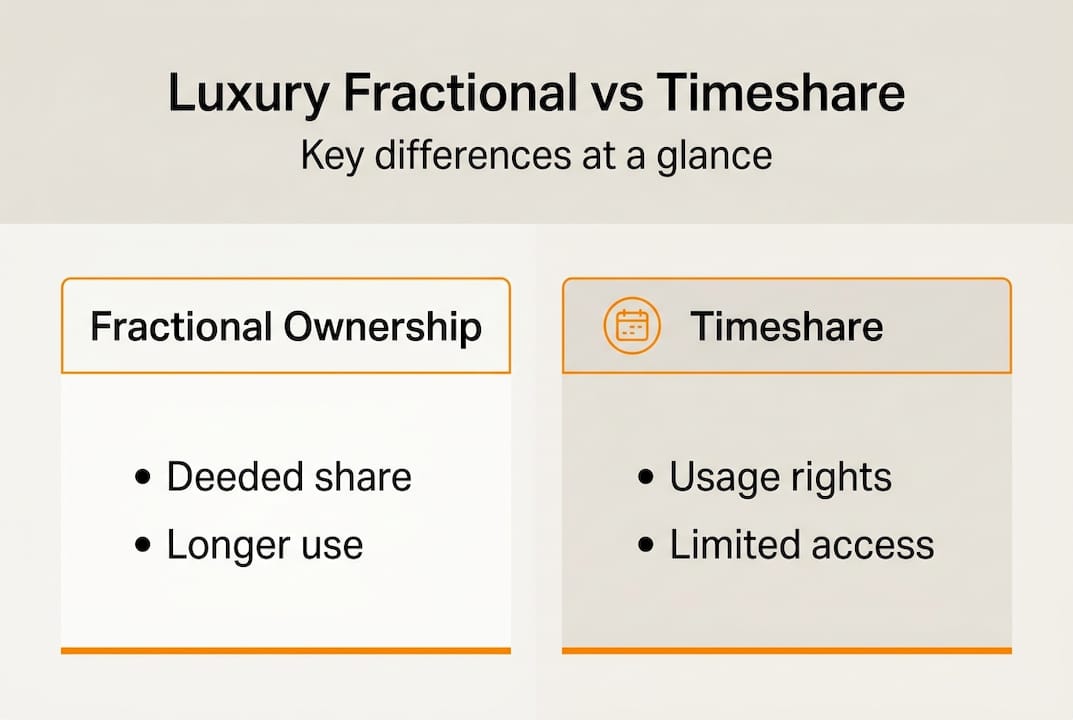
Fractional buyers tend to have higher incomes, longer usage rights, and access to significantly larger and more exclusive properties than timeshare buyers. This reflects a fundamentally different investment mindset.
| Attribute | Fractional ownership | Timeshare |
|---|---|---|
| Ownership type | Deeded real estate share | Right-to-use contract |
| Typical buyers | Income $150k+ | Income $75k+ |
| Property size | 3 to 5 bedrooms | Studio to 2 bedrooms |
| Annual use | 5+ weeks | 1 to 2 weeks |
| Concierge services | Included | Rarely included |
| Resale options | Open market | Highly restricted |
Scenarios where fractional ownership is the stronger choice:
- You want genuine legal ownership and the ability to pass the asset to your children
- You seek 5 or more weeks annually in a specific, curated property
- You value bespoke concierge services and a private residence atmosphere
- You are building a multi-destination portfolio without locking up full capital in each location
Scenarios where a timeshare might suit:
- You want a very low entry cost and flexibility across resort networks
- You require only one or two weeks per year in a holiday setting
For families who want to how to buy luxury property with long-term legacy in mind, fractional ownership is the clear choice. It offers control, prestige, and a transferable asset rather than a depreciating contract.
Who should consider luxury fractional real estate
With the models compared, it is time to explore who benefits most from luxury fractional real estate.
The ideal fractional buyer is not defined solely by wealth. They are defined by lifestyle ambition. International families who spend extended time across multiple destinations, serial entrepreneurs who travel between financial capitals, and executives seeking a guaranteed sanctuary during Cannes Film Festival or Menton’s Lemon Festival are all natural candidates. So too are digital millionaires who want their wealth anchored in appreciating stone rather than volatile markets.
Qualifying income for luxury fractional real estate is typically US $150,000 or above annually, and the model is designed for those who want 5 or more weeks per year in a prime property without committing the full capital a sole purchase demands.
Key benefits for this profile include:
- Capital efficiency: Access a €3M villa on the Cap d’Antibes coastal sentiers for a fraction of the full acquisition cost
- Prime location access: Secure a foothold in markets where full ownership is increasingly competitive
- Legacy building: Pass a deeded share to your heirs, creating a family anchor in a world-class destination
- Hassle-free management: Arrive to a property that is perfectly prepared, without the operational burden of sole ownership
- Flexible scheduling: Align your stays with the Antibes yacht regattas, Nice’s Carnaval, or quiet autumn weeks when the Riviera exhales
- Portfolio diversification: Hold fractional interests across multiple destinations, from the Côte d’Azur to Ibiza or Mauritius
The steps for luxury property purchase are well-defined, and fractional buyers follow the same rigorous due diligence as sole purchasers. Legal audits, title verification, and management company assessments are all essential.
Pro Tip: Before committing, map your actual travel patterns over the past three years. If you consistently spend 4 to 8 weeks in a single destination, fractional ownership will likely deliver better value and a richer experience than either renting or full ownership.
The real value: More than a cost-saving measure
We observe, time and again, that fractional ownership is misread as simply a way to split a bill. That framing misses the point entirely.
The families and investors we work with are not choosing fractional models because they cannot afford full ownership. Many could. They choose it because it gives them something sole ownership rarely does: genuine freedom. The freedom to hold a curated position in Sainte-Maxime, another in Ibiza, and perhaps one in Mauritius, without the weight of managing three full estates. The freedom to arrive and simply live, with every detail handled.
We have seen emerging luxury market trends shift decisively toward experience over accumulation. The most sophisticated buyers are no longer measuring success by how many properties they own outright. They measure it by the quality and breadth of the life those properties enable. Fractional ownership is the architecture of that life. It is a legacy instrument, a lifestyle passport, and a remarkably intelligent investment vehicle, all at once.
Explore luxury opportunities on the Côte d’Azur
If you are considering how to put this knowledge to work for your family or investment portfolio, the next step is straightforward. We invite you to explore our curated selection of French Riviera luxury villas, spanning the sun-gilded coastline from Menton to Saint-Tropez. For those seeking something truly singular, our exclusive off-market listings offer access to properties that never reach the open market. We also accept cryptocurrency payments, reflecting our commitment to serving a new generation of global wealth. When you are ready to speak with someone who understands both the Riviera and your ambitions, speak to an expert from our team.
Frequently asked questions
Is luxury fractional real estate the same as a timeshare?
No. Luxury fractional ownership gives you a deeded share in a specific prime property and 5+ weeks of use annually, whereas timeshares typically offer a right-to-use contract with far less exclusivity and shorter annual access.
How much time do I really get each year in a fractional property?
Typically, you will enjoy 5 or more weeks of exclusive use each year, allocated flexibly across seasons depending on the ownership structure and scheduling agreement.
What is the minimum income for luxury fractional ownership?
Most programmes require a qualifying annual income of at least US $150,000, reflecting the premium nature of the properties and services involved.
Can I sell my fractional property share in future?
Yes. Because fractional shares are deeded real estate interests, you can sell, gift, or bequeath your share on the open market just as you would any other property asset.
What services are included with luxury fractional ownership?
Expect hotel-level services as standard, including concierge, daily housekeeping, property maintenance, and often bespoke local experiences tailored to each owner’s preferences.
Recommended
- Emerging Luxury Market: Shaping 2026 Wealth Strategies
- 7 Essential Steps for Buying Luxury Property in 2025
- Key steps in international luxury property buying 2026
- Luxury market trends on the Côte d’Azur: insights for 2026
- Investissement immobilier patrimonial : Sécuriser et transmettre en 2026 – Balmont Conseil
 //
//