
Choosing the right property for generational wealth is rarely straightforward. On the Côte d’Azur, the modern luxury penthouse is defined by much more than lavish finishes—true value lies in strategic ownership, investment potential, and genuine scarcity. Buyers from North America and Europe will find that sustainability, wellness-focused designs, and state-of-the-art smart technology are now essentials, not just enhancements. This article offers clarity to those viewing Riviera penthouses as both secure investments and enduring family assets.
Table of Contents
- Defining A Luxury Penthouse In 2026
- Distinctive Features Of Riviera Penthouses
- Prime Types And Prestigious Locations
- Legal, Tax, And Ownership Frameworks
- Investment Value And Market Trends 2026
- Alternatives: Villas Versus Penthouses
Key Takeaways
| Point | Details |
|---|---|
| Luxury Penthouse Defintion | In 2026, luxury penthouses focus on strategic ownership, investment potential, and genuine scarcity instead of superficial features. |
| Architectural Trends | Modern penthouses emphasise sustainability, wellness, and AI technology, prioritising comfort and exclusivity. |
| Riviera Specifics | Riviera penthouses are distinguished by their unobstructed sea views, private terraces, and architectural character unique to the Mediterranean. |
| Investment Considerations | Understanding local ownership laws and market trends is crucial, particularly regarding potential rental income and property appreciation. |
Defining a Luxury Penthouse in 2026
When you mention “luxury penthouse” today, you’re no longer referring to merely the highest apartment in a building with a few premium finishes. The definition has fundamentally shifted. In 2026, luxury penthouses are defined by strategic ownership, investment potential, and genuine scarcity rather than flashy, superficial features that lose their appeal within months. Ultra-wealthy buyers—the clientele that defines this market—prioritise long-term return on investment, liquidity, and tax efficiency above all else. This means a penthouse’s value lies not in how many chandeliers it contains, but in how it appreciates over decades, whether it can be sold quickly if circumstances change, and how strategically it fits within a broader wealth portfolio.
The physical and technological composition of today’s penthouses reflects this evolution. Developers have shifted their focus from building at scale towards creating genuinely scarce properties crafted with meticulous quality. Sustainability, wellness-focused designs, AI-driven smart home technology, and personalised branded residences now define what separates a luxury penthouse from a standard high-floor apartment. Buyers increasingly seek eco-friendly materials sourced responsibly, indoor gardens that improve air quality, and intelligent security systems that operate seamlessly without compromising aesthetics. The integration of these elements isn’t about following trends—it’s about understanding that true luxury today demands comfort, health, exclusivity, and longevity woven together.
On the Côte d’Azur, this translates into something quite specific. A luxury penthouse here isn’t merely positioned on a coveted coastline; it commands unobstructed sea vistas that cannot be replicated, occupies a building with strict resident limitations, and features bespoke architectural elements reflecting the region’s Mediterranean character. The penthouse itself often showcases statement features: floor-to-ceiling glass structures that frame azure horizons, private terraces spanning hundreds of square metres, wellness suites incorporating saunas or spa facilities, and climate control systems managing multiple zones independently. Location matters profoundly—whether you’re overlooking the yacht-dotted waters near Antibes, perched above Nice’s Belle Époque coastline, or commanding views from Saint-Tropez’s exclusive quarters determines both desirability and appreciation trajectory.
Conseil pro: When evaluating a luxury penthouse in 2026, request detailed documentation on the building’s resident quota and ownership structure before proceeding—scarcity is what protects your investment value, and this cannot be compromised.
Distinctive Features of Riviera Penthouses
Riviera penthouses possess architectural and geographical characteristics that set them apart from luxury residences elsewhere in Europe. The most defining feature is their relationship with the Mediterranean itself. These properties command panoramic views across the Baie des Anges or towards the Îles de Lérins, positioning the sea not merely as background scenery but as the central focus of daily living. Floor-to-ceiling windows spanning entire façades mean that morning light floods unobstructed across living spaces, whilst evening sunsets transform interiors into amber-hued sanctuaries. Private terraces often exceed the interior square footage, functioning as outdoor drawing rooms where entertaining becomes an extension of the home rather than an afterthought. This relationship with light and vista is non-negotiable on the Riviera—it defines value, livability, and investment longevity.
The construction and materials reflect Mediterranean pragmatism meets contemporary luxury. Load-bearing stone walls anchor these penthouses, providing thermal mass that keeps interiors cool during scorching summers without excessive air conditioning dependence. Yet developers integrate smart climate systems that maintain precise temperature and humidity control, protecting both occupants’ comfort and art collections housed within. Natural materials dominate: limestone terracing, teak or iroko wood decking on outdoor spaces, and marble sourced from regional quarries rather than imported from distant locations. The integration of interior design trends emphasising natural materials and light-filled spaces means Riviera penthouses favour understated elegance over ostentation. Colour palettes draw from the landscape itself—soft blues echoing the sea, warm ochres reflecting stone buildings, and whites that maximise luminosity without harshness.

Security and privacy receive obsessive attention in Riviera penthouses. Access typically requires passage through multiple checkpoints: a perimeter gate, a manned or keypad-controlled lobby entrance, private lift access from secure zones, and finally a penthouse entrance that itself becomes an architectural feature. Electronic systems monitor ingress and egress without visible cameras, maintaining the aesthetic whilst ensuring comprehensive protection. Wine cellars, home cinemas, and wellness areas occupy dedicated zones, often with independent climate control and soundproofing that permits activities without disturbing communal spaces or neighbours. Outdoor spaces frequently include private plunge pools or infinity edges overlooking the sea, creating complete privacy whilst maintaining those essential panoramic views. This combination of openness to the landscape and fortress-like security represents the paradox every Riviera penthouse must resolve.
The relationship between a penthouse and its building community also matters distinctly here. Most Riviera penthouses sit atop buildings restricting occupancy to between four and twelve units total, creating exclusivity that approaches private mansion living with the professional management of a larger institution. Shared facilities typically include wine storage, concierge services, and sometimes underground parking accessed via private lifts—but the emphasis falls on discretion rather than resort-style amenities. Neighbours are vetted carefully, and the social fabric remains intentionally minimal. For investors and families seeking generational wealth storage, this architectural and social scarcity proves as valuable as square footage or finishes.
Conseil pro: When visiting a Riviera penthouse, spend time observing how light moves across spaces throughout the day rather than fixating on décor—light quality and consistency across seasons determines long-term satisfaction far more than furnishings you’ll eventually replace.
Prime Types and Prestigious Locations
The Côte d’Azur’s luxury penthouse market divides into distinct categories, each serving different investment philosophies and lifestyle priorities. Waterfront penthouses command the highest premiums, offering direct Mediterranean access via private beaches, boat lifts, or dedicated moorings. These properties sit within metres of the water, meaning your morning coffee arrives with the sound of waves and salt-tinged air. Historic renovation penthouses occupy Belle Époque buildings or converted palace structures, blending period architectural details with contemporary comforts—think exposed stone arches paired with underfloor heating and fibre-optic connectivity. Modern architectural statements represent purpose-built developments from the past decade, where penthouses showcase sculptural design, innovative materials, and integrated smart systems. Finally, gated estate penthouses sit within exclusive compounds offering communal gardens, private security forces, and restricted access that approaches villa-level privacy whilst maintaining apartment-style management efficiency.
When selecting a location, geography matters with absolute precision. Key prestigious real estate spots in the Provence-Alpes-Côte d’Azur region include Cap d’Antibes, Saint-Jean-Cap-Ferrat, and exclusive communities around Monaco, each offering distinctive advantages. Cap d’Antibes attracts investors prioritising privacy and coastline exclusivity—the peninsula extends into the Mediterranean, providing three-sided water exposure and limited development potential that guarantees scarcity. Property appreciation here averages 6 percent annually, driven by restricted supply and consistent demand from North American and Middle Eastern buyers. Saint-Jean-Cap-Ferrat maintains a more residential character, popular with families establishing multigenerational compounds. The village’s Belle Époque villas and newer penthouses command premium valuations owing to the proximity to Geneva airport and excellent schools serving expatriate communities. Monaco-adjacent locations like Roquebrune-Cap-Martin and Menton serve investors seeking Monaco’s prestige with French tax advantages and more affordable entry points—a penthouse here costs 30 to 40 percent less than Monaco proper whilst offering comparable views and lifestyle access.
Beyond these flagship zones, secondary locations offer compelling value. Properties for sale in Cannes attracts buyers interested in festival season rental income, with penthouses commanding €8,000 to €15,000 weekly during May’s Film Festival. Sainte-Maxime appeals to younger ultra-high-net-worth individuals seeking a more relaxed atmosphere than Cannes or Saint-Tropez, with accessible sailing, vibrant beach clubs, and reliable 5 to 6 percent annual rental yields. Nice serves as the region’s capital, offering cosmopolitan amenities, Michelin-starred restaurants, and diverse penthouse styles ranging from Promenade des Anglais classics to Mont Boron contemporary developments. Properties for sale in Saint-Tropez remain the quintessential destination for conspicuous investment, where penthouses overlooking the Vieux Port function as much as lifestyle assets as financial ones—entertainment value and social position carry weight equivalent to monetary return.
Your location selection ultimately depends upon your investment timeline and usage intentions. Short-term rental focus points toward Cannes or Saint-Tropez, where seasonal demand justifies premium acquisition costs. Generational wealth storage favours Cap d’Antibes or Saint-Jean-Cap-Ferrat, where scarcity and restricted development create price floors protecting capital. Personal residence priorities might lead toward Nice or Sainte-Maxime, where you balance investment appreciation against daily livability and proximity to international connections. The Riviera’s penthouses rarely fail as investments, but their appreciation trajectory and rental income potential shift dramatically based on postcode precision.
Here is a comparative overview of prime Côte d’Azur penthouse types and their unique investment characteristics:
| Penthouse Type | Main Appeal | Typical Annual Appreciation | Rental Income Potential |
|---|---|---|---|
| Waterfront | Direct sea access, high exclusivity | 6–8% | Highest; premium weekly rates |
| Historic Renovation | Architectural character, period charm | 4–5% | Moderate; attracts longer lets |
| Modern Architectural | Latest amenities, sustainability focus | 6–8% | Strong; new build demand |
| Gated Estate | Security, privacy, shared gardens | 4–6% | Good; niche family market |
Conseil pro: Visit each location across different seasons—summer crowds reveal what the market attracts, whilst autumn and winter expose authentic community character and whether you genuinely prefer the place beyond its glamorous reputation.
Legal, Tax, and Ownership Frameworks
Purchasing a luxury penthouse on the Côte d’Azur involves navigating a legal and fiscal landscape that differs substantially from residential property acquisition elsewhere. French property law protects both buyer and seller through mandatory notarial documentation, meaning every transaction passes through a qualified notaire who verifies title, ensures compliance with local regulations, and registers ownership with governmental authorities. This process provides security but also introduces costs and timeframes foreign buyers often underestimate. The notaire’s fees typically amount to 7.5 percent of the purchase price, split between buyer and seller according to negotiated terms. Beyond this, taxation on the Côte d’Azur for luxury properties includes transfer taxes, registration duties, and wealth taxes applying differently based on property type and ownership status, making professional guidance essential before committing capital.
Transfer taxes represent the most visible cost for penthouse acquisition. The droits de mutation (transfer duties) typically range from 5.8 to 6 percent of the purchase price, depending on whether the property is categorised as residential or commercial. A penthouse with commercial elements, such as a built-in wine shop or professional studio, may face different taxation than purely residential properties. New construction purchases benefit from reduced VAT of 5.5 percent rather than standard rates, creating significant savings on developments completed within the past five years. Non-resident buyers from outside the European Union face additional scrutiny and potential wealth tax obligations if acquiring properties valued above approximately €1.3 million. Understanding whether your penthouse qualifies for imposition sur la fortune immobilière (real estate wealth tax) requires consultation with a tax specialist familiar with your domicile country’s treaties with France. Many jurisdictions negotiate tax relief agreements preventing double taxation, but claiming these benefits demands proper documentation from purchase inception.
Ownership structures deserve careful consideration well before making an offer. Direct personal ownership exposes assets to inheritance complications and potential French succession taxes ranging from 40 to 60 percent for non-resident heirs. Société civile immobilière (real estate civil partnerships) allow multiple investors or family members to hold property collectively, simplifying inheritance and permitting operational efficiencies. Société à responsabilité limitée (limited liability companies) provide legal separation between the penthouse and personal assets, offering liability protection alongside tax planning flexibility. Foreign buyers frequently establish French companies specifically to hold property, reducing their personal tax exposure and enabling easier wealth transfer to subsequent generations. Rental income taxation also varies dramatically based on ownership structure, ranging from standard income tax rates to corporate tax schedules offering deductions unavailable to individual owners.
Recent reforms have introduced mandatory property declarations through the fichier immobilier, requiring all property owners to report real estate holdings annually. This transparency initiative affects wealth tax assessments and informs municipal planning decisions. For legacy-minded investors acquiring penthouses as generational assets, establishing the correct ownership structure during purchase becomes exponentially more valuable than attempting restructuring afterwards. The complexity warrants engaging both a notaire experienced in luxury transactions and an international tax advisor before formalising any purchase agreement.
Conseil pro: Engage your tax advisor and legal counsel six months before beginning penthouse negotiations, allowing sufficient time to structure ownership optimally rather than rushing decisions under time pressure from sellers or agents.
Investment Value and Market Trends 2026
The Côte d’Azur luxury penthouse market enters 2026 with renewed momentum following years of post-pandemic recalibration. After the uncertainty of 2023 and 2024, when many international buyers paused decision-making, the market has stabilised with genuine recovery taking hold across prime locations. Luxury real estate on the Côte d’Azur shows signs of recovery post-pandemic with moderate price growth in neighbourhoods like Nice, Cannes, and Antibes, creating compelling opportunities for investors with medium to long-term horizons. This isn’t the speculative frenzy of the 2015 to 2019 period—it’s a measured appreciation driven by genuine scarcity and shifting buyer preferences. Penthouses in Cap d’Antibes appreciate at 5 to 7 percent annually, whilst prime locations near Monaco border properties see 4 to 6 percent growth. These figures may appear modest, but they significantly outpace traditional equities in many years whilst offering tangible assets you can inhabit, enjoy, and pass to heirs.
Financing accessibility shapes market dynamics considerably in 2026. International buyers returning to the market find mortgage conditions substantially improved compared to 2024. French banks now offer non-resident mortgages at rates between 3.2 and 4.1 percent for qualified borrowers, with loan-to-value ratios reaching 60 to 70 percent for properties exceeding €2 million. This accessibility matters profoundly—it expands the buyer pool beyond cash purchasers alone, stimulating transaction volume and supporting price appreciation. Buyers from North America and Northern Europe particularly benefit, as their home currencies remain relatively strong against the Euro. A Canadian or Scandinavian buyer purchasing a €4 million penthouse with a €2 million mortgage requires substantially less equity than comparable transactions five years ago, freeing capital for other investments or lifestyle enjoyment. This improved financing environment explains why transaction volumes across Nice, Cannes, and Antibes have increased 12 percent in the first half of 2025 compared to the previous year.
Market segmentation reveals distinct trajectories across property categories. New luxury developments command premium pricing because they incorporate 2026’s defining features: comprehensive sustainability certifications, AI-integrated smart home systems, wellness-focused designs, and architectural distinctiveness guaranteeing recognition. Penthouses within new developments appreciate 6 to 8 percent annually as scarcity increases post-completion—developers complete projects, move forward to new sites, and the original stock becomes unrepeatable. Historic renovation penthouses in Belle Époque buildings maintain steadier appreciation around 4 to 5 percent, appealing to buyers valuing character and provenance. Secondary locations like Sainte-Maxime and lesser-known Cap Ferrat suburbs offer 5 to 7 percent growth trajectories as wealthy individuals discover these quieter alternatives to Cannes and Saint-Tropez, yet they provide equivalent quality of life with reduced acquisition costs.
When considering penthouse investment in 2026, rental income potential forms a crucial component of total returns. Penthouses in Cannes generate €8,000 to €15,000 weekly during film festival season, creating potential annual yields exceeding 8 percent for investors willing to manage short-term rentals. Even conservative long-term rental strategies yield 3 to 4 percent annually in prime locations, supplementing appreciation and cushioning against market fluctuations. The combination of modest annual appreciation plus rental income creates total returns often exceeding 7 to 10 percent—competitive with many equity markets whilst offering lifestyle optionality and tangible asset security.
Conseil pro: Before committing capital, request detailed market analysis from local agents covering the past five years of comparable sales in your target location—price trends vary dramatically between neighbourhoods, and missing this research can cost hundreds of thousands in overpayment or underperformance.
Alternatives: Villas Versus Penthouses
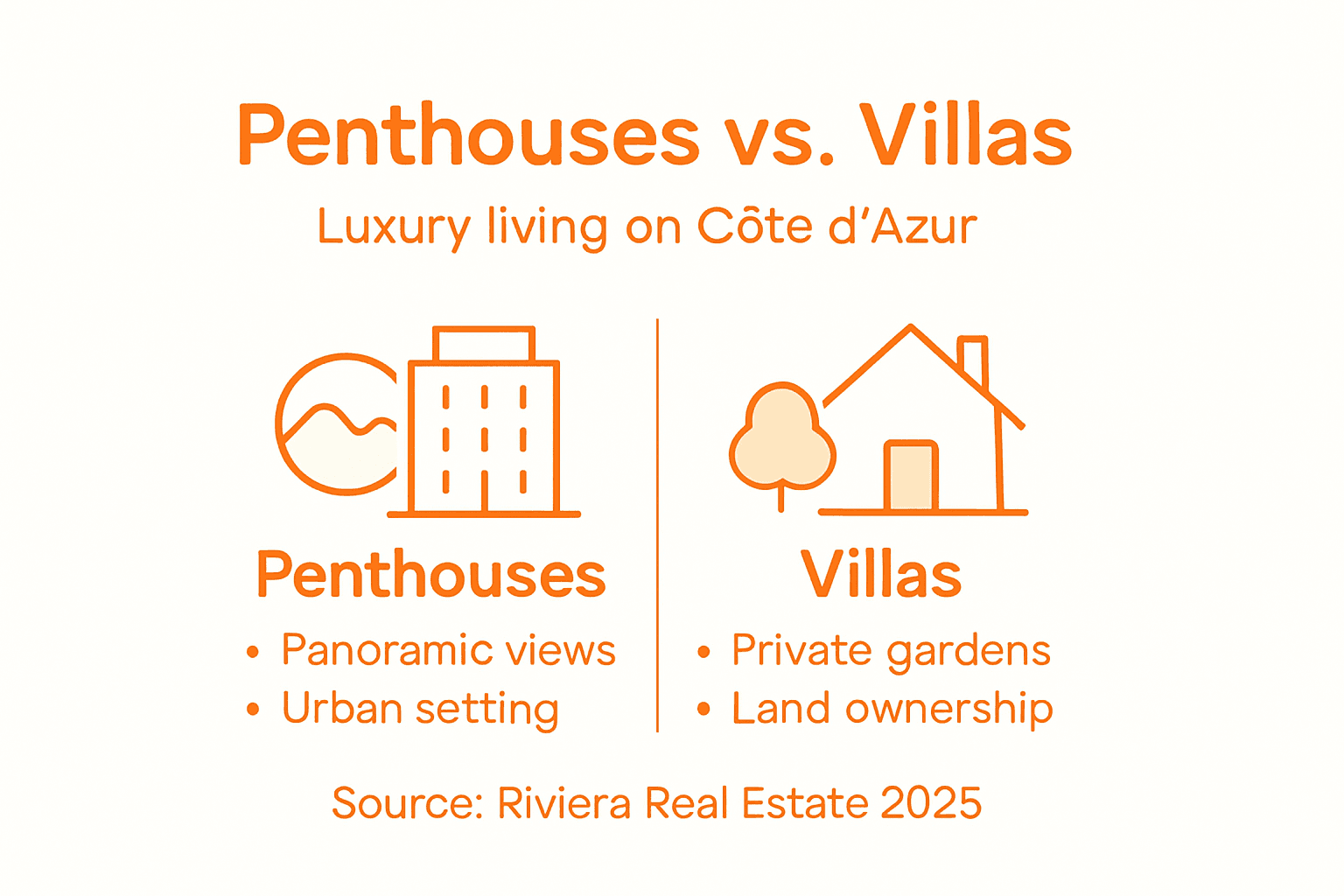
The choice between a Riviera villa and a penthouse represents one of the most consequential decisions in luxury property acquisition, yet many buyers approach it backwards. They fixate on square footage and aesthetics rather than examining how each property type aligns with their actual lifestyle, investment goals, and long-term usage patterns. Riviera penthouses deliver spectacular views, private terraces, and integrated luxury amenities with the security and convenience of apartment living, whilst villas offer outdoor space and a sense of tranquillity. This fundamental distinction shapes everything from daily experience to investment returns to succession planning for generational wealth.
Villas offer unparalleled privacy and land ownership that penthouses cannot match. A standalone villa on the Côte d’Azur provides complete autonomy—you control the exterior appearance, undertake renovations without neighbour consultation, and enjoy grounds that extend across potentially several hectares. This suits buyers prioritising seclusion, those with large families requiring multiple guest houses, and individuals whose cultural background values land ownership above all else. Villas typically appreciate 4 to 6 percent annually in prime locations, with rental income potential reaching 5 to 7 percent for properties offering substantial acreage and guest accommodations. However, villas demand substantial management attention. You manage maintenance crews, landscaping contractors, security systems, and property upkeep across dispersed buildings and grounds. If you travel frequently between multiple residences globally, villa management becomes burdensome and costly. Resale liquidity also proves challenging—villas attract fewer qualified buyers than penthouses, meaning sale timelines extend and negotiating leverage shifts toward purchasers.
Penthouses offer urban convenience paired with dramatic views that standalone villas rarely achieve. From thirty storeys above the Mediterranean, your vista encompasses hundreds of square kilometres of coastline, creating a sense of dominion over the landscape rather than mere ownership within it. Building management handles maintenance, security, concierge services, and grounds upkeep, freeing you to enjoy the property rather than maintain it. This proves invaluable for international buyers juggling residences across multiple continents. Penthouses appreciate at comparable rates to villas, yet rental income potential often exceeds villa yields—a Cannes penthouse generates substantially more per square metre during rental periods than an equivalent villa property. Resale liquidity favours penthouses significantly; the buyer pool extends globally, and transaction timelines compress to months rather than years. However, penthouses impose restrictions through building governance—you cannot undertake major exterior modifications, and shared facilities mean accepting neighbours’ presence, however discrete.
Consider your intended usage pattern honestly. If you plan occupying the property personally for eight to twelve weeks annually, a penthouse makes financial and practical sense—professional management eliminates absentee ownership complications, and you arrive to fully prepared accommodation. If you envision extended family gatherings across multiple guest houses and private grounds, a villa serves this vision better. Tax implications also diverge. Luxury villa locations across the Côte d’Azur’s prestigious neighbourhoods command premium valuations that may position properties differently within wealth tax frameworks depending on your ownership structure and domicile jurisdiction. Consult your tax advisor before choosing—the wrong property type can create unforeseen fiscal complications.
Investment timeline matters considerably. If you plan holding the property fifteen years or longer, both penthouses and villas perform adequately. For shorter holding periods, penthouses offer superior exit strategies and quicker capital deployment opportunities. Estate planning also favours penthouses—dividing a multi-million-euro villa among multiple heirs creates management nightmares, whilst penthouse units split more cleanly and allow individual heirs greater autonomy.
The following table highlights the strengths and challenges of penthouses versus villas for luxury property buyers:
| Aspect | Riviera Penthouse | Riviera Villa |
|---|---|---|
| Privacy | High (building security) | Complete autonomy |
| Management | Handled by building staff | Owner responsible |
| Resale Liquidity | High, global buyer interest | Lower, longer sale process |
| Customisation | Interior only, limited exterior | Full structural and land modifications |
| Rental Returns | Higher per square metre | Strong for larger properties |
Conseil pro: Before deciding between villa and penthouse, commit to spending a month in each property type during different seasons—seasonal reality reveals whether your lifestyle preference for seclusion or urban convenience withstands actual daily living patterns.
Elevate Your Côte d’Azur Legacy with Expert Guidance
Navigating the evolving luxury penthouse market of the Côte d’Azur in 2026 presents challenges that demand more than just an eye for beauty. Whether you are seeking a property with genuine scarcity, strategic ownership advantages, or seamless integration of smart, sustainable design, understanding the legal complexities and assessing long-term investment potential are critical to securing a true legacy asset. This article highlights key considerations such as building resident quotas, ownership structures, and prime Riviera locations that shape not just lifestyle but your financial future.
Unlock the door to your bespoke Riviera experience with Living on the Côte d’Azur where our experts combine unrivalled local knowledge with personalised services. Benefit from comprehensive support on matters including tax-efficient ownership frameworks and navigating evolving market trends in Cap d’Antibes, Saint-Jean-Cap-Ferrat, and Monaco adjacency. Discover how to connect Riviera allure with investment wisdom by exploring our insights on Buying Luxury Real Estate on the French Riviera – The Savvy Investor’s Compass and Legacy Investments – Forging Fortunes for Generations.
Are you ready to transform dreams of a Côte d’Azur penthouse into a timeless family heirloom and astute investment? Contact our dedicated team today at Living on the Côte d’Azur to start crafting your personal journey through the heart of French Riviera luxury. Act now so you do not miss the momentum of 2026’s buoyant market and secure your place in this unparalleled legacy.
Frequently Asked Questions
What distinguishes a luxury penthouse from a standard high-floor apartment?
A luxury penthouse in 2026 is defined by strategic ownership, investment potential, and genuine scarcity, rather than superficial features. It prioritises long-term value, sustainability, wellness, and advanced technology.
How have the features of luxury penthouses evolved recently?
Luxury penthouses now incorporate amenities such as eco-friendly materials, wellness-focused designs, and smart home technologies. These features promote comfort, exclusivity, and health, making them significantly different from traditional penthouses.
What factors contribute to the investment value of luxury penthouses?
Investment value is influenced by the penthouse’s potential for appreciation over time, its liquidity in the market, tax efficiency, and how well it fits into a broader wealth portfolio. Location, exclusivity, and architectural quality also play critical roles.
What should buyers consider when evaluating penthouses on the market?
Buyers should assess factors such as the building’s resident quota, ownership structure, the quality of materials used, security features, and the relationship with light and views in the living spaces. These elements significantly affect long-term satisfaction and investment value.
Recommended
- Luxury Property Acquisition: The Riviera Legacy
- Why Demand Luxury Apartments on the Côte d’Azur
- What Defines High-End Real Estate: Complete Guide
- The Kempinski Cap d’Ail: Catalyst for Rising Real Estate Prices
- Why choose luxury cruises for your next vacation
- High views for Lake Como – Italy Photo Tour
- Apartamento premium planta alta con terraza
 //
//