TL;DR:
- Luxury real estate terminology reflects standards of price, location, heritage, and uniqueness beyond mere expense.
- Understanding specific terms like VEFA, bespoke, and off-market improves negotiation power and investment accuracy.
- Clear language and verification of property features are essential for confident, strategic property investments.
When a Cannes listing describes a villa as “exclusive” and a Côte d’Azur brochure promises a “prestige residence,” most readers nod along, assuming they understand. They rarely do. The language of luxury real estate is its own dialect, one where imprecise reading can shift a negotiation, misrepresent a valuation, or cloud an otherwise brilliant investment decision. We have seen high-net-worth buyers walk away from off-market gems and overpay for ordinary stock, simply because they mistook marketing vocabulary for objective fact. This guide decodes the essential terminology shaping the French Riviera market in 2026, so you invest with precision.
Table of Contents
- What makes a property ‘luxury’? Core definitions and distinctions
- Critical luxury property jargon every investor must know
- Features that define luxury: From opulence to innovation
- Applying terminology: How language affects investment strategy
- Perspective: Why terminology transparency is the missing luxury in property investment
- Explore luxury French Riviera investments with expert guidance
- Frequently asked questions
Key Takeaways
| Point | Details |
|---|---|
| Luxury terms matter | Knowing the language helps investors identify genuine high-end properties and avoid costly mistakes. |
| Jargon decoding | Understanding legal, marketing, and regional terms gives buyers a strategic advantage in negotiations. |
| Feature-driven value | Luxury properties are defined by features, innovations, and experience—not just price or location. |
| Regional nuance | The meaning of luxury changes across markets, so international investors should localise their understanding. |
| Investment impact | Applying proper terminology ensures stronger portfolios and smarter investment strategies. |
What makes a property ‘luxury’? Core definitions and distinctions
Let us begin where confusion thrives: the word “luxury” itself. In everyday usage, luxury suggests something expensive. In real estate, it demands far more rigour. A property commanding €900,000 in Saint-Tropez may feel luxurious to one buyer yet fall well short of the standards a seasoned investor applies. Understanding the formal taxonomy changes everything.
Luxury describes properties exceeding the top 10% of a given market in terms of price, specification, and finish. Prime refers to location first, where proximity to coastline, cultural anchors, or established prestige corridors such as Cap d’Antibes or Monaco’s borders defines value. Prestige adds an element of heritage or social cachet: a Belle Époque villa on the Croisette carries prestige that no newly built apartment can replicate purely through design. Bespoke means uniquely commissioned or customised, a property where the architecture, interiors, and landscaping reflect a single owner’s vision rather than a developer’s template. Exclusive, when used honestly, indicates genuine scarcity: limited units, restricted access, or a site that cannot be replicated.
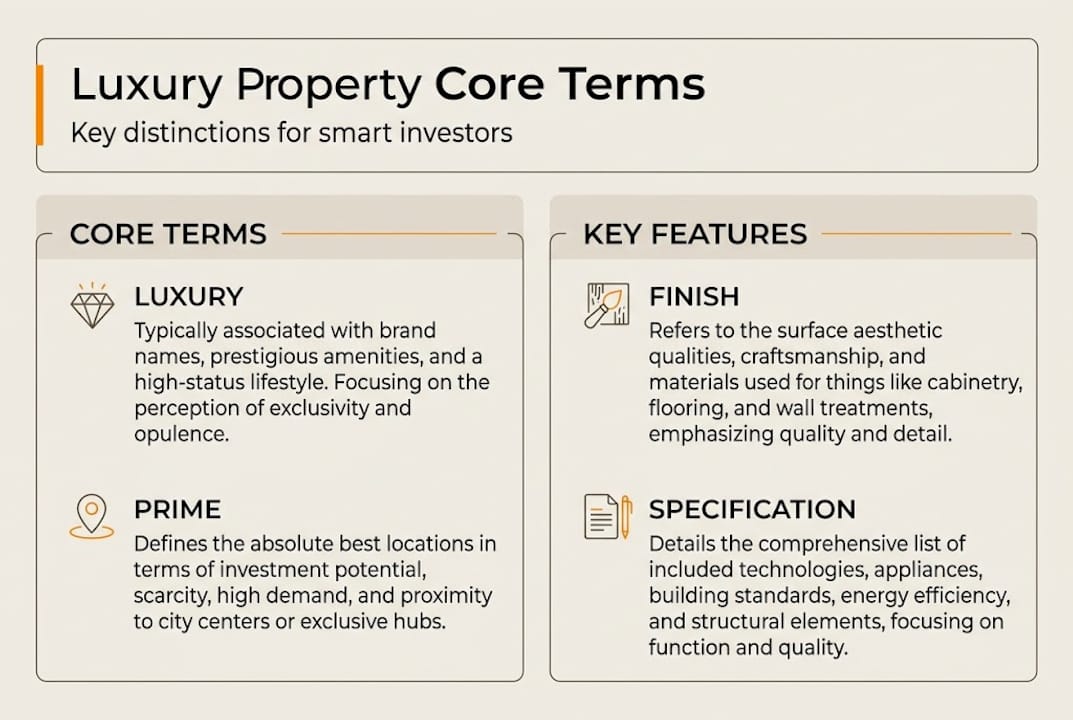
As luxury property terms vary significantly by region and market trends, what qualifies as prestige in Nice’s Mont Boron differs considerably from the standards applied along the Lérins Islands coastline near Cannes. Investors comparing markets across the Riviera and, say, London’s Belgravia must calibrate their definitions carefully. The same word carries different weight depending on geography, culture, and the local supply of truly exceptional stock.
Key features and value-defining terminology shape investment perceptions in ways that are both measurable and surprisingly subjective. A comparison illustrates this clearly:
| Term | General meaning | Riviera-specific nuance |
|---|---|---|
| Luxury | Top 10% of market by price and spec | Often implies sea view, concierge, high-end finishes |
| Prime | Superior location | Seafront, Monaco border, Cap d’Antibes, Èze promontory |
| Prestige | Heritage or social standing | Belle Époque, classified buildings, famous former residents |
| Bespoke | Custom-designed | Architect-led, single-commission interiors and landscape |
| Exclusive | Genuine scarcity | Limited units, gated domain, off-market access only |
Buyers who understand this table negotiate differently. They question whether “luxury” is genuinely substantiated by specification or merely aspirational branding. They ask which features create lasting value versus surface appeal.
Key distinguishing features in truly luxury stock include:
- Panoramic sea views from principal rooms, not side angles or terraces only
- Architectural provenance or a recognised design signature
- Materials selected for longevity: stone, hardwood, artisan tile
- Smart home technology integrated discreetly rather than retrofitted
- Private outdoor space with mature landscaping or a usable pool area
- Designer-quality finishes across every touchpoint, from fixtures to soft furnishings
“Luxury is not a price point. It is a convergence of irreplaceable elements: position, provenance, precision of craft, and the promise of an experience that no other property can offer.”
The regional dimension matters enormously. In Menton, where the Lemon Festival draws thousands each February and Val Rahmeh’s botanical gardens perfume the air, prestige attaches to hillside positions with views across the Italian border. In Antibes, where Picasso’s spirit still inhabits the old fortress, prestige is cultural and historic. Calibrating your terminology to the specific micromarket is not pedantry. It is investment intelligence.
Critical luxury property jargon every investor must know
With the foundational vocabulary established, we can move into the operational language: the abbreviations, legal terms, and marketing phrases that appear in listings, contracts, and agent conversations every single day.
VEFA stands for Vente en l’État Futur d’Achèvement, the French off-plan purchase contract under which you buy a property before construction completes. VEFA purchases benefit from a ten-year structural warranty (the garantie décennale), lower notary fees compared to resale, and staged payment plans tied to construction milestones. For new Sainte-Maxime beachside residences or Nice’s emerging Mont Boron towers, VEFA is the primary acquisition vehicle.

PPE or Propriété Par Étages is the Swiss equivalent of a sectional title scheme, relevant for investors operating across borders. ROI (return on investment) is expressed as a percentage of annual rental income against the purchase price, typically 3 to 5% for elite Riviera rentals. Off-market refers to properties not listed on public portals, circulated exclusively through private agent networks. These represent some of the most prized acquisitions on the Côte d’Azur precisely because competition is limited.
Dual mandate describes an arrangement where two agents hold a shared exclusive or co-exclusive instruction, occasionally creating confusion over representation. Turnkey means the property is fully furnished and operationally ready from day one, a significant advantage for buyers seeking immediate rental income during Cannes Film Festival season or the Monaco Grand Prix.
As marketing language influences buyer perceptions and property valuations directly, the words chosen in a listing are never accidental. “Curated” implies editorial taste applied to design selection. “Secure” suggests gated access, alarm systems, or 24-hour concierge. “Discreet” is code for off-market or limited disclosure, appealing to ultra-high-net-worth buyers who value privacy above all.
Understanding legacy and ROI nuances requires fluency in the language that surrounds them. Investors who cannot decode these terms rely entirely on agents to interpret, a position of vulnerability in any negotiation.
Common jargon pitfalls include:
- Assuming “renovated” means fully refurbished. It may mean a kitchen update only.
- Reading “sea glimpse” as “sea view.” These are not equivalent.
- Mistaking “artist’s impression” for a finalised design in off-plan brochures.
- Accepting “rare opportunity” without verifying actual market comparables.
A numbered checklist for approaching any luxury listing:
- Request the full legal designation and planning permissions.
- Ask for clarification on every superlative used in the description.
- Verify whether “exclusive” refers to the listing mandate or the property itself.
- Confirm the specific definition of “sea view” with compass bearings if needed.
- Review the property pros terminology independently before signing anything.
Pro Tip: When an agent uses “iconic,” ask them to specify exactly what makes the property irreplaceable. If they cannot answer with facts, the word is decorative, not descriptive.
Features that define luxury: From opulence to innovation
Terminology is only meaningful when it maps to tangible, verifiable features. This is where the elegance of language meets the substance of stone. On the French Riviera, where the salt-kissed air carries equal parts history and ambition, luxury features are both architectural and experiential.
Architectural language in prestige listings frequently deploys terms such as “grand,” “monumental,” “organic,” and “biophilic.” Biophilic design, which integrates natural materials, greenery, and natural light into every plane of the building, is the defining aesthetic of 2026’s most sought-after new developments. It is not merely visual preference; it reflects a measurable improvement in wellbeing and, increasingly, a premium that survives market corrections.
Features and definitions that shape how luxury hospitality and residential property are perceived include:
| Feature category | Examples | Investment significance |
|---|---|---|
| Wellness | Spa, hammam, indoor pool, meditation garden | Commands 15 to 20% premium in rental yield |
| Smart technology | Home automation, security, climate control | Reduces operating cost, appeals to tech-literate buyers |
| Eco credentials | Solar arrays, rainwater harvesting, BREEAM ratings | Future-proofs asset against tightening regulations |
| Privacy | Gated domain, mature tree screening, no overlooking | Non-negotiable for UHNW clients |
| Views | Panoramic sea, mountain, or port views | Single greatest determinant of Riviera value |
Ultra-luxury is defined by properties surpassing standard prestige metrics entirely, those with helicopter pads, private beach access, wine cellars curated by sommeliers, or guest pavilions designed as independent residences. These are not whims; they are value anchors that attract a global clientele willing to pay a substantial premium.
A curated list of luxury features reveals that amenities once considered rare are now expected at the higher end. A private pool is standard. A wellness spa is expected. What differentiates genuinely exceptional properties in 2026 is the calibre of feature execution: custom Italian joinery, geothermal heating, or a rooftop terrace framing the Baie des Anges panorama from Nice’s Château Hill.
Eco-luxury properties on the French Riviera represent a 15% demand spike compared to conventional luxury stock, driven by buyers who regard environmental performance as a legacy value rather than a lifestyle choice. Solar arrays, green certifications, and biophilic design are no longer optional enhancements in modern Riviera developments; they are prerequisites for long-term capital appreciation.
Much like understanding how luxury fragrance is defined by the rarity of its ingredients rather than merely its price, true luxury property value lies in the irreplaceability of its elements, not the headline figure alone.
Pro Tip: When evaluating a “wellness retreat” or “spa villa” listing, request independent evidence of spa certification or spa management contracts. Marketing language and operational reality are not always aligned.
Key features to assess beyond the brochure:
- Construction materials: locally sourced stone versus composite panels
- Glazing standards: double or triple glazing, UV filtration, thermal performance
- Landscape maturity: a ten-year-old garden versus newly planted hedging
- Certifications: HQE, BBC, or BREEAM ratings for French eco-builds
- Service infrastructure: concierge partnerships, property management contracts
Applying terminology: How language affects investment strategy
Every term you now understand translates directly into negotiating power, portfolio clarity, and long-term returns. Language is not decoration in luxury real estate. It is architecture in its own right.
When a seller describes a Cap d’Antibes estate as “turnkey,” a terminology-literate buyer immediately verifies the inventory list, confirms the included art and furnishings, and establishes the management contracts already in place. Without that literacy, “turnkey” becomes an assumption, and assumptions are expensive on eight-figure transactions.
Proper knowledge of luxury terminology shapes portfolio and investment decisions at every stage, from initial shortlisting through to divestment planning. A luxury portfolio is not simply a collection of expensive properties. It is a strategically assembled group of assets defined by complementary attributes: one generating seasonal rental income in Sainte-Maxime, another held as a long-term legacy position near Monaco, a third providing lifestyle access during the Cannes Film Festival or Menton’s Lemon Festival in February.
A striking data point: studies of high-net-worth buyer behaviour consistently show that buyers who invest in understanding terminology before entering negotiation secure an average of 7 to 12% better pricing outcomes on premium transactions. Terminology is not academic. It is financial leverage.
A practical checklist for applying terminology to investment decisions:
- Define your investment thesis first. Legacy holding? Rental yield? Capital growth? The terminology that matters shifts accordingly.
- Verify all descriptors independently. Do not accept “prime” without checking location data.
- Cross-reference legal documents. Ensure VEFA contract terms match the developer’s verbal commitments.
- Interrogate ROI projections. Ask whether figures are gross or net, and which rental weeks are already contracted.
- Identify the off-market pipeline. The most exceptional Riviera assets rarely appear on public portals.
A numbered investment strategy framework:
- Build a personal glossary before each market you enter.
- Engage a bilingual legal advisor to review all French-language documentation.
- Request disclosure of the full mandate type before any negotiation begins.
- Benchmark terminology against comparable transactions in the same commune.
- Revisit your terminology understanding each year, as the market evolves and so does its language.
Perspective: Why terminology transparency is the missing luxury in property investment
We have observed something consistently in our work across the Côte d’Azur and beyond: the investors who feel most confident are rarely the wealthiest. They are the most informed. There is a persistent myth in high-end property circles that ambiguity is elegant, that the best properties sell themselves without explanation. In reality, vague language is a tool, deployed when specifics might disappoint.
Agents occasionally benefit from buyers remaining comfortable with imprecision. “Exceptional” need not be substantiated. “Rare” requires no comparison. This is not cynicism; it is observation. The ultra-luxury market rewards those who challenge this norm, who ask their advisors to define every superlative, who insist on measured sea views rather than illustrated ones.
The French Riviera market in 2026 is genuinely exceptional, offering appreciation of 5 to 8% annually in prime locations, genuine off-market scarcity, and a lifestyle infrastructure unmatched anywhere in Europe. None of that value is accessible without the linguistic confidence to engage it precisely. True luxury, we believe, is knowing exactly what you are buying and why.
Explore luxury French Riviera investments with expert guidance
Terminology mastery is the first step; the next is finding properties that genuinely live up to the language used to describe them. At Living on the Côte d’Azur, we curate access to properties where every descriptor is earned. Whether you are building a legacy and ROI strategy across generations or seeking your first prestige acquisition on the Riviera, we bring the fluency and the access that make the difference. Our off-market luxury portfolio includes estates that never reach public listing, accessible exclusively through our private network. We also accept cryptocurrency, because the future of luxury investment is as innovative as the properties we represent.
Frequently asked questions
What does ‘bespoke’ mean in luxury property listings?
‘Bespoke’ indicates a property with customised features and design tailored uniquely for the owner or a specific market, reflecting genuine exclusivity rather than a developer’s standard specification.
How do regional differences affect luxury property terminology?
Regional variations in terminology mean that ‘prestige’, ‘prime’, or ‘exclusive’ carry different standards in Cannes versus Monaco or Saint-Tropez, requiring careful interpretation from international investors entering each micromarket.
Why is understanding property jargon so important for investment?
Clear comprehension prevents costly misunderstandings in listing details, negotiations, and legal agreements; high-net-worth real estate strategies depend directly on the buyer’s ability to decode the nuanced language surrounding every transaction.
What is an ‘off-market’ luxury property?
An off-market property is not publicly listed and is accessible only through private networks or trusted agents; invisible luxury properties on the Côte d’Azur represent some of the most exclusive and privately transacted real estate in Europe.
What is VEFA in French luxury property?
VEFA, or Vente en l’État Futur d’Achèvement, is a French off-plan purchase contract used widely in new luxury developments, offering buyers lower notary fees, staged payment plans, and a ten-year structural warranty.
Recommended
 //
//