
TL;DR:
- Successful luxury investment on the Côte d’Azur requires thorough preparation, capital, and clear objectives.
- A disciplined, step-by-step workflow from market research to management ensures optimal yields and legacy preservation.
- Engaging experienced legal, property, and tax professionals early mitigates risks and maximizes long-term value.
The French coast between Nice and Saint-Jean-Cap-FerratConversely between the lemon-scented ramparts of old Nice, and the palazzo-lined quays of Monaco’s border, sits one of the world’s most coveted and complex rental investment arenas. The salt-kissed air alone is not enough to guarantee returns. Even the most seasoned family offices find that luxury rental assets on the côte d’azur can produce exceptional 3–5% seasonal yields or quietly haemorrhage value through compliance failures, misaligned management, and legal oversights. We believe the difference is discipline. In this guide, we lay out a structured workflow that transforms an aspirational acquisition into a generational asset, walking you through every prerequisite, every operational detail, and every regulatory safeguard that truly matters.
Table of Contents
- What you need before you start: Prerequisites for luxury investment
- Step-by-step workflow: acquisition to rental income
- Managing the property: Operations, tenants, and legacy protection
- regulatory, risk, and tax workflow essentials
- Why most luxury investors overlook workflow—and what shifts real returns
- elevate your investment: Next steps with expert support
- frequently asked questions
Key Takeaways
| Point | Details |
|---|---|
| Preparation is critical | Laying the right foundations with professional advisers and a solid checklist prevents costly mistakes. |
| Follow a clear workflow | A structured approach from acquisition to rental yields the best results and risk reduction. |
| Professional management matters | Expert property management is essential for maximising legacy value and ensuring tenant satisfaction. |
| Stay compliant | Ongoing due diligence and tax planning are vital for regulatory and financial success. |
| Legacy over glamour | Focus on discipline and workflow for long-term success—not just the prestige of assets. |
What you need before you start: Prerequisites for luxury investment
Before a single offer is made or a viewing arranged beneath the mimosa-lined boulevards of Cap d’antibes, you need your house in order. Not the villa itself, but the strategic, legal, and financial house that will determine whether your investment becomes a treasure or a liability.
The first and most fundamental prerequisite is substantial, structured capital. We are speaking of a minimum entry of €2 million for a competitive coastal property with genuine rental appeal, though prime sea-view villas in Saint-tropez or along Monaco’s borders command considerably more. Beyond the purchase price, budget for acquisition costs of 7–8%, renovation or staging to luxury-let standard, ongoing management fees, and a prudent reserve.
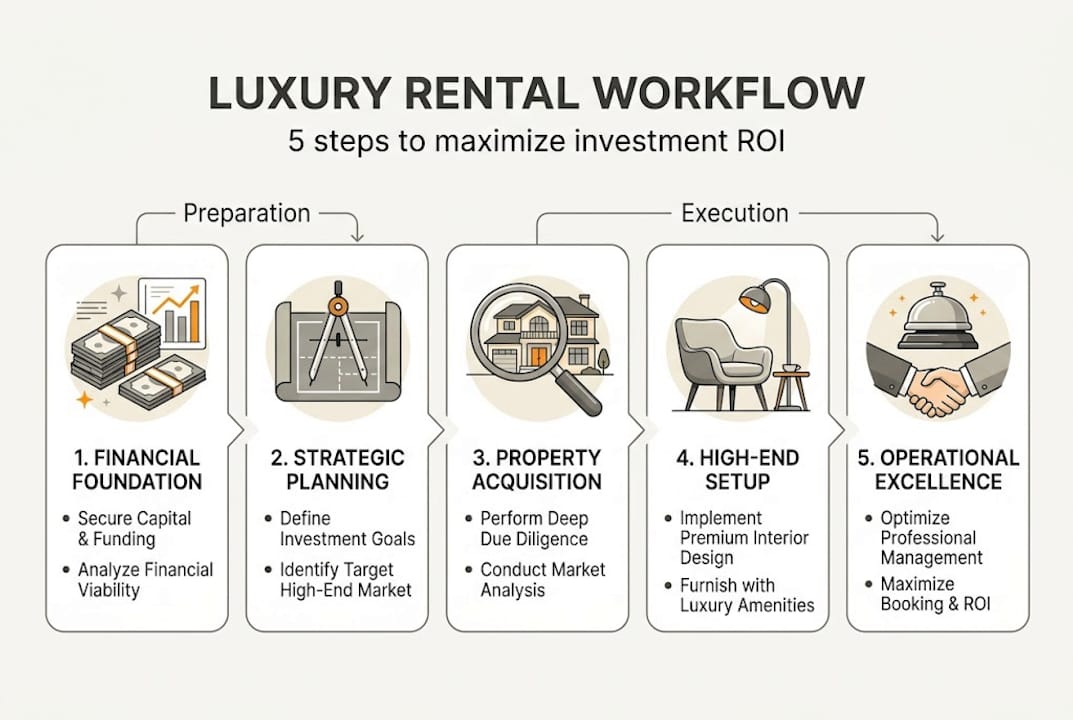
Your investment objectives must be defined with equal precision. Are you prioritising rental yield, capital appreciation over 10 years, or legacy transfer to the next generation? The answer shapes everything from location to legal ownership structure.
Knowledge of the côte d’azur market is non-negotiable. As careful due diligence confirms, a well-structured checklist is critical to acquisition success. We recommend using a luxury investment checklist and familiarising yourself with the distinctions between locations. Nice’s Mont boron attracts year-round urban tenants; sainte-maxime captures summer families seeking nartelle beach sunsets; cannes draws film festival royalty every may.
Essential prerequisites at a glance:
- Clear legacy or yield objectives documented in writing
- Capital structure confirmed with your wealth manager
- Legal adviser with franco-european cross-border experience engaged
- Licensed luxury real estate agent retained
- Property management firm shortlisted prior to acquisition
- Tax adviser briefed on ownership structure and residency status
| Item | Required standard | Key professional |
|---|---|---|
| Capital readiness | €2M+ liquid or structured | Private banker or wealth manager |
| Legal ownership structure | SCI, holding company, or personal title | French property lawyer |
| Tax residency analysis | Cross-border treaty reviewed | International tax adviser |
| Market knowledge brief | Location and yield comparisons | Property specialist budget |
| Professional team assembled | All three roles confirmed | Lead adviser coordinates |
For a clear-eyed overview of buying luxury property on the riviera, start with the fundamentals before the romanticism takes hold.
Pro tip: Begin every investment conversation with your legacy objectives, not your budget. When you know what you are building for your heirs, every subsequent decision—from location to legal structure—falls into elegant alignment.
Step-by-step workflow: acquisition to rental income
With your foundations firmly in place, the real work begins. A structured, repeatable process is what separates the investors who extract consistent yield from those who spend years correcting avoidable errors. As a structured acquisition process shows, moving from property evaluation to closing in a disciplined sequence ensures better yields.

1. Market research and location selection. Study micro-markets with precision. A penthouse overlooking the croisette in cannes performs differently from a provençal mas near menton’s lemon festival groves. Match the asset profile to your target tenant.
2. Property shortlisting. Filter on rental yield potential, year-round appeal, proximity to airports, and heritage or renovation status. Work with your agent to narrow to three or four serious candidates.
3. Professional viewings and technical survey. Never rely on photographs. Commission a technical survey covering structural integrity, seismic resilience where applicable, and any environmental constraints.
4. Due diligence and legal audit. This is the hinge of the entire process. Title clarity, planning permissions, existing tenancy rights, and any charges on the property must be verified by your lawyer before offer.
5. Price negotiation and offer. Armed with survey results and comparable data, negotiate from a position of intelligence. Document every exchange.
6. Contract signing, notarial process, and closing. In france, the compromis de vente locks both parties in. Your notaire coordinates the final transfer of funds and title.
7. Pre-let preparation. Stage the property to luxury-let standard, commission professional photography, ensure all rental licences and regulatory registrations are in place, and appoint your management team before the first booking is accepted.
8. Live listing and income realisation. List across curated luxury platforms, set seasonal pricing strategy, and begin generating income. Review your property purchase steps to ensure nothing was missed.
| Stage | Traditional approach | workflow-optimised approach |
|---|---|---|
| Due diligence | Post-offer, often cursory | Pre-offer, comprehensive audit |
| Legal structure | Set up after purchase | defined before first viewing |
| Pre-let preparation | Ad hoc, post-closing | planned concurrently with closing |
| Time to first rental income | 6–18 months | 3–6 months |
| Risk of compliance issue | High | Low |
Pro tip: Document every stage meticulously, including email exchanges, survey notes, and verbal agreements reduced to writing. This paper trail is your shield against future disputes and your compliance defence in any regulatory review.
Managing the property: Operations, tenants, and legacy protection
With the property generating rental income, the work shifts from acquisition to operational excellence. This is where many wealthy investors falter—because managing a luxury rental is an entirely different discipline from owning one.
The choice between self-management and property management for legacies is, frankly, not a close call at the highest end of the market. Professional management firms with established networks on the riviera handle maintenance, tenant vetting, guest experience curation, emergency response, and seasonal pricing with a sophistication that preserves both yield and reputation.
Key operational workflows in a professionally managed property:
- Pre-arrival inspection and luxury staging for each tenancy
- rigorous tenant and guest vetting including references and identity verification
- dedicated concierge service for elite guests
- 24-hour emergency maintenance response
- quarterly property health checks and preventative maintenance schedules
- Annual property condition report for insurance and asset valuation purposes
“Professional property management safeguards both ROI and the family legacy in the côte d’azur, with well-managed luxury villas consistently achieving occupancy rates 20–30% higher than self-managed equivalents during peak season.” Source: Living on the côte d’azur
For legacy protection specifically, management quality is inseparable from asset quality. A poorly maintained villa on the côte d’azur—no matter how prestigious its address—will erode in value, reputation, and desirability for the next generation. Working with trusted professionals who understand the riviera’s social fabric ensures your property remains a jewel, not a burden, in your family’s portfolio.
The local network matters enormously. A management partner with relationships among antibes’ marina community, the cannes festival circuit, and menton’s cultural calendar can attract the calibre of tenant who respects the property and returns year after year. That repeat tenancy is what transforms a rental asset into a legacy cornerstone.
regulatory, risk, and tax workflow essentials
No workflow is complete without a clear-eyed reckoning with france’s regulatory and tax landscape. Tax planning and risk assessment are, without question, critical to luxury rental investment outcomes. The riviera’s prestige commands premium returns, but those returns exist within a framework of obligations that cannot be ignored.
Your compliance audit, step by step:
- confirm ownership structure is optimal for your tax residency and legacy objectives before any title transfer.
- Register the property with the local mairie (town hall) for rental activity as required by french law.
- obtain rental licences and any applicable touristic registration numbers for short-term lets.
- Draft and review all tenancy contracts with your property lawyer, ensuring compliance with french housing law and international guest standards.
- File all required tax returns on rental income, including those governed by any double-taxation treaty relevant to your residency.
- Annual compliance review to account for regulatory changes, which in france can move quickly.
“ignoring compliance exposes landlords to regulatory penalties and voided contracts, with fines in france reaching tens of thousands of euros for unlicensed rental activity.”
The real estate risk factors most likely to harm your investment are tax mismanagement, improper contract structure, and failure to maintain current rental licences. None of these risks are exotic. They are entirely foreseeable, and therefore entirely preventable with the right team.
We also see growing regulatory attention on luxury real estate tax strategies in 2026, particularly around short-term rental income declarations and capital gains on non-resident owners. This is not the landscape for guesswork.
Pro tip: If your portfolio spans more than one country—which, for most family offices we work with, it does—engage a cross-border tax specialist who understands both french tax law and the regulations of your home jurisdiction. The interaction between the two is where the most costly errors occur.
Why most luxury investors overlook workflow—and what shifts real returns
Here is the uncomfortable truth we observe among even our most accomplished clients: the very traits that create wealth—instinct, decisiveness, appetite for beauty—can work against disciplined workflow in luxury real estate. It is seductive to fall in love with an èze village stone house overlooking the méditerranée, or a penthouse in nice with château hill panoramas flooding every room with golden light. But the seduction of the asset is precisely when the workflow must become more rigorous, not less.
We have seen exceptional properties underperform for years because the acquisition excitement eclipsed the due diligence discipline. Real returns—the kind that compound across generations—come from meticulous process: documented steps, scheduled reviews, unyielding compliance checks, and a management standard that never drifts. You can explore proven ROI strategies to sharpen this further. The investors who build true riviera legacies are not necessarily those with the most spectacular properties. They are the ones whose workflow is as refined as their taste.
elevate your investment: Next steps with expert support
If this workflow has clarified the path you want to take, we are here to walk it alongside you. Our curated portfolio of french riviera villas and penthouses spans the côte d’azur’s most prestigious addresses, from cap d’antibes’ secluded coastal sentiers to sainte-maxime’s sun-drenched nartelle shoreline. For those building or refining a high-net-worth legacy strategy, our advisory team combines riviera market intelligence with a global network reaching ibiza, dubai, portugal, and beyond. We also welcome cryptocurrency transactions for seamless, modern wealth deployment. To explore what is possible, speak to a côte d’azur expert and take the first step with confidence.

frequently asked questions
What is the most important stage in a luxury rental investment workflow?
Due diligence and compliance checks before acquisition are the most critical steps, as due diligence reduces risk and prevents costly mistakes that are far harder to correct after title has transferred.
How can I protect my luxury property’s legacy while renting it out?
Engaging a professional property management service ensures consistently high standards and preserves long-term asset value, as professional management protects both rental yield and generational legacy.
Which professionals should be involved at the start of my investment workflow?
You should consult a property lawyer, a luxury real estate agent, and a cross-border tax adviser from the outset, since early engagement of advisers materially mitigates luxury property risks.
What are the main risks in luxury rental investment on the côte d’azur?
Key risks include compliance failures, tax mismanagement, unreliable tenants, and improper contract structure, with compliance gaps and tax mismanagement representing the most financially damaging exposures.
Is it worth using a workflow to document and organise luxury rental investments?
Absolutely—systematic workflows increase returns and lower risks significantly, while also creating the documented trail needed to support legacy transfer to the next generation.
Recommended
- 7 Essentials for a Luxury Investment Property Checklist
- How to Evaluate Luxury Real Estate for Smarter Investments
- 7 Essential Luxury Real Estate Checklists for Elite Buyers
- Maximise your real estate ROI on the Côte d’Azur: proven strategies
- Real Estate Low Budget Game | Beginner Real Estate Training From $0
 //
//