
TL;DR:
- Italy offers prestigious legacy properties that require expert navigation through legal, cultural, and fiscal processes.
- Buyers must secure a Codice Fiscale, conduct thorough due diligence, and follow a structured purchase workflow.
- Heritage properties provide long-term value through legal protection, restoration deductions, and tax reductions.
Italy does not simply sell property. It bestows it. For high-net-worth buyers seeking a legacy investment etched in Renaissance stone or tucked within a cypress-lined Tuscan estate, the Italian market offers prestige that few places on earth can replicate. Yet the purchase workflow is layered with legal precision, cultural regulation, and fiscal nuance that demands more than enthusiasm. It demands expertise. Whether you are acquiring a lakeside villa on Como, a fortified borgo in Umbria, or a palazzo overlooking the Amalfi coast, mastering every stage of this process is what separates a sound legacy investment from a costly oversight.
Table of Contents
- Key prerequisites for buying real estate in Italy
- Step-by-step workflow for Italian real estate purchase
- Costs, taxes, and closing for luxury and legacy properties
- Legacy property purchases: State pre-emption, restoration, and due diligence
- What legacy investments reveal about Italy’s luxury real estate market
- Connect with legacy luxury experts and next steps
- Frequently asked questions
Key Takeaways
| Point | Details |
|---|---|
| Complete workflow clarity | Every stage from offer through notarial deed is clearly mapped for luxury and legacy purchases. |
| No broad buying restrictions | International HNWIs can buy Italian luxury property if reciprocity is verified by a notary. |
| Legacy-specific tax incentives | Buyers of historic assets may benefit from IMU reduction and restoration deductions. |
| State pre-emption and restoration rules | Legacy purchases require navigating state oversight, strict restoration compliance, and enhanced due diligence. |
Key prerequisites for buying real estate in Italy
Having set the scene for Italian luxury real estate, let’s clarify what you need to begin the process. Before a single offer is submitted, a series of prerequisites must be in place. Think of these as the foundations upon which every subsequent step rests. Skipping them is not merely inconvenient — it can render a transaction legally invalid.
The Codice Fiscale: your entry pass
The Codice Fiscale is Italy’s tax identification code, and without it, no Italian real estate transaction can proceed. It functions similarly to a national insurance number in the United Kingdom, identifying you within the Italian tax system. Foreign buyers obtain this from the nearest Italian consulate abroad or directly from an Agenzia delle Entrate office in Italy. The process is relatively swift, typically completed within a day, and it must be secured before any formal offer or contract is signed.
Reciprocity rules for non-EU buyers
Italy welcomes international wealth with open arms, but not without verification. Non-EU buyers can purchase Italian property provided the reciprocity principle is confirmed by a notary, a condition already established for the United States and most other major economies. This is not a barrier — it is a formality. Your appointed notary will confirm eligibility, and the Italy real estate guide on our portal provides a detailed country-by-country breakdown of reciprocity status.
Legacy and luxury property eligibility
For buyers drawn specifically to immobili vincolati (protected heritage properties), eligibility carries an additional layer of scrutiny. These assets are governed by the Italian Cultural Heritage Code, and buyers must acknowledge the obligations tied to ownership before any purchase is formalised. Our property acquisition guide outlines these distinctions in full.
Key documents you will need at the outset:
- Valid passport or national identification
- Codice Fiscale (tax code)
- Proof of source of funds (particularly relevant for high-value acquisitions)
- Notarised translation of key documents if not in Italian
- Banking arrangements in Italy or via an approved international transfer
Initial deposit expectations
Once eligibility is confirmed, buyers should be prepared to offer a holding deposit, often between €5,000 and €30,000, to signal serious intent. This is separate from the formal contractual deposits that follow.
Pro Tip: Engage a bilingual Italian property lawyer before submitting any offer. They work independently of the notary and protect your interests exclusively, whereas the notary serves as a neutral state officer.
| Requirement | EU buyers | Non-EU buyers |
|---|---|---|
| Codice Fiscale | Mandatory | Mandatory |
| Reciprocity check | Not required | Required by notary |
| Legacy property declaration | If applicable | If applicable |
| Proof of source of funds | Recommended | Strongly recommended |
Step-by-step workflow for Italian real estate purchase
With your prerequisites ready, you’re prepared to navigate the purchase workflow. The Italian system is structured and sequential, with each stage carrying specific legal and financial weight. Understanding the chronology prevents costly errors and positions you as a well-prepared buyer, which, in a competitive market for elite properties, carries genuine negotiating power.
The standard Italian purchase workflow follows these stages: obtaining your Codice Fiscale, submitting a formal purchase offer known as the Proposta d’Acquisto with an initial deposit, completing cadastral and preliminary checks, conducting comprehensive due diligence across title, urban planning, and technical aspects, executing the preliminary agreement (Compromesso) with a deposit of 10 to 20 per cent, and finally completing the notarial deed (Rogito) that transfers ownership. The total timeline from Compromesso to final deed is typically one to three months.
The six stages explained:
Obtain your Codice Fiscale. This is done at an Italian consulate or tax office. No purchase can proceed without it.
Submit the Proposta d’Acquisto (formal offer). This written offer, accompanied by a small holding deposit, demonstrates genuine intent. If the seller accepts, the deposit becomes binding. If they decline, you receive it back in full.
Conduct cadastral and preliminary checks. Your lawyer verifies the property’s cadastral category, land registry details, and any existing mortgages or encumbrances. For legacy properties, this phase also includes checking for cultural heritage listings.
Complete comprehensive due diligence. This encompasses title clarity, urban planning compliance, building permits, structural surveys, and for older estates, environmental inspections. Never underestimate this stage. Irregular building work, common in older Italian properties, can create significant legal exposure.
Sign the Compromesso (preliminary agreement). This bilateral contract locks both parties in. The buyer pays a deposit of 10 to 20 per cent of the agreed price. If the buyer withdraws, this deposit is forfeited. If the seller withdraws, they must return double the deposit. It is a powerful instrument of mutual commitment.
Execute the Rogito (notarial deed). Signed before a state-appointed notary, this final deed transfers full ownership. Remaining funds are transferred, taxes are paid, and you receive the keys.
Consult our luxury property buying guide for detailed commentary on each stage, and explore our international property buying steps for comparisons with other elite European markets.
| Stage | Typical timing | Key action |
|---|---|---|
| Codice Fiscale | Before offer | Tax registration |
| Proposta d’Acquisto | Day 1 | Offer and initial deposit |
| Preliminary checks | Days 7 to 21 | Cadastral and title review |
| Full due diligence | Weeks 2 to 6 | Legal, technical, urban review |
| Compromesso | Weeks 4 to 8 | 10 to 20% deposit, bilateral contract |
| Rogito | Months 2 to 4 | Transfer of ownership |
Pro Tip: Request that the Compromesso includes penalty clauses tied to specific completion dates. For legacy assets, build in extra time for heritage compliance checks before the final deed.
Our successful buying steps resource offers further guidance on structuring these timelines to your advantage.
Costs, taxes, and closing for luxury and legacy properties
Once you’ve followed the workflow, understanding every cost and tax implication is vital. Italy’s tax structure for real estate is not punitive, but it is precise, and errors in classification can prove expensive.

The breakdown is as follows: when buying from a private seller, registration tax stands at 9 per cent of the cadastral value, reduced to 2 per cent for a prima casa (primary residence). Fixed mortgage and cadastral taxes are applied at €50 each. When purchasing from a company or developer, VAT applies at either 10 or 22 per cent depending on the property’s classification. Notary fees run between 1 and 2 per cent, agent commissions around 3 per cent, and total closing costs range from 7 to 15 per cent of the purchase price.
What makes this particularly important for luxury buyers:
Cadastral value, the figure upon which many taxes are calculated, is typically well below market value for prestigious properties. This means the effective tax burden for a €5 million estate may be computed on a cadastral value of €1.2 million or less, producing a considerably more favourable tax outcome than headline rates suggest.
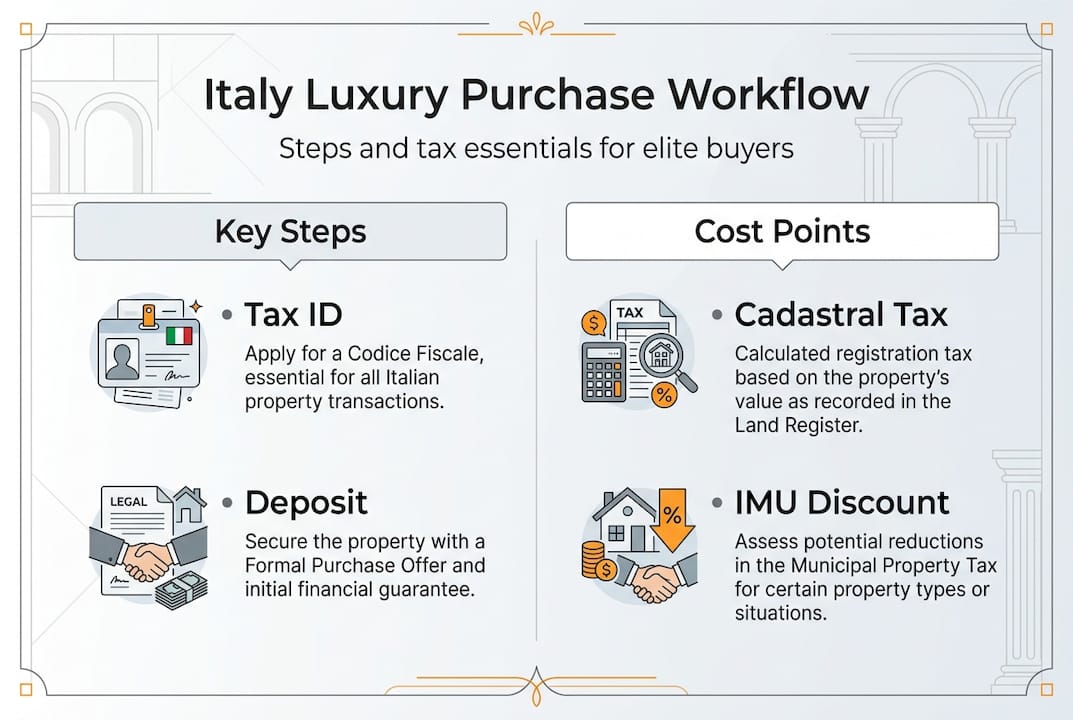
Standard versus legacy property costs at a glance:
| Cost element | Standard purchase | Legacy property |
|---|---|---|
| Registration tax | 9% (private seller) | 9%, with possible reductions |
| IMU (local property tax) | Standard rate | 50% reduction available |
| Notary fees | 1 to 2% | 1 to 2% (higher for complex deeds) |
| Restoration costs | Not applicable | Variable, significant |
| Agent commission | 3% | 3% |
Tax advantages worth noting:
- Prima casa registration tax reduction (2%) applies when the property becomes your primary Italian residence.
- Legacy properties carry an IMU reduction of up to 50%, which on a high-value estate represents a meaningful annual saving.
- Restoration expenditure on heritage properties can attract deductions of up to 50%, as detailed in the section below.
Pro Tip: Always request that the notary calculate taxes based on the cadastral value where legally permissible. This is entirely standard practice in Italy and reduces your immediate fiscal outlay substantially.
Explore the key features in Italian estates to understand how property classification affects your tax profile and long-term yield potential.
Legacy property purchases: State pre-emption, restoration, and due diligence
For investors seeking legacy and historic properties, there are extra steps and more opportunity. Italy’s immobili vincolati, those protected under Legislative Decree 42 of 2004 (the Cultural Heritage Code), represent some of the most extraordinary real estate on earth. A 16th-century Venetian palace, a hillside Sicilian masseria, a fortified medieval tower in Puglia — these are not simply homes. They are cultural custodianships. The purchase workflow reflects this elevated responsibility.
State pre-emption: the 60-day window
One of the most distinctive features of legacy property acquisition in Italy is the state’s right of first refusal. After the final deed (Rogito) is executed and notified to the relevant authorities, the Italian state has 60 days to exercise its pre-emption right and purchase the property at the same price agreed between buyer and seller. In practice, the state rarely exercises this right, particularly for private residential transactions. However, buyers must understand that ownership is not fully unencumbered until this window closes.
Restoration obligations
Purchasing a protected heritage property carries an obligation to maintain and restore it in accordance with guidelines set by the Sovrintendenza, Italy’s heritage oversight authority. These rules govern materials, colours, structural interventions, and even landscaping in some instances. This is not a constraint to fear. It is, rather, a mark of distinction. Properties maintained to Sovrintendenza standards appreciate reliably and attract the highest calibre of seasonal tenants.
Enhanced due diligence requirements:
- Confirm whether the property holds a vincolo (heritage restriction) from the Sovrintendenza
- Review the property’s cultural interest declaration (dichiarazione di interesse culturale)
- Verify any prior restoration works were carried out with proper authorisation
- Assess outstanding obligations or pending restoration orders
- Confirm there are no unresolved state interventions or notifications
“Legacy properties governed by Italy’s Cultural Heritage Code offer extraordinary prestige and genuine tax advantages, but they demand meticulous due diligence. Buyers who engage specialist heritage lawyers before the Compromesso are best positioned to navigate state pre-emption timelines and restoration obligations without disruption to their acquisition.”
Tax incentives that reward custodianship:
The Italian state compensates heritage buyers generously for assuming these obligations. A 50% IMU reduction applies to qualifying legacy properties, and restoration expenditure attracts deductions of up to 50%, providing meaningful relief against works that can run into seven figures for grand estates.
Pro Tip: Commission a specialist vincolo assessment before signing the Compromesso. This document confirms the precise scope of heritage restrictions and is essential for budgeting restoration costs accurately.
Discover the off-market property benefits that often accompany heritage and legacy assets across elite European markets, including exclusive access to unlisted immobili vincolati rarely available through public channels.
What legacy investments reveal about Italy’s luxury real estate market
We have accompanied many discerning buyers through the Italian purchase workflow, and what strikes us most consistently is this: the buyers who flourish are those who understand that a legacy property is not simply an asset. It is a relationship with the Italian state, with history, and with future generations.
The regulatory framework for protected heritage properties can appear daunting at first. State pre-emption, restoration mandates, Sovrintendenza approvals — these are real obligations. Yet they are also precisely what preserves the value of these properties over the long term. A heritage-restricted palazzo cannot be demolished, subdivided beyond recognition, or stripped of its character. That legal protection is, paradoxically, one of its greatest investment virtues.
What many international buyers overlook is the fiscal reward that accompanies responsible custodianship. When restoration deductions of up to 50% are factored against the cost of works, and annual IMU savings are compounded across a decade, the effective cost of ownership becomes considerably more attractive than a superficial reading of the workflow suggests.
Our view, refined through years of guiding elite buyers through European luxury markets as featured in our Italy real estate guide, is that Italy’s legacy properties represent a rare convergence of cultural prestige, regulatory stability, and genuine tax efficiency. The key is approaching them not with impatience, but with the same considered elegance that the properties themselves embody.
Connect with legacy luxury experts and next steps
If you’re ready to explore legacy luxury in Italy or other premier markets, here’s how to connect with experts. At Living on the Côte d’Azur, we curate opportunities that transcend the transactional. Our portfolio spans the sun-drenched excellence of the French Riviera to the storied grandeur of Italian estates, connecting visionary investors with properties that carry both financial weight and cultural soul. We understand what luxury real estate truly means at the highest level of the market — and we know that for families building intergenerational wealth, the right Italian property can become the cornerstone of a lasting legacy. Explore our curated resources on legacy luxury ROI and connect with our specialist team to begin your journey with confidence and clarity.
Frequently asked questions
How long does the Italian luxury real estate purchase workflow typically take?
The process typically takes one to three months from the preliminary agreement (Compromesso) to the final notarial deed, though legacy properties with heritage checks may require additional time.
Are there any restrictions for non-EU buyers on luxury Italian properties?
Most non-EU buyers can purchase Italian property once a notary confirms the reciprocity principle, with no broad restrictions applying to luxury or legacy assets in most cases.
What are the main tax advantages for legacy property buyers in Italy?
Eligible heritage properties may benefit from a 50% IMU reduction and restoration expenditure deductions of up to 50%, offering significant long-term fiscal advantages for qualifying buyers.
What is the state pre-emption right for historic property purchases?
The Italian state can exercise its pre-emption right within 60 days of the notarised deed for legacy properties, though in practice this right is rarely exercised for private residential acquisitions.
Recommended
 //
//