
TL;DR:
- Porto offers a compelling real estate investment opportunity with above-average prices, strong rental yields, and structured tax incentives. Its diverse demand from students, expatriates, and professionals supports a resilient rental market, enhanced by regulatory policies favoring long-term leasing. Strategic, location-specific investments aligned with CIA requirements can generate predictable, attractive returns while enjoying Porto’s vibrant lifestyle and economic growth.
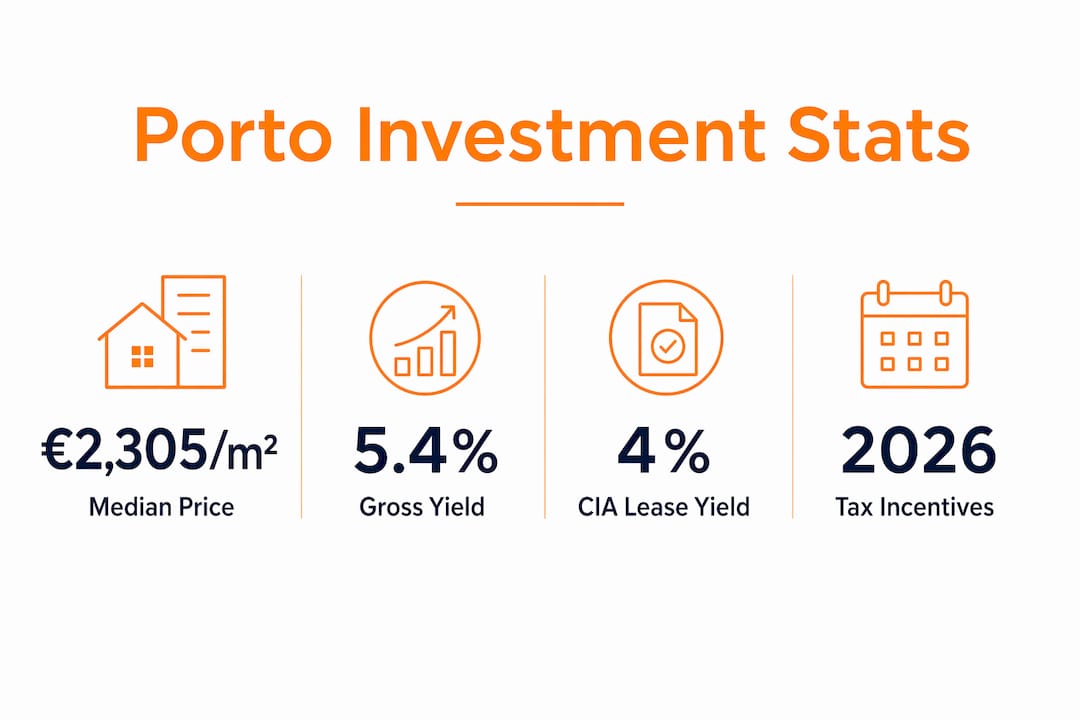
Porto is defined as one of Europe’s most compelling real estate investment destinations, offering a rare convergence of rising property values, favourable tax incentives, and a quality of life that draws expatriates and high-net-worth buyers from across the globe. The city’s Porto investment advantages extend well beyond sentiment. With a metropolitan median housing price of €2,305/m² sitting above Portugal’s national median of €2,076/m², Porto’s market fundamentals are measurable, not merely aspirational. The introduction of the Construir Portugal programme under Decree-Law No. 97/2026 has further sharpened the city’s appeal, creating a structured framework of tax reliefs that reward long-term, compliant investment. For the discerning investor or expatriate considering where to place capital in 2026, the case for Porto is grounded in data, policy, and enduring lifestyle prestige.
Why invest in Porto’s real estate market right now?
Porto’s median housing price of €2,305/m² confirms that the city commands a premium over the national average, reflecting sustained demand from both domestic buyers and international investors. That premium is not arbitrary. Porto’s historic centre, UNESCO-listed and perpetually photogenic, anchors values in a way that few European cities outside Paris or Lisbon can replicate. Neighbourhoods such as Bonfim, Paranhos, and Matosinhos each carry distinct price profiles, meaning that location selection within Porto is as consequential as the city-level decision itself.
Over the past decade, Porto has recorded significant appreciation, particularly in the post-pandemic period when northern Portugal attracted remote workers and digital nomads seeking Atlantic-facing quality of life at a fraction of London or Amsterdam costs. The market has since stabilised, which is precisely the moment that experienced investors recognise as the entry point of greatest clarity. Speculative froth has receded; fundamentals remain intact.
Compared with Lisbon, Porto still offers relative value. Lisbon’s premium neighbourhoods routinely exceed €5,000/m², while Porto’s most sought-after addresses remain accessible to buyers who understand that investing in Portuguese cities at this stage of the cycle rewards patience and precision over speed.
| Metric | Porto | National average |
|---|---|---|
| Median price per m² | €2,305 | €2,076 |
| Annual price growth (2025) | Above average | 16.8% |
| Gross rental yield | ~5.4% | Lower |
| Net rental yield | ~3.2% | Lower |
Pro Tip: When evaluating Porto neighbourhoods, compare Bonfim for emerging capital growth against Foz do Douro for premium stability. The two strategies serve entirely different investor profiles and time horizons.
What tax incentives support Porto real estate investment?
The Construir Portugal programme, enacted through Decree-Law No. 97/2026, introduces Contracts for Residential Leasing (CIA) that fundamentally alter the economics of owning rental property in Porto. These contracts unlock a suite of fiscal advantages that make compliant long-term leasing materially more attractive than speculative short-term strategies.
The principal incentives under the CIA framework include:
- Exemption from Real Estate Transfer Tax (RETT): Qualifying acquisitions structured under CIA conditions are exempt from this transaction cost, which typically represents 6 to 8% of purchase price on residential property.
- Stamp Duty exemption: CIA-aligned purchases benefit from full Stamp Duty relief, removing a further layer of acquisition cost.
- IMI reductions: Annual municipal property tax (IMI) is reduced for properties let under long-term CIA contracts, improving net yield from year one.
- Reduced VAT rates: New builds and qualifying rehabilitations that meet programme criteria benefit from reduced VAT, lowering the cost base for developers and investors acquiring off-plan assets.
- Rent cap compliance: To access these benefits, investors must accept rent caps tied to the programme’s affordability parameters. This is not a concession but a structural underwriting constraint that filters for quality, long-term tenants.
The policy logic is deliberate. Porto’s shift toward long-term moderate-rent leasing under the CIA framework reflects a broader government commitment to sustainable housing supply and quality tenant relationships. Investors who align their acquisition strategy with these conditions gain fiscal advantages while simultaneously reducing vacancy risk.
Pro Tip: Treat CIA rent caps as a yield floor, not a ceiling. Properties priced correctly within the programme’s parameters attract reliable, professional tenants who stay longer and maintain assets better than short-term occupants.
How do Porto’s rental dynamics affect investment returns?
Porto’s gross residential rental yield averages approximately 5.4%, with net yields settling near 3.2% after costs, taxes, and management fees. These figures position Porto above the Portuguese national average and compare favourably with mature European markets such as Barcelona or Amsterdam, where net yields have compressed below 3% in most central districts.
The demand side of Porto’s rental market is structurally diverse, which is a significant advantage for investors stress-testing occupancy scenarios.
- University students: Porto houses over 80,000 university students, anchoring mid-term rental demand across districts adjacent to the Universidade do Porto and the Universidade Católica Portuguesa. This cohort provides predictable seasonal occupancy with limited vacancy risk.
- Expatriates and digital nomads: Porto’s growing reputation as a tech and entrepreneurial hub draws professionals on mid-term contracts of three to twelve months, a segment that values quality over price and generates above-average rental income.
- Tourists: International visitor numbers sustain short-term demand, though regulatory tightening has redirected much of this demand toward licensed operators rather than individual landlords.
| Rental strategy | Gross yield | Risk profile | Regulatory status |
|---|---|---|---|
| Long-term CIA lease | 4.5 to 5.4% | Low | Fully supported |
| Mid-term (3 to 12 months) | 5.0 to 6.0% | Medium | Permitted |
| Short-term (Airbnb-style) | 6.0 to 8.0% | High | Restricted |
Short-term rental regulations in Porto have tightened considerably, with new licences restricted in saturated zones. This regulatory pressure does not diminish the investment case. It concentrates returns into the mid-term and long-term segments, where yields remain attractive and income is more predictable.
What lifestyle and economic factors make Porto appealing?
Porto’s investment appeal is inseparable from its quality of life, and for expatriate buyers in particular, the two considerations reinforce each other. A city that people genuinely want to live in sustains rental demand, supports capital values, and attracts the calibre of tenant that protects your asset.

Porto is a growing tech hub with an entrepreneurial ecosystem that has drawn companies including Farfetch, Natixis, and Critical Software to establish significant operations in the city. This corporate presence creates a steady pipeline of professional tenants on relocation packages, precisely the profile that mid-term landlords prize. The Web Summit’s move to Lisbon accelerated Portugal’s broader tech credibility, and Porto has benefited directly from that halo effect.
Infrastructure is a further differentiator. Porto’s metro network continues to expand, connecting the city centre to Francisco Sá Carneiro Airport in under forty minutes. High-speed rail links to Lisbon reduce the effective distance between Portugal’s two major cities, broadening the pool of buyers who consider Porto a viable primary or secondary residence. The climate, mild Atlantic with over 2,700 hours of sunshine annually, requires no embellishment.
Safety, cultural richness, and a cost of living that remains significantly below comparable Western European cities complete the picture. For the expatriate investor, Porto offers the rare combination of a city that is genuinely pleasurable to inhabit and financially rewarding to own property within.
How to approach Porto real estate investment strategically
Successful Porto investment in 2026 demands precision in three dimensions: location, asset type, and time horizon. The market segmentation between premium and emerging neighbourhoods is pronounced, and conflating the two produces neither the capital preservation of the former nor the yield of the latter.
A structured approach follows this sequence:
- Define your primary objective. Capital appreciation and rental yield are not mutually exclusive, but they are weighted differently by neighbourhood. Foz do Douro and Cedofeita offer prestige and long-term value preservation. Campanhã and Bonfim offer higher current yields with greater appreciation potential as regeneration matures.
- Align with CIA requirements from the outset. Structuring your acquisition to qualify for Construir Portugal incentives requires meeting specific area classifications and rent cap conditions. Treat these as underwriting parameters, not afterthoughts. Properties that qualify deliver materially better post-tax returns.
- Match tenant profile to asset type. A studio near the Universidade do Porto serves a student tenant. A two-bedroom apartment in Boavista serves a corporate expatriate. A renovated townhouse in Miragaia serves the premium short-to-mid-term visitor. Each profile carries different yield, vacancy, and maintenance characteristics.
- Stress-test three scenarios. Model your returns under long-term CIA lease, mid-term professional let, and vacancy. If the asset performs adequately under the most conservative scenario, the upside cases become genuine optionality rather than necessary assumptions.
- Consider new development projects carefully. Portuguese new developments in major cities have recorded 10 to 15% annual appreciation, and off-plan acquisitions in Porto’s regeneration zones carry the additional advantage of lower notary fees and potential VAT reductions under the Construir Portugal framework.
Pro Tip: Never acquire in Porto without a Portuguese fiscal representative and a local property lawyer who specialises in CIA contract structuring. The tax advantages are real, but they require precise documentation from the point of acquisition.
Key takeaways
Porto’s investment case in 2026 rests on measurable fundamentals: above-average yields, structured tax incentives under Construir Portugal, and a rental market sustained by students, expatriates, and professionals.
| Point | Details |
|---|---|
| Above-average pricing | Porto’s €2,305/m² median exceeds the national average, confirming sustained demand. |
| CIA tax incentives | RETT, Stamp Duty, and IMI exemptions reward long-term, compliant rental strategies. |
| Gross yield of 5.4% | Net yields near 3.2% remain competitive against comparable European markets. |
| Diverse tenant demand | Over 80,000 students plus expatriates and digital nomads sustain occupancy year-round. |
| Location precision matters | Premium and emerging neighbourhoods serve different investor objectives and risk profiles. |
Porto in 2026: what I have observed on the ground
Porto’s market is mature in the best sense of the word. It has passed through the speculative phase that characterised 2017 to 2019, absorbed the disruption of the pandemic years, and emerged with a cleaner, more fundamentals-driven dynamic. What I find most compelling is not the headline yield figure but the structural depth of demand. A city with 80,000 university students, a growing technology sector, and an international airport connecting it to over 100 destinations does not depend on any single tenant profile to sustain occupancy.
The regulatory environment is often cited as a concern by investors unfamiliar with the CIA framework. My view is the opposite. Regulation that discourages speculative short-term letting and rewards long-term, quality tenancies is precisely the kind of policy that protects asset values over a decade. The investors who will struggle in Porto are those who acquired expecting Airbnb returns and now face a changed landscape. Those who entered with a long-term thesis are finding the market increasingly aligned with their strategy.
The one caution I would offer is on location complacency. Porto is not a single market. Acquiring in the wrong neighbourhood at the wrong price, even in a city with strong fundamentals, produces mediocre outcomes. The step-by-step investment process matters enormously here. Due diligence on title, structural condition, and neighbourhood trajectory is non-negotiable. Porto rewards the precise investor and punishes the impatient one.
— ab
Discover curated investment opportunities with Livingonthecotedazur
At Livingonthecotedazur, we connect discerning investors with exceptional property opportunities across Portugal, the French Riviera, Ibiza, Dubai, and beyond. Our expertise in luxury real estate extends to Porto’s most prestigious addresses, where we guide clients through acquisition strategy, CIA compliance, and long-term portfolio positioning. We accept cryptocurrency payments and work exclusively with buyers who understand that property is not merely a transaction but a legacy. Whether you are seeking a Porto townhouse for rental income or a broader European portfolio anchored by prestige assets, our team provides the bespoke counsel your ambitions deserve. Explore our exclusive off-market properties and begin your conversation with us today.
FAQ
Is Porto a good investment in 2026?
Porto is a strong investment destination in 2026, supported by a median price of €2,305/m², gross rental yields of approximately 5.4%, and structured tax incentives under the Construir Portugal programme. The market rewards long-term, compliant strategies over speculative short-term approaches.
What tax benefits are available for Porto property investors?
Under Decree-Law No. 97/2026, investors who structure acquisitions through Contracts for Residential Leasing (CIA) qualify for exemptions from Real Estate Transfer Tax, Stamp Duty, and reductions in annual IMI. Reduced VAT rates also apply to qualifying new builds and rehabilitations.
What rental yields can investors expect in Porto?
Porto’s gross residential rental yield averages approximately 5.4%, with net yields near 3.2% after costs and taxes. Long-term and mid-term leases offer the most predictable returns given current regulatory constraints on short-term rentals.
Which Porto neighbourhoods offer the best investment value?
Premium neighbourhoods such as Foz do Douro and Cedofeita offer capital preservation and prestige. Emerging zones including Bonfim and Campanhã deliver higher current yields with stronger appreciation potential as urban regeneration continues.
Can expatriates buy property in Porto?
Expatriates and non-resident foreign nationals face no restrictions on purchasing property in Porto. Portugal’s open ownership framework, combined with the CIA incentive structure and a straightforward fiscal representation requirement, makes acquisition accessible for international buyers.
Recommended
 //
//