
TL;DR:
- French Riviera property prices have never declined historically, even during global crises.
- Scarcity and international demand drive long-term appreciation and market resilience.
- Strategic, concentrated investments in prime locations outperform other global markets over time.
Along a coastline where the Mediterranean light turns limestone villas to gold, something remarkable has held true for decades: French Riviera property prices have never declined historically. Not during global recessions. Not during pandemic lockdowns. Not even during the turbulent financial crises that flattened prime markets from London to Singapore. For high-net-worth investors who understand that true wealth is built on resilience, not speculation, this single fact rewrites every conversation about where to place capital. In the pages that follow, we will clarify what property appreciation means in this context, explore the forces that sustain it, present the latest market figures, and share actionable strategies for those ready to act.
Table of Contents
- Defining property appreciation and its significance
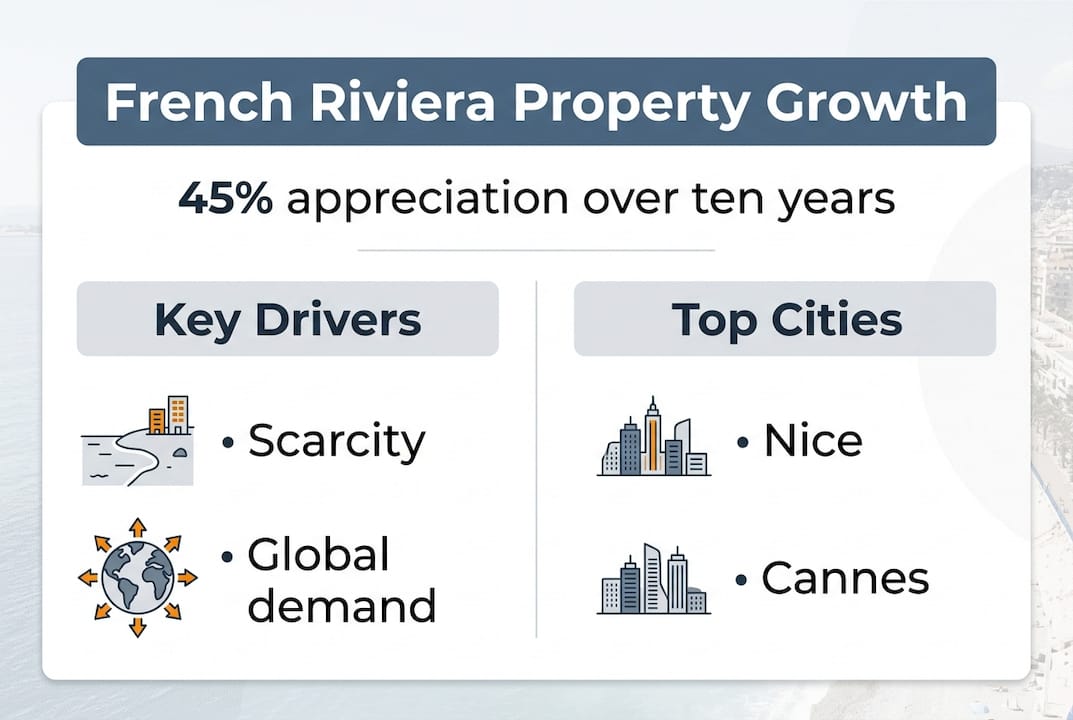
- Key drivers of property appreciation in the French Riviera
- Market trends and appreciation statistics: 2026 snapshot
- Strategic insights: How to harness property appreciation
- Why property appreciation is different on the French Riviera
- Unlock exclusive investment opportunities on the French Riviera
- Frequently asked questions
Key Takeaways
| Point | Details |
|---|---|
| Consistent market resilience | French Riviera property prices have never shown a decline, offering unique security for investors. |
| Scarcity drives value | Limited supply and high demand from global buyers consistently elevate property values. |
| Strong appreciation in prime areas | Cities like Nice experienced a 45% price increase over ten years, making them top investment targets. |
| Actionable strategies matter | Knowledge of market trends, timing, and local expertise is key to harnessing appreciation potential. |
Defining property appreciation and its significance
Property appreciation is, at its most precise, the increase in a property’s market value over time. Simple enough. Yet the implications for long-term wealth, legacy planning, and return on investment are anything but simple, particularly when you are operating in a market as singular as the Côte d’Azur.
For discerning investors, appreciation is not merely a pleasant bonus. It is the mechanism by which stone becomes legacy. A villa in Cap d’Antibes purchased today is not simply a home beside a salt-kissed coastline; it is a store of value that compounds quietly, year after year, while the Mediterranean sun continues its eternal work. Understanding market value in Riviera properties means grasping why scarcity is the single most powerful force in this equation.
The French Riviera possesses a finite and irreplaceable supply of prime real estate. There are only so many beachfront parcels in Saint-Tropez, only so many Belle Époque façades in Nice, only so many perched villages above Èze where Nietzsche once walked in contemplative solitude. This scarcity, combined with relentless international demand, creates a market that behaves differently from virtually every other prime location on earth.
Consider the key factors that sustain Riviera appreciation:
- Irreplaceable geography: Coastline, mountains, and protected landscapes limit new supply permanently
- Global tourism magnetism: Cannes Film Festival, Monaco Grand Prix, and Nice Carnival draw elite visitors who often become buyers
- High-net-worth buyer dominance: Buyers from Europe, the Middle East, Asia, and the Americas maintain consistent demand
- Regulatory protections: Strict French planning laws restrict overdevelopment, preserving existing asset values
- Currency diversification appeal: Euro-denominated assets attract global capital seeking stability
The numbers confirm what instinct already suggests. Nice saw a +45% increase over a single decade, a figure that silences sceptics and rewards the patient. Understanding the key features for investors who target this region means recognising that appreciation here is structural, not cyclical.
Pro Tip: Always track multi-year appreciation data rather than reacting to single-year fluctuations. A three to five year view reveals the true trajectory of Riviera property values and protects you from making decisions based on seasonal noise.
Key drivers of property appreciation in the French Riviera
Understanding appreciation’s importance sets the stage for examining the powerful forces behind value growth. The Riviera does not appreciate by accident. Several distinct, reinforcing drivers explain why this market consistently outperforms global benchmarks.
Scarcity as the master driver. The Alpes-Maritimes département is geographically constrained in ways that no policy or financial instrument can change. Mountains meet sea with extraordinary abruptness, leaving precious little buildable land. Scarcity and HNWI demand keep prices stable even when broader French or European markets soften. This is not a theory; it is the lived experience of every market cycle the region has endured.
International demand and lifestyle prestige. The Riviera’s market resiliency factors are inseparable from its cultural cachet. Buyers do not simply purchase properties here; they acquire membership in one of the world’s most coveted lifestyle communities. From Pampelonne’s paddleboards to the Croisette’s yacht-gazing promenades, the experiential value embedded in ownership is immeasurable.
The table below compares the French Riviera’s long-term appreciation profile against other prime global markets:
| Market | 10-year appreciation (approx.) | Price resilience during downturns |
|---|---|---|
| French Riviera (Nice) | +45% | No historical decline |
| London prime | +18% | Moderate declines recorded |
| Paris prime | +32% | Minor corrections noted |
| Dubai luxury | +28% | High volatility observed |
| Monaco | +55%+ | Exceptional resilience |
Economic stability and investor confidence further underpin growth. France’s legal framework, transparent notarial system, and EU membership provide the institutional assurance that serious capital requires. Explore the investment benefits of this regulatory environment in detail to understand why institutional investors increasingly view the Riviera as a safe harbour.

Cities driving the strongest appreciation include Nice, with its Baie des Anges panoramas and Cours Saleya vitality; Cannes, where Lérins Abbey kayaks and film-world glamour coexist; and Saint-Tropez, where the Vieux Port’s fisherman lore meets contemporary opulence. Each city carries its own appreciation narrative, explored through our annual growth guide.
Studying long-term price trends across the region confirms that the most consistent performers share three traits: a prestigious address, genuine scarcity, and strong international buyer interest.
Market trends and appreciation statistics: 2026 snapshot
With drivers in mind, let us look at the latest numbers and how they play out for real investors.
The Q1 2026 data from the Chambre des Notaires des Alpes-Maritimes paints a clear picture. Q1 2026 apartment sales up 1.6% YoY, with an average price of €227,800 for a 52m² apartment. This figure represents the broader market; prime luxury properties command considerably more, with sea-view villas routinely transacting above €2 million.
“We are the département where prices have never declined.” Chambre des Notaires des Alpes-Maritimes, 2026
The statistical story becomes even more compelling when viewed over a full decade. Nice alone recorded a 45% increase across ten years, a figure that any seasoned investor will recognise as extraordinary for a mature, established market. Read our apartment investment insights to understand how these averages translate into specific property categories.
| Metric | 2026 figure |
|---|---|
| Q1 apartment sales change (YoY) | +1.6% |
| Average apartment price (52m²) | €227,800 |
| Nice 10-year appreciation | +45% |
| Historical price declines recorded | None |
Understanding property valuation impact requires looking beyond headline averages. The spread between a well-located, well-maintained Cannes apartment and a comparable property in a less prestigious arrondissement can be vast, and that gap tends to widen over time.
For context, consider Sainte-Maxime, where Nartelle beach sunsets and golf-green escapes draw buyers seeking a quieter alternative to Saint-Tropez, yet values have tracked upward in alignment with the wider Riviera trend. Menton, fragrant with lemons and draped in Italian-influenced elegance, has also attracted buyers pursuing both lifestyle and regional investment trends with an eye for relative value.
Pro Tip: Focus your search on regions with a proven and uninterrupted appreciation record. Chasing emerging micro-markets can offer upside, but the Riviera’s most prestigious addresses provide a combination of growth and capital preservation that few locations in the world can rival.
Strategic insights: How to harness property appreciation
After seeing the statistics, learn how investors can maximise gains and minimise risks through actionable strategies.
The Riviera’s resilience does not mean passive ownership guarantees optimum returns. The most sophisticated investors treat this market with the same rigour they apply to any significant asset class. Here is how the best approach it:
- Anticipate appreciation trends using local data. Do not rely on national French property indices. The Alpes-Maritimes market moves to its own rhythm. Track notarial data, study micro-market performance by postcode, and monitor lasting value investing patterns by property type.
- Time your entry with discipline. The Riviera rarely offers deep discounts, but periods of broader European market anxiety can briefly suppress transaction volumes and create negotiation leverage for cash buyers. Be ready to act when others hesitate.
- Manage currency and regulatory risk proactively. Non-Eurozone investors face currency fluctuation risk. Hedging strategies and phased acquisitions can protect your position. Stay current with tax guidance specific to foreign ownership, as French tax structures reward long-term holding.
- Diversify across property types. A portfolio that combines a sea-view apartment in Nice with a Provençal mas near Antibes and an off-plan unit in Sainte-Maxime captures different appreciation cycles and tenant profiles. Seasonal rental yields of 3 to 5% provide income while values grow.
- Monitor interest rate trajectories. Easing European Central Bank rates in 2026 are improving financing conditions for leveraged buyers, as property investor rate dynamics directly affect both acquisition costs and competitive dynamics in the prime segment.
The fact that HNWI and international demand make the French Riviera market resilient is not a passive observation. It is a strategic signal: when global uncertainty rises, Riviera property demand from the world’s wealthiest individuals actually intensifies, as capital seeks safe, appreciating, and beautiful stores of value.
Pro Tip: Working with agents who have genuine off-market access is the single most powerful advantage available to Riviera buyers. The best properties rarely appear on public portals; they change hands quietly, between trusted networks, at prices that still reflect long-term value.
Why property appreciation is different on the French Riviera
Most global real estate strategies are built on a flawed assumption: that all prime markets behave similarly during downturns. They do not. We have watched investors apply London or New York frameworks to the Riviera and misread the market entirely, waiting for corrections that simply never arrive.
The Riviera market resilience is not a marketing claim. It is a documented, notarially verified reality. The region has never experienced price declines, unlike virtually every other prime market on the planet. That is not luck. It is the inevitable outcome when you combine finite geography, aspirational global demand, and the lifestyle currency of the world’s most coveted address.
Conventional wisdom tells investors to diversify away from any single market. We would argue the opposite for the Riviera: a meaningful, concentrated position in the right property here, held patiently across a decade, outperforms almost any other strategy available to a high-net-worth individual. The sea does not move. The light does not change. And the desire to live beautifully on these shores only deepens with time.
Unlock exclusive investment opportunities on the French Riviera
If the appreciation story of the Côte d’Azur has resonated with you, the next step is access. We curate the finest off-market luxury property opportunities on the Riviera, from cliff-top Cap d’Antibes villas to Menton’s lemon-blossom-scented townhouses, most of which never reach the open market. Our investment options Côte d’Azur portfolio spans every price point above €1.2 million, including new constructions with ten-year warranties and VEFA protections. We also accept cryptocurrency payments, making acquisition seamless for digital wealth holders. Explore the full landscape of legacy and ROI possibilities and connect with our team of Riviera specialists today.
Frequently asked questions
What makes property appreciation so reliable on the French Riviera?
A constant shortage of prime real estate combined with sustained HNWI demand ensures prices remain stable and continue rising even when broader markets falter. No other prime European market can claim a comparable, unbroken track record.
Which cities on the Riviera show the highest appreciation?
Nice, Cannes, and Saint-Tropez lead long-term performance, with Nice recording +45% over a decade, while Monaco-adjacent addresses command the region’s most exceptional premiums.
Is property appreciation guaranteed for all types of French Riviera properties?
Prime villas and apartments in prestigious locations consistently deliver the strongest appreciation, as scarcity of prime properties is the core driver; peripheral or less distinguished addresses may not replicate the same performance.
How do international buyers impact appreciation trends?
International demand intensifies competition for a finite pool of desirable properties, and international buyers drive sustained price growth particularly within the luxury segment, where supply constraints are most acute.
Recommended
 //
//