
TL;DR:
- Managing a property portfolio requires coordinated governance, unified data, and disciplined diversification. It enables early detection of risks, cost leaks, and opportunities for optimal capital allocation across assets. Effective oversight ensures long-term wealth preservation and strategic decision-making.
Property portfolio management is the coordinated, strategic oversight of multiple real estate assets designed to optimise financial performance and manage risk at the portfolio level. Unlike managing a single property, it requires consolidated governance, unified performance measurement, and disciplined capital allocation across every asset you hold. The distinction matters enormously. Investors who treat each property as an isolated unit consistently miss cost leakages, correlation risks, and rebalancing opportunities that only become visible when you view the portfolio as one system. At Livingonthecotedazur, we work with high-net-worth investors who understand that prestige properties on the Côte d’Azur are not just beautiful acquisitions. They are positions within a curated portfolio that must perform.
Why treating your real estate portfolio as a unified system maximises returns
The single most powerful shift in real estate investment management is moving from fragmented asset tracking to a coordinated portfolio view. When each property is managed in isolation, you lose the ability to see how assets interact, where capital is being wasted, and which leases are quietly eroding your net operating income.
Cost leakage from underused space and misaligned leases is the primary barrier to portfolio optimisation. This kind of loss is invisible in decentralised systems and only surfaces when you consolidate your data into a single dashboard. A villa in Cap Ferrat and a commercial unit in Cannes may each look profitable in isolation, yet together they may share a correlated risk exposure that a unified view would immediately flag.
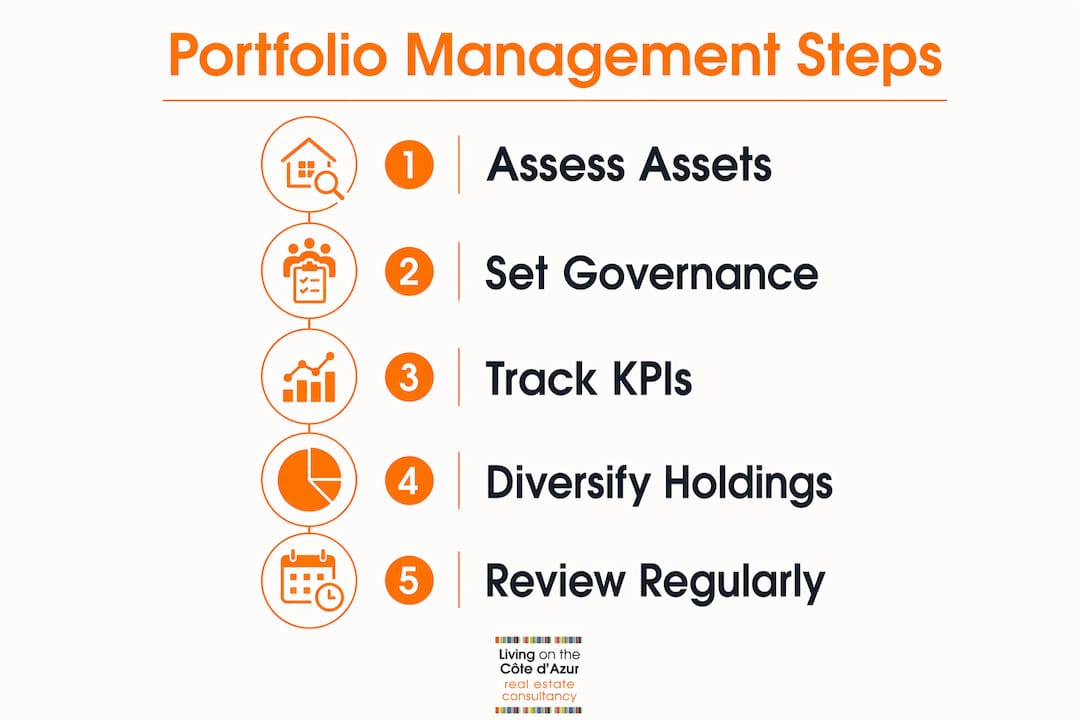
Best practice measures portfolio-wide KPIs including occupancy rates, net operating income (NOI), and capital expenditure across every asset simultaneously. These three metrics form the backbone of any serious real estate portfolio analysis. Occupancy tells you demand health, NOI tells you operational efficiency, and capital spend tells you where your cash is actually going.
The practical benefits of a unified system include:
- Consolidated reporting: One dashboard replaces multiple spreadsheets, reducing the time your team spends gathering data rather than acting on it.
- Capital allocation clarity: You can see which assets are consuming disproportionate capital relative to their returns and rebalance accordingly.
- Lease management oversight: Expiry dates, rent review clauses, and break options across all properties become visible at once, preventing costly surprises.
- Operational benchmarking: You can compare performance across assets by type, location, and tenant profile to identify genuine outliers.
- Risk concentration detection: Correlated exposures across geographies or tenant sectors become apparent only when assets are viewed together.
Pro Tip: Set a quarterly portfolio review date and treat it with the same discipline as a board meeting. Review consolidated KPIs, flag any asset deviating more than 10% from its target NOI, and document the decision made. This single habit prevents strategy drift more reliably than any software.
Cross-functional collaboration enabled by shared portfolio views accelerates decision-making and cost control across dispersed assets. When your legal, financial, and property management teams all work from the same data, decisions that once took weeks compress into days.
How to implement effective governance frameworks in property portfolio management
Governance is the operating system of your portfolio. Without explicit rules for capital allocation, risk tolerance, and rebalancing, every decision becomes reactive and emotional. Effective portfolio governance defines decision authority, risk monitoring protocols, and rebalancing rules to prevent strategy drift across market cycles. This is the single most underrated element of property asset management.

The difference between property management and portfolio governance is fundamental. Property management handles daily operations: maintenance, tenant relations, rent collection. Portfolio governance handles strategic decisions: which assets to hold, which to exit, how to allocate the next tranche of capital. Conflating the two is one of the most common and costly mistakes sophisticated investors make.
A practical governance framework follows these steps:
- Define your investment mandate. Write down your target return, acceptable risk level, geographic focus, and asset class mix. This document becomes the reference point for every future decision.
- Assign decision rights explicitly. Clarify who can approve capital expenditure above a set threshold, who can authorise a new acquisition, and who can trigger an asset disposal. Ambiguity here creates paralysis.
- Set rebalancing rules. Decide in advance what triggers a portfolio review. A 15% deviation from target allocation, a sustained drop in occupancy below a defined threshold, or a change in interest rate environment are all valid triggers.
- Build a risk register. Map every asset’s exposure to tenant concentration, lease expiry risk, capital intensity, and geographic economic factors. Review it at every quarterly meeting.
- Establish an exception management process. When market conditions create an opportunity outside your mandate, define the process for evaluating and approving exceptions. This prevents both missed opportunities and undisciplined acquisitions.
Pro Tip: Treat your investment mandate as a living document, not a founding charter. Review it annually and update it when your financial position, tax situation, or market outlook changes materially. A mandate written in 2022 may be dangerously misaligned with conditions in 2026.
Distinguishing between property management and portfolio management avoids fragmented data and poor long-term decisions. The governance layer sits above daily operations and must remain insulated from short-term operational noise. When a difficult tenant or a leaking roof dominates your strategic thinking, governance has broken down.
Successful management treats properties as policy allocations linked to portfolio objectives rather than isolated asset choices. This institutional mindset is what separates investors who build lasting wealth from those who accumulate properties without a coherent system.
How does technology enhance property portfolio oversight?
Modern integrated platforms have transformed what is possible in real estate portfolio analysis. The gap between investors using unified digital systems and those relying on spreadsheets is widening every year, and the financial consequences are significant.
Firms adopting integrated real estate operating systems can achieve 50% productivity gains and reduce software costs by 65%, managing combined assets exceeding £500 billion. That productivity gain is not abstract. It translates directly into faster decisions, fewer errors, and lower administrative overhead across your entire portfolio.
The most advanced platforms now use AI to generate leasing intelligence at scale. Modern platforms leverage over 57 billion square feet of leasing data and map more than 544,000 tenant entities to power AI-driven portfolio insights. That depth of data enables pattern recognition that no human analyst could replicate manually. For investors in commercial real estate portfolio management, this means identifying tenant demand signals before they appear in headline market reports.
The practical technology benefits worth prioritising are:
- Unified data sources: A single platform that pulls together lease data, financial performance, maintenance costs, and market comparables eliminates the reconciliation work that consumes analyst time.
- AI-driven leasing signals: Predictive tools flag which tenants are likely to renew, expand, or vacate, giving you time to act rather than react.
- Automated reporting: Dashboards that update in real time replace monthly manual reports and reduce the risk of decisions made on stale data.
- Scenario modelling: Integrated platforms allow you to model the impact of interest rate changes, vacancy increases, or capital expenditure decisions across the full portfolio before committing.
| Technology capability | Portfolio benefit |
|---|---|
| Unified data dashboard | Eliminates fragmented reporting and reveals cost leakages |
| AI tenant entity mapping | Predicts lease renewals and vacancy risk in advance |
| Automated KPI tracking | Monitors occupancy, NOI, and capital spend in real time |
| Scenario modelling tools | Tests capital allocation decisions before execution |
| Cross-team shared access | Aligns legal, financial, and operational teams on one view |
Fragmented data creates operational friction, and teams spending more time gathering than analysing data indicate poor governance structures. Technology does not replace governance. It makes governance executable at scale. For investors managing real estate portfolio analysis across multiple geographies, a unified platform is no longer optional. It is the foundation.
For those tracking key metrics across real estate portfolios, the shift to integrated systems consistently reveals inefficiencies that were previously invisible in siloed reporting structures.
Practical strategies for optimising portfolio diversification and risk-adjusted returns
True diversification in real estate investment management is far more nuanced than owning properties in different cities or across different asset classes. Investors who believe a mix of residential, commercial, and hospitality assets provides genuine protection are often surprised when a single economic shock hits all three simultaneously.
Diversification must consider tenant industries, lease expiry profiles, and economic exposure rather than just property type or location for true risk reduction. A portfolio of office buildings in three different cities may appear diversified. If all three cities depend on the same industry for employment, the portfolio carries concentrated economic risk regardless of geography.
The most resilient portfolios are built around economic driver diversification. Consider these dimensions when assessing your current exposure:
- Tenant industry spread: Do your tenants operate in sectors with different economic cycles? Technology, healthcare, logistics, and hospitality respond differently to recessions and interest rate changes.
- Lease expiry staggering: A portfolio where 60% of leases expire in the same year faces a cliff-edge risk. Staggering expiry dates across a 5–7 year window smooths income volatility significantly.
- Capital intensity balance: High-maintenance assets consume disproportionate capital during downturns. Balancing low-maintenance, long-lease assets against higher-yield, higher-maintenance ones protects cash flow when credit tightens.
- Geographic economic factors: Look beyond postcode. Understand the primary economic drivers of each location. A coastal resort town and a financial district may both be in France, yet their income streams respond to entirely different forces.
- Currency and cross-border exposure: For investors holding assets across multiple countries, currency movements can materially affect consolidated returns even when individual assets perform well.
Institutional investors blend sector views with rigid long-term policy constraints rather than relying solely on raw return forecasts to survive market cycles. This is the discipline that separates institutional-grade portfolio management from opportunistic acquisition. Raw return forecasts are seductive but unreliable. Policy constraints, by contrast, force you to hold positions through short-term volatility rather than selling at the worst moment.
Risk-adjusted performance metrics, particularly the Sharpe ratio adapted for illiquid assets, allow you to compare the return per unit of risk across your holdings. An asset generating a 6% yield with low volatility and long lease security may be more valuable to your portfolio than one generating 9% with high tenant turnover and capital expenditure demands. For investors building legacy-grade portfolios across prestigious locations, this kind of disciplined analysis is what separates wealth preservation from wealth erosion.
Key takeaways
Effective property portfolio management requires governance, unified data, and disciplined diversification working together as one system, not three separate activities.
| Point | Details |
|---|---|
| Governance is the foundation | Define decision rights, rebalancing rules, and risk tolerance before acquiring assets. |
| Unified data reveals hidden losses | Cost leakage and inefficiencies only surface when all assets report into one consolidated system. |
| Technology multiplies governance | Integrated platforms with AI analytics reduce friction and accelerate portfolio decisions. |
| Diversify by economic driver | Spread exposure across tenant industries and lease profiles, not just asset types or locations. |
| Blend forecasts with policy constraints | Institutional-grade portfolios survive market cycles by following rules, not chasing returns. |
What I have learned from watching portfolios succeed and fail
I have spent years working alongside investors who hold extraordinary properties in some of the world’s most prestigious locations. The ones who build lasting wealth share one trait that has nothing to do with which properties they buy. They treat their portfolio as a governed system, not a collection of individual bets.
The investors who struggle almost always share the opposite trait. They make acquisition decisions based on individual property appeal, then manage each asset in isolation. They have no consolidated view of their NOI, no rebalancing rules, and no process for flagging when a single asset is consuming a disproportionate share of their capital and attention. By the time the problem is visible, it has already cost them.
What surprises most investors when they first see a properly governed portfolio is how much of the value comes from what you do not do. You do not sell during a correction because your policy constraints prevent it. You do not over-allocate to a single sector because your mandate caps it. You do not ignore a deteriorating asset because your quarterly review flags it automatically. Discipline, not brilliance, is the differentiator.
The technology question is real but secondary. I have seen investors with sophisticated platforms make poor decisions because their governance was weak. I have also seen investors with basic tools outperform because their decision framework was clear and consistently applied. Technology amplifies governance. It does not replace it.
My honest advice to any investor managing more than two or three properties is this: write your investment mandate before your next acquisition. Define what you are building, what you will not hold, and what triggers a sale. That document will protect you from more mistakes than any platform or adviser ever could. The Côte d’Azur rewards investors who think in decades, not quarters. So does every other prestige market we work in.
— Ab Kuijer
How Livingonthecotedazur supports your portfolio ambitions
At Livingonthecotedazur, we work with high-net-worth investors who understand that a curated portfolio of luxury properties demands more than beautiful acquisitions. It demands a framework. Our team brings together legal audits, tax structuring, financing guidance, and deep local knowledge across Saint-Tropez, Monaco, and the wider Côte d’Azur to help you build positions that perform as well as they look. Whether you are adding your first Riviera asset or rebalancing an established portfolio, we provide the kind of personalised, transparent guidance that turns prestige real estate into enduring wealth. Explore our off-market Côte d’Azur properties or learn how we approach legacy and yield structuring for investors who think in generations.
FAQ
What is property portfolio management?
Property portfolio management is the strategic governance and coordinated oversight of multiple real estate assets to optimise returns and manage risk at the portfolio level. It differs from individual property management by focusing on consolidated performance, capital allocation, and long-term investment strategy rather than daily operations.
What KPIs should I track across my property portfolio?
The three core KPIs are occupancy rate, net operating income, and capital expenditure. Tracking these across all assets simultaneously reveals performance gaps and cost leakages that individual property reports consistently miss.
How does governance prevent strategy drift in real estate portfolios?
Governance prevents strategy drift by establishing explicit rules for capital allocation, rebalancing triggers, and risk tolerance before market conditions change. Without these rules, decisions become reactive and emotionally driven during market cycles.
How should I diversify a luxury real estate portfolio?
Diversify by tenant industry, lease expiry profile, capital intensity, and geographic economic drivers rather than simply by asset type or location. Portfolios that appear diversified by property class often carry hidden correlations tied to a single economic sector or employment base.
What role does technology play in managing a property portfolio?
Integrated platforms consolidate data from all assets into a single dashboard, enabling real-time KPI tracking, AI-driven leasing insights, and scenario modelling. Firms using integrated systems report significant productivity gains and reduced software costs compared to fragmented, multi-tool approaches.
Recommended
 //
//