
TL;DR:
- Real estate commissions are percentage-based fees paid to agents, usually between 5% and 6% of the final sale price, split between listing and buyer’s agents.
- Since 2024, buyer-agent compensation is negotiated separately, with sellers often covering both parties’ fees through concessions.
A real estate commission is the fee paid to property agents, calculated as a percentage of the final sale price, representing their compensation for facilitating a transaction from listing to closing. For anyone exploring a property purchase or sale, understanding real estate fees is not optional. It is the difference between a transaction that feels transparent and one that delivers unwelcome surprises at the notary’s table. Total commissions typically range from 5% to 6% of the home sale price, meaning a €400,000 property carries roughly €20,000 to €24,000 in agent fees alone. The 2024 National Association of Realtors settlement then shifted how buyer-agent compensation is disclosed and negotiated, making this knowledge more pressing than ever for buyers and sellers alike.
How are real estate commissions calculated?
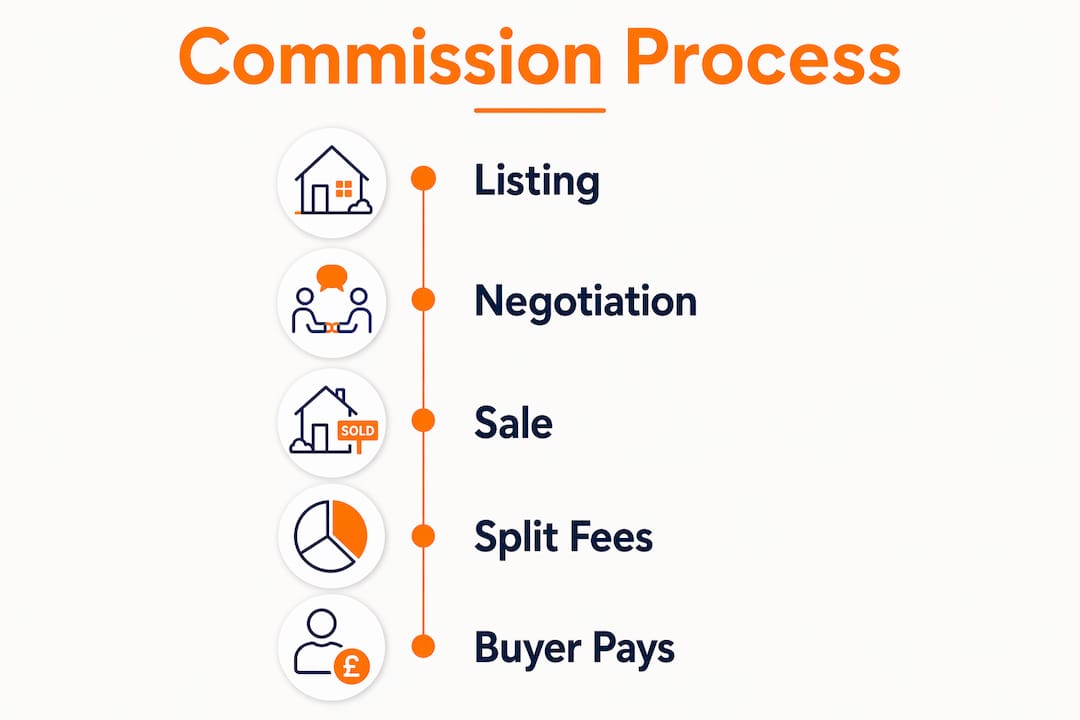
Real estate agent commission rates are applied as a straightforward percentage of the property’s final agreed sale price, not its asking price. Commission is a negotiated percentage of the sale price, split between the listing agent, the buyer’s agent, and their respective brokerages. On a €500,000 sale at 5%, the total commission is €25,000, commonly divided equally between both sides.

What most buyers and sellers do not realise is that the money does not flow directly to the agent. At closing, commission flows first to brokerages, which then pay agents according to internal split agreements. Typical listing-side brokerage splits approximate 2.75% to 3.0%, with buyer-side splits at 2.5% to 3.0%. An agent on a 60/40 brokerage split retains only 60% of their side’s commission, meaning the same sale price can produce very different take-home figures depending on the firm.
This structure matters to you as a client because it explains agent motivation. Commissions incentivise closing sales rather than rewarding hours worked or time spent on listings. An agent who cannot close earns nothing, which aligns their interest with yours in completing the transaction at the best possible price.
| Commission rate | Sale price | Total commission | Each agent’s side |
|---|---|---|---|
| 5% | €400,000 | €20,000 | €10,000 |
| 5.5% | €500,000 | €27,500 | €13,750 |
| 6% | €750,000 | €45,000 | €22,500 |
| 5% | €1,500,000 | €75,000 | €37,500 |
Rates vary by region, property type, and the leverage each party holds in the negotiation. Luxury markets on the Côte d’Azur, where villas in Cap d’Antibes or Cannes command prices well above €2 million, often see commissions structured differently from standard residential markets, with flat fees or tiered percentages applied above certain price thresholds.
Pro Tip: Always ask your agent to confirm the total commission percentage in writing before signing any listing or buyer-broker agreement. Verbal assurances carry no legal weight at the closing table.
Who pays the real estate commission after 2024?
The 2024 National Association of Realtors settlement fundamentally changed how buyer-agent compensation is handled. Before August 2024, sellers routinely paid both their own agent and the buyer’s agent through a single commission disclosed on the MLS listing. That automatic arrangement no longer exists. Buyers must now sign written buyer-broker agreements before property showings, and buyer-agent compensation is negotiated off the MLS rather than advertised as a standard figure.
Three distinct payment models now operate in the market:
- Seller-paid commission: The seller covers both agents’ fees through the sale proceeds, often structured as a concession within the purchase contract. This remains the most common arrangement in practice.
- Buyer-paid commission: The buyer pays their agent directly, either as a flat fee or percentage, separate from the property price. This model is growing but still uncommon in most markets.
- Negotiated shared cost: Both parties contribute to agent fees, with the split agreed during offer negotiations. This approach suits transactions where the seller’s net proceeds and the buyer’s cash position both require careful management.
The party responsible for buyer-agent commission shifted from seller to buyer in principle after 2024, yet seller-paid commissions remain dominant through concessions and negotiated terms. The practical reality is that mortgage financing mechanics sustain the traditional model. Most buyers finance their purchase and cannot easily add agent fees to a mortgage, so sellers absorb the cost within the sale price structure.
The 2024 settlement increased documentation requirements across every stage of a transaction. Buyer-broker agreements, broker-to-broker agreements, purchase contracts, and closing statements all now require consistent commission disclosures. For buyers and sellers on the French Riviera, where transactions frequently involve international parties and cross-border financing, this transparency is genuinely welcome.
Pro Tip: If you are buying property in France, confirm whether your agent’s fee is included within the advertised price (frais d’agence inclus) or added on top (frais d’agence en sus). The distinction can represent tens of thousands of euros on a luxury acquisition.
Traditional vs alternative commission structures: what are the differences?
Standard percentage commissions are not the only option available to buyers and sellers. Understanding the full spectrum of commission structures in real estate helps you select the arrangement that suits your transaction.
Traditional percentage commission remains the dominant model globally. It rewards agents for achieving the highest possible sale price, since their fee rises proportionally. For a seller of a €3 million villa in Saint-Jean-Cap-Ferrat, a 5% commission represents €150,000 in fees. That figure concentrates the mind and makes negotiation worthwhile.
Discount brokers and flat-fee agents offer reduced services at lower cost. A flat-fee listing agent might charge €3,000 to place a property on the market, leaving the seller to handle viewings, negotiations, and legal coordination independently. The saving is real, but so is the additional burden. In a luxury market where discretion, presentation, and network access determine outcomes, reduced-service models carry genuine risk.
For-sale-by-owner (FSBO) transactions eliminate agent fees entirely but require the seller to manage every aspect of the sale. Research consistently shows that FSBO properties sell for less than agent-represented ones, often by a margin that exceeds the commission saved. On a Côte d’Azur property, where international buyers require multilingual negotiation and legal due diligence across multiple jurisdictions, FSBO is rarely the prudent choice.
Hybrid models combine a reduced listing fee with a full buyer-agent commission, preserving buyer-side representation while reducing seller costs. These arrangements suit mid-market transactions where competition is strong and the property sells quickly without extensive agent effort.
For luxury Riviera property buyers, the calculus is different. The complexity of acquiring a prestige asset in Mougins, Èze, or Roquebrune-Cap-Martin, where provenance, planning permissions, and rental yield projections all require specialist knowledge, makes full-service representation worth every centime of the commission.
Practical tips for negotiating real estate commissions
Negotiating real estate commissions is entirely legitimate and more common than most clients realise. Despite settlement changes, many sellers still pay around 5% to 6%, but market conditions, property value, and agent competition all create room for discussion. Here is how to approach it with confidence.
- Raise the conversation early. Commission rates should be discussed at your first meeting with an agent, not after you have fallen in love with a property or accepted an offer. Early discussion sets the tone for a transparent relationship.
- Understand what the fee covers. A full-service agent provides marketing, professional photography, international listing exposure, legal coordination, and negotiation expertise. Before asking for a reduction, confirm precisely which services are included and which are not.
- Use market context as leverage. In a seller’s market where properties move quickly, agents face less work per transaction. In a slower market, their effort and risk increase. Adjust your negotiation accordingly.
- Request itemised disclosure. Ask for a written breakdown of how the commission is split between listing agent, buyer’s agent, and their respective brokerages. Buyer-agent compensation must now be addressed in the written brokerage agreement before any property showings, so there is no reason for ambiguity.
- Consider the total transaction cost. On the Côte d’Azur, notary fees, transfer taxes, and legal costs add 7% to 10% to the purchase price for resale properties. Commission is one line in a broader cost structure. Optimising the whole picture matters more than winning a single negotiation.
Pro Tip: For expert negotiation strategies on luxury property acquisitions, engage a buyer’s agent whose fee is clearly defined before you begin viewing. Their knowledge of local pricing and off-market inventory often saves far more than their cost.
Key takeaways
Real estate commissions are negotiated percentage fees, typically 5% to 6% of the final sale price, split between agents and brokerages, with payment responsibility now formally negotiated rather than automatically assumed by the seller.
| Point | Details |
|---|---|
| Commission calculation | Fees are a percentage of the final sale price, not the asking price, split between both agents and their brokerages. |
| Post-2024 payment rules | Buyers must sign written broker agreements before viewings; seller-paid commissions remain common through negotiated concessions. |
| Brokerage splits matter | Agents receive only a portion of their commission side; internal brokerage splits affect agent motivation and earnings. |
| Negotiation is legitimate | Commission rates are negotiable at any price point; raise the conversation early and request written disclosure of all splits. |
| Luxury market considerations | High-value transactions on the Côte d’Azur often use tiered or flat-fee structures above certain price thresholds, making specialist advice indispensable. |
Why I think most buyers misread the commission question entirely
After years of working with discerning buyers across the French Riviera, from the lemon-scented promenades of Menton to the yacht-dotted marinas of Antibes, the single most consistent misunderstanding I encounter is this: clients assume the commission question is about cost. It is not. It is about alignment.
When a buyer’s agent is paid a percentage of the purchase price, their incentive is to close the transaction, not necessarily to negotiate the lowest price on your behalf. The 2024 regulatory changes, by forcing explicit written agreements before showings, have made this tension visible in a way it never was before. That visibility is a gift. Use it. Ask your agent directly how their fee is structured and what their incentive is when you push for a lower offer.
In the luxury segment specifically, where a Cap d’Antibes villa or a Saint-Paul-de-Vence estate represents a generational acquisition rather than a simple property purchase, the commission conversation is inseparable from the service conversation. We have seen clients save on commission and lose on price, on legal due diligence, on rental yield projections. The numbers rarely lie in their favour. What I tell every client is this: understand the fee structure completely, negotiate where the market allows, and then invest in the representation that protects the asset you are building for your family’s future.
— ab
Discover prestige properties with full fee transparency
At Livingonthecotedazur, we believe that every client deserves complete clarity on fees before a single viewing is arranged. Our team specialises in luxury Riviera transactions where commission structures, notary fees, and acquisition costs are presented transparently from the first conversation. Whether you are acquiring a sea-view villa above Cannes, an off-plan residence in Sainte-Maxime, or a discreet estate in Mougins, our off-market property portfolio offers access to acquisitions where fees are negotiated with your legacy in mind. Contact us to begin a conversation about your next prestige acquisition on the Côte d’Azur.
FAQ
What is a typical real estate commission rate in 2026?
Total commissions typically range from 5% to 6% of the final sale price, split between the listing agent and the buyer’s agent and their brokerages. Rates vary by region, property value, and negotiation.
Who pays the buyer’s agent commission after the 2024 NAR settlement?
Buyer-agent compensation is now formally negotiated rather than automatically paid by the seller. Sellers still commonly cover buyer-agent fees through concessions, but buyers may also pay their agent directly under a written agreement.
Can you negotiate a real estate commission?
Yes. Commissions are negotiable and based on closing performance rather than hours worked. Raise the discussion at your first agent meeting and request written confirmation of all splits before signing any agreement.
What is a listing commission?
A listing commission is the fee paid to the seller’s agent, typically representing half of the total commission. It covers marketing, viewings, negotiation, and legal coordination from listing to closing.
How are commissions structured differently in luxury real estate?
In high-value markets such as the Côte d’Azur, commissions on properties above €2 million are often tiered or capped as a flat fee rather than a straight percentage. Specialist buyer agents in luxury real estate provide fee structures aligned with the complexity and discretion these transactions demand.
Recommended
 //
//