
While Monaco and Dubai dominate headlines, Portugal quietly commands a 12% year-on-year surge in luxury property transactions, outpacing traditional havens. For high-net-worth investors seeking legacy assets that blend appreciation with seasonal rental yields, this Atlantic gem offers political stability, residency pathways, and a lifestyle that transforms stone into heirloom. You’ll discover how Portugal’s legal framework, tax incentives, and coastal allure create a fortress for generational wealth while delivering tangible returns in an era of market volatility.
Table of Contents
- Key takeaways
- Portugal’s stable luxury real estate market and growth potential
- Residency benefits and financial incentives for investors in Portugal
- Seasonal rental income potential and lifestyle appeal
- Mitigating risks and ensuring a secure legacy investment in Portugal
- Discover premium real estate opportunities tailored for you
- Frequently asked questions
Key Takeaways
| Point | Details |
|---|---|
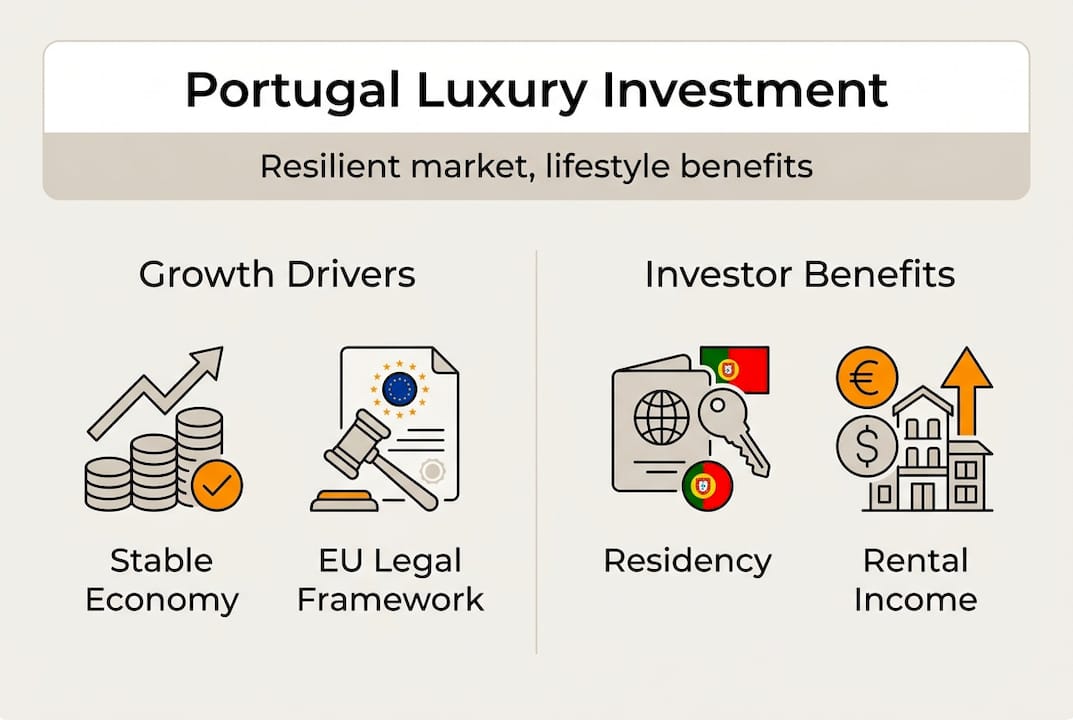
| Market resilience and growth | Portugal’s luxury property market has shown strong growth and resilience, underpinned by a diversified economy and coastal demand that sustains value. |
| Residency and tax incentives | The Golden Visa and Non-Habitual Resident regimes offer pathways to residence and favourable tax treatment, enhancing after tax returns for long term investors. |
| Rental income and appreciation | Coastal areas deliver seasonal rental income alongside steady capital appreciation, with occupancy staying high in premium belts like the Algarve. |
| Strategic location and infrastructure | Strategic location near international airports and planned transport upgrades are expected to boost coastal suburb values. |
Portugal’s stable luxury real estate market and growth potential
Portugal’s luxury property market has shown strong growth and resilience, attracting global investors who recognise its divergence from speculative bubbles. Unlike markets tethered to single industries, Portugal’s economy blends tourism, technology hubs, and renewable energy, insulating real estate from sector-specific shocks. Lisbon’s Avenida da Liberdade penthouses now command €8,000 per square metre, whilst Porto’s Foz do Douro villas appreciate 9% annually, driven by remote-working executives and retirees seeking Atlantic sunsets over Alpine chill.
Historical data reveals Portugal weathered the 2008 crisis with a 15% dip, recovering within four years compared to Spain’s decade-long stagnation. The Algarve’s golden triangle, Quinta do Lago to Vale do Lobo, maintained occupancy rates above 75% even during pandemic lockdowns, proving its appeal to European elites seeking private estates over crowded Riviera marinas. This resilience stems from supply constraints: strict coastal zoning limits new builds, ensuring scarcity premiums for existing properties.
Top appreciation regions through 2030:
| Region | 2026 avg price/sqm | Projected 5-year growth | Key drivers |
|---|---|---|---|
| Lisbon (Chiado, Príncipe Real) | €7,200 | 38% | Tech sector expansion, cruise tourism |
| Porto (Foz, Boavista) | €4,800 | 42% | UNESCO heritage, wine tourism |
| Algarve (Vilamoura, Quinta do Lago) | €5,500 | 35% | Golf resorts, year-round climate |
| Comporta coast | €6,000 | 50% | Underdeveloped luxury, eco-tourism |
Risks exist: Portugal’s ageing infrastructure in rural areas and bureaucratic delays can test patience. Yet the government’s €6 billion Recovery and Resilience Plan prioritises transport upgrades and digital connectivity, directly enhancing property values in secondary cities like Braga and Évora. For legacy investors, these are tomorrow’s Portos, offering entry points at €3,000 per square metre before gentrification premiums take hold.
Pro Tip: Target properties within 15 minutes of international airports or high-speed rail links. Lisbon’s pending metro extension to Cascais will compress travel times, likely triggering 20% appreciation in coastal suburbs by 2028.
Portugal’s property investment landscape also benefits from EU membership, ensuring legal harmonisation and dispute resolution mechanisms absent in non-bloc jurisdictions. Portuguese real estate opportunities extend beyond residential: agricultural estates in Alentejo with organic certification yield 5% annually through olive oil and wine exports, diversifying portfolios whilst retaining land value.
Residency benefits and financial incentives for investors in Portugal
Portugal’s Golden Visa programme transforms property purchases into residency permits, a rarity among EU nations tightening immigration. A €500,000 investment in urban real estate or €400,000 in low-density regions grants you and your family Schengen access, renewable every two years with minimal physical presence requirements. After five years, permanent residency or citizenship becomes available, offering a Plan B for geopolitical uncertainty whilst maintaining your primary residence elsewhere.
The non-habitual resident (NHR) tax regime slashes income tax to 10% for qualifying professions, including architects, investors, and consultants, for a decade. Foreign pension income often escapes Portuguese tax entirely under double-taxation treaties, making Cascais and Tavira magnets for British and Scandinavian retirees. Capital gains on property held over two years face just 28% tax, reduced to 14% if reinvested in Portuguese real estate within three years, a mechanism purpose-built for portfolio expansion.
Golden Visa qualifying investments beyond property:
- €500,000 in Portuguese investment funds focusing on startups or renewables
- €350,000 in scientific research or cultural heritage restoration projects
- €250,000 in arts production or national heritage rehabilitation in low-density areas
- Creation of 10 full-time jobs, appealing to entrepreneurs establishing Iberian operations
These alternatives suit investors seeking liquidity over bricks, though property remains the preferred route for tangible legacy assets. The programme’s 2026 reforms excluded Lisbon and Porto’s urban cores to redirect capital towards interior regions, yet coastal Algarve and Silver Coast properties still qualify, preserving access to prime lifestyle zones.
Pro Tip: Combine Golden Visa residency with NHR status by timing your tax residency declaration. Spend 183 days in Portugal during year one to trigger NHR benefits, then revert to minimal stays whilst maintaining visa validity, optimising tax efficiency without lifestyle disruption.
Succession planning gains elegance under Portuguese law: forced heirship rules reserve two-thirds of estates for direct descendants, but foreign nationals can elect their home country’s inheritance laws, enabling bespoke wealth transfer. Trusts, though uncommon in Portugal, are recognised for non-residents, allowing British or Swiss structures to hold Portuguese property whilst sidestepping local probate complexities.
Seasonal rental income potential and lifestyle appeal
Portugal’s prime locations deliver growing demand for seasonal rentals, offsetting ownership costs whilst preserving capital appreciation. Algarve villas command €8,000 weekly during July and August, with shoulder seasons (April to June, September to October) fetching €4,500 as golfers and hikers replace beach crowds. Lisbon apartments near Belém or Alfama generate €3,000 monthly through corporate lets and festival visitors, achieving 70% annual occupancy with professional management.

Luxury rental platforms report 40% booking increases for Portuguese properties since 2024, driven by travellers seeking alternatives to overtouristed Mediterranean islands. Your five-bedroom Comporta estate, purchased at €2.5 million, can yield €120,000 gross annually, netting 4.8% after management fees and maintenance. This income stream funds property taxes, insurance, and periodic renovations, transforming the asset into a self-sustaining legacy vehicle.
Rental yield comparison by property type:
| Property type | Purchase price range | Gross annual yield | Net yield (post-costs) | Peak season |
|---|---|---|---|---|
| Algarve beachfront villa | €1.8M-€4M | 5.5% | 4.2% | June-September |
| Lisbon city apartment | €600K-€1.2M | 6.2% | 4.8% | Year-round |
| Porto historic townhouse | €500K-€900K | 5.8% | 4.5% | May-October |
| Comporta eco-retreat | €2M-€5M | 4.8% | 3.6% | July-August, December |
Lifestyle factors amplify investment logic. Portugal ranks third globally for quality of life, balancing 300 days of sunshine with affordable private healthcare and English fluency in urban centres. Your family’s August retreats to a Tavira villa become traditions, weaving memories into the asset’s narrative whilst European guests fund the privilege during your absence. The country’s safety, Portugal holds the sixth-lowest crime rate in the EU, ensures peace of mind for absentee owners.
Cultural and recreational draws sustaining rental demand:
- Algarve’s 42 golf courses attract 1.2 million players annually, peak season March to November
- Lisbon’s Web Summit and tech conferences drive corporate bookings, €300+ nightly rates
- Douro Valley wine estates offer harvest experiences, filling September and October calendars
- Madeira’s levada trails and Porto Santo’s beaches diversify coastal appeal beyond mainland
Portugal’s time zone alignment with UK and proximity to European capitals (Lisbon to London: 2.5 hours) make it accessible for long weekends, sustaining off-peak bookings. Your property isn’t merely an investment; it’s a launchpad for Sintra’s Moorish palaces, Óbidos’ medieval ramparts, and Peniche’s surf breaks, experiences that justify premium rates and repeat bookings.
Mitigating risks and ensuring a secure legacy investment in Portugal
Portugal provides transparent legal frameworks and political stability, reducing risks common in international real estate investments. The nation’s democracy, uninterrupted since 1974, contrasts with neighbours experiencing populist upheavals. Property rights are constitutionally protected, with foreign ownership restrictions limited to border zones and military areas, irrelevant for coastal luxury markets. Title insurance, whilst optional, costs 0.5% of purchase price and eliminates concerns over historical claims or boundary disputes.
Market transparency ranks high: Portugal’s land registry (Conservatória do Registo Predial) is digitised and publicly accessible, allowing due diligence on ownership history, mortgages, and liens within 48 hours. Notaries, state-appointed and impartial, verify all transactions, preventing the fraud endemic in less-regulated jurisdictions. Agent licensing through APEMIP ensures professional standards, though savvy investors still engage independent legal counsel fluent in cross-border tax implications.
Common pitfalls and mitigation strategies:
- Underestimating renovation costs in historic properties: Commission structural surveys (€1,500-€3,000) revealing hidden issues before purchase
- Currency fluctuations eroding returns: Lock exchange rates via forward contracts when transferring funds from sterling or dollars
- Tax residency triggers: Consult specialists in dual-taxation treaties to avoid unintended liabilities in your home country
- Rental income misreporting: Use licensed property managers issuing compliant invoices, avoiding penalties from Autoridade Tributária audits
Political risk remains negligible. Portugal’s coalition governments favour foreign investment, with no serious movement to replicate Spain’s tourist restrictions or Italy’s luxury property taxes. The European Central Bank’s monetary policy directly influences Portuguese mortgage rates, currently 3.8% for non-residents, offering leverage to amplify returns if you’re comfortable with debt.
Pro Tip: Structure ownership through a Portuguese company (Sociedade Unipessoal por Quotas) if purchasing multiple properties. This simplifies accounting, enables VAT reclaims on renovations, and streamlines inheritance by transferring shares rather than individual titles, saving 0.8% stamp duty per subsequent generation.
Environmental considerations grow critical. Coastal erosion affects 15% of Algarve’s shoreline; prioritise properties 200 metres inland or atop cliffs with erosion monitoring data. Wildfire risk in interior regions demands defensible space clearance and insurance riders, though coastal zones face minimal threat. Climate projections favour Portugal: rising temperatures enhance year-round appeal whilst Southern Spain and Italy confront water scarcity, potentially redirecting future demand northward.
Legal protections extend to tenants, which can delay evictions if rental income strategies falter. Short-term rental licences (Alojamento Local) require compliance with safety codes and neighbour notifications, with Lisbon and Porto capping new licences in saturated neighbourhoods. Engage local attorneys early to navigate these evolving regulations, ensuring your legacy asset remains revenue-generating across decades.
Discover premium real estate opportunities tailored for you
Navigating Portugal’s luxury market demands insight beyond listings. Our team specialises in legacy investments, connecting discerning families with off-market estates that blend appreciation security and lifestyle resonance. We’ve guided clients to Sintra quintas with centuries-old gardens and Comporta plots where architects craft bespoke eco-villas, properties absent from public portals yet ideal for generational wealth.
Our real estate investment strategies integrate tax optimisation, residency planning, and rental yield forecasting, ensuring your Portuguese acquisition aligns with broader wealth preservation goals. Whether you’re curating high-value real estate across Iberia or seeking a single Algarve sanctuary, we provide the due diligence and local expertise that transform transactions into legacies. Contact us to explore opportunities tailored to your family’s vision, where Atlantic horizons meet strategic foresight.
Frequently asked questions
What is the minimum investment to qualify for Portugal’s Golden Visa?
The current minimum property investment is €500,000 in most regions, reduced to €400,000 in designated low-density areas like interior Alentejo or Beiras. Urban Lisbon and Porto no longer qualify under 2026 rules, redirecting capital towards coastal Algarve, Silver Coast, and rural zones. Alternative pathways include €350,000 in heritage restoration or €500,000 in investment funds, though property remains the tangible choice for legacy-focused buyers.
Which Portuguese regions offer the best luxury real estate appreciation?
Lisbon, Porto, and the Algarve lead in luxury market growth, combining infrastructure, international demand, and lifestyle appeal. Lisbon’s tech sector expansion drives 8% annual appreciation in Chiado and Santos, whilst Porto’s UNESCO status sustains 9% growth in Foz do Douro. Algarve’s golden triangle, Quinta do Lago to Vale do Lobo, benefits from golf tourism and limited coastal supply, projecting 7% gains through 2030. Emerging Comporta offers 10%+ potential as luxury developers establish eco-resorts.
How can luxury property investors generate seasonal rental income in Portugal?
Seasonal luxury rentals in coastal and urban centres enjoy strong demand from international tourists, supporting attractive rental yields. List Algarve villas on platforms specialising in high-end properties, targeting July to September peak season at €6,000 to €10,000 weekly. Lisbon apartments achieve year-round occupancy through corporate lets and festival visitors, netting 4-6% annually. Engage licensed property managers handling guest services, maintenance, and tax compliance, preserving your time whilst maximising returns.
What are the main risks of investing in Portuguese luxury real estate and how to mitigate them?
Risks include market fluctuations and legal complexities; thorough due diligence and reputable local advisors are essential for risk mitigation. Currency volatility between euros and your home currency can erode returns, mitigated via forward contracts locking exchange rates. Regulatory changes, such as rental licence caps in Lisbon, require monitoring; diversify across regions or property types. Engage independent legal counsel reviewing title history, tax implications, and inheritance laws, ensuring your legacy asset withstands bureaucratic shifts and family transitions across generations.
Recommended
 //
//