
TL;DR:
- French Riviera real estate offers territorial scarcity, stability, and high annual appreciation rates.
- Preparation with proper documentation and a trusted advisory team is essential for smooth acquisition.
- Off-market opportunities and digital assets like cryptocurrency are increasingly important in high-end transactions.
The French Riviera does not simply offer property. It offers permanence, prestige, and the rare satisfaction of owning something that outlasts market cycles. From the lemon-scented ramparts of Menton to the yacht-dotted marinas of Antibes, this coastline has long been the chosen canvas for those who build wealth with intention. Yet the acquisition process here is layered, competitive, and unforgiving of shortcuts. Whether you are channelling inherited capital into a Provençal mas near the Monaco border or acquiring a sea-view residence above Nice’s Baie des Anges, getting every step right is not optional. This guide walks you through the entire journey, with precision.
Table of Contents
- Understanding the French Riviera real estate landscape
- Essential preparation: Requirements and assembling your advisory team
- Step-by-step acquisition: From negotiation to notarial signature
- Verifying ownership and protecting your legacy
- Insider perspective: What most guides miss about luxury real estate security
- Ready to secure your Riviera legacy? Next steps with our expert team
- Frequently asked questions
Key Takeaways
| Point | Details |
|---|---|
| Prepare specialist team | Engaging expert advisers and assembling proper documentation is essential for non-resident and high-value deals. |
| Secure legacy ownership | Managing the entire process from negotiation to legal verification maximises security and long-term value. |
| Consider new payment options | Alternative payments such as crypto can be used safely with experienced notaries and volatility protection. |
| Protect with structure | Effective tax and succession structures are essential to safeguard assets for future generations. |
Understanding the French Riviera real estate landscape
The Côte d’Azur is not simply expensive. It is strategically scarce. The combination of protected coastline, strict planning regulations, and relentless international demand creates a supply constraint that consistently drives values upward. Properties here appreciate at 5 to 8% annually, a figure that places the Riviera among Europe’s most resilient luxury markets. That is not a coincidence. It is the result of geography, governance, and global desire converging in one luminous strip of the Mediterranean.
What draws legacy investors beyond the obvious glamour? The answer sits at the intersection of lifestyle and financial architecture. A Cap d’Antibes villa offers privacy that money cannot manufacture elsewhere. A Monaco-adjacent plot carries a prestige that compounds across generations. The key features of French Riviera real estate go far beyond marble finishes and infinity pools. They include jurisdictional advantages, rental yield potential of 3 to 5% through elite seasonal lets, and a cultural permanence that resonates with heirs as much as investors.
The market in 2026 reflects several converging forces:
- Sustained demand from Middle Eastern, American, and Asian buyers seeking European lifestyle anchors
- Eco-luxury premiums on villas with solar arrays, green certifications, and biophilic design
- Off-plan momentum in locations like Sainte-Maxime and Nice’s Mont Boron, where new builds command early-buyer advantages
- Digital payment adoption, with cryptocurrency increasingly used as a route into high-value transactions
| Driver | Classic motivation | 2026 motivation |
|---|---|---|
| Location | Prestige and lifestyle | Privacy, yield, and legacy |
| Property type | Belle Époque villas | Eco-villas and off-plan residences |
| Payment method | Bank transfer | Bank transfer plus crypto |
| Ownership goal | Personal use | Generational wealth transfer |
On the subject of digital assets: crypto solutions for property buyers are now a genuine route into French Riviera acquisitions, with notaries facilitating conversion to euros at a fixed rate. Volatility is hedged through careful timing, but this route requires specialist advisors who understand both the legal and financial dimensions. It is an emerging tool for diversification, not a shortcut.
Essential preparation: Requirements and assembling your advisory team
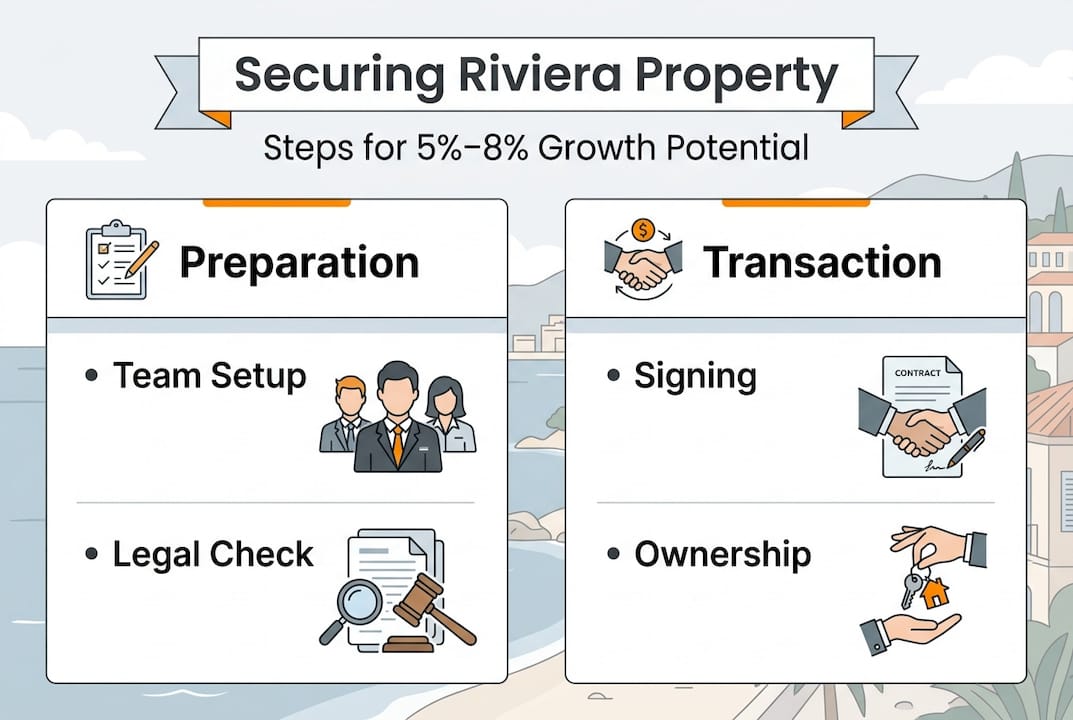
The French property acquisition system rewards those who arrive prepared. Before a single offer is made, your documentation must be immaculate and your advisory team assembled. This is not bureaucratic formality. It is the foundation upon which a flawless transaction is built.
For non-residents, the mandatory documentation typically includes:
- Proof of identity: Valid passport and secondary identification
- Proof of funds: Bank statements, investment portfolio summaries, or asset declarations
- Fiscal identification: A French tax number (numéro fiscal) obtained through the tax authority
- KYC compliance documents: Know Your Client materials required by notaries and financial institutions
- Source of funds declaration: Particularly important for high-value or crypto-related transactions
The notary (notaire) in France is a public officer, not simply a conveyancer. They represent the state, verify title, and hold funds in escrow. Their involvement is non-negotiable and their due diligence is thorough. Alongside the notary, you will need independent legal counsel familiar with cross-border transactions, a tax adviser who understands French wealth structures, and a trusted property agent with genuine access to the market.

| Adviser | Role | Why it matters |
|---|---|---|
| Notaire | Legal validation and title transfer | Mandatory by French law |
| Legal counsel | Contract review and buyer protection | Independent from the seller |
| Tax adviser | Ownership structure and fiscal planning | Prevents costly errors |
| Property agent | Market access and negotiation | Critical for off-market deals |
For alternative payment structures, including cryptocurrency, specialist advisors are essential to navigate the compliance requirements and protect your position. We recommend engaging your property advisory team at least three months before you intend to make an offer. The same applies to arranging luxury property finance, where French and international bank timelines differ considerably.
Pro Tip: Engage a bilingual notary and a local legal adviser simultaneously. The notary acts for the transaction; your legal counsel acts exclusively for you. This dual layer of protection is standard practice among experienced Riviera investors.
Step-by-step acquisition: From negotiation to notarial signature
With your team in place and documentation ready, the acquisition process follows a clear sequence. Each stage carries legal weight, and each deserves your full attention.
- Identify and negotiate: Whether through listed inventory or off-market networks, agree on a price and key terms before any paperwork is signed.
- Sign the Compromis de Vente: This preliminary contract binds both parties legally. The buyer typically pays a deposit of 5 to 10% at this stage. A ten-day cooling-off period applies to private buyers.
- Notarial due diligence: The notary conducts title searches, checks for encumbrances, verifies zoning compliance, and confirms there are no outstanding charges on the property.
- Secure finance or arrange payment: Traditional mortgage approval or crypto-to-fiat conversion via notary must be confirmed during this window.
- Sign the Acte de Vente: The final deed of sale, signed before the notary, transfers legal ownership. Funds are released, and keys change hands.
| Stage | Typical timeframe | Key action |
|---|---|---|
| Offer and negotiation | 1 to 4 weeks | Agree price and conditions |
| Compromis de Vente | Week 1 to 2 | Sign and pay deposit |
| Due diligence period | 6 to 10 weeks | Notary checks and finance |
| Acte de Vente | Week 8 to 12 | Final signature and transfer |
For those using digital assets, crypto property deals require conversion to euros before the Acte de Vente, with the notary overseeing the process. Timing the conversion to a fixed rate protects against market swings. Our dedicated guide on using Bitcoin for property and digital payments and real estate outlines the precise mechanics. The full property acquisition steps are also available for deeper reference.
Pro Tip: Cross-border and crypto transactions routinely add four to six weeks to the standard timeline. Build this buffer into your planning from the outset, particularly if you are coordinating with international banks or digital asset custodians.
Verifying ownership and protecting your legacy
The Acte de Vente is signed. Champagne is warranted. But the work of a legacy investor does not end at the notary’s table. It begins there.
Ownership is formally registered at the Service de Publicité Foncière, France’s land registry. This registration, completed by your notary within a few weeks of signing, is the definitive legal record of your title. Retain certified copies of all documents. They are irreplaceable.
Ongoing compliance obligations include:
- Annual French tax declarations: Even non-residents with French property have reporting obligations
- IFI (Impôt sur la Fortune Immobilière): France’s real estate wealth tax, applicable above a net property value of €1.3 million
- Rental income reporting: If you let the property seasonally, income must be declared in France and potentially in your country of residence
- Succession planning updates: French inheritance law (réserve héréditaire) applies by default and may conflict with your home jurisdiction’s rules
For those serious about generational wealth, the ownership vehicle matters enormously. A Société Civile Immobilière (SCI) allows multiple shareholders, simplifies inheritance, and can reduce notary fees on transfer. A SARL de famille suits those combining personal use with commercial letting. Both structures require specialist advisors, and as specialist advisors confirm, correct structuring from the outset prevents costly restructuring later.
“A Riviera estate is not merely an address. It is a living archive of family ambition, a sanctuary that salt air and sunlight conspire to make timeless.”
We recommend reviewing your legacy investment process annually and staying current with French fiscal updates. The real estate legacy value of Côte d’Azur property is well-documented, but only those who manage their assets actively will capture its full potential.
Pro Tip: Schedule a bi-annual review with your French tax adviser and legal counsel. French property law evolves, and what was optimal at acquisition may need refinement as your portfolio and family circumstances change.
Insider perspective: What most guides miss about luxury real estate security
Most acquisition guides treat the process as a checklist. Sign here, pay there, register this. What they miss is the invisible architecture that separates a good purchase from a generational one.
The most significant Riviera transactions rarely appear on public portals. They move through curated networks, whispered between trusted agents over espresso in Cannes or during a Carnaval evening in Nice. Off-market opportunities represent a disproportionate share of the finest properties available, and accessing them requires relationships, not just budgets.
We also observe that many buyers underestimate the hidden costs: agency fees, notary fees typically ranging from 7 to 8% on older properties, co-ownership charges, and renovation obligations on listed buildings. These are not surprises for those who engage specialists early. They are surprises for those who do not.
Finally, digital transformation is reshaping exclusivity itself. Crypto payments, virtual tours, and cross-border SCI structures are no longer novelties. They are tools that sophisticated investors use to move faster and more discreetly. Legacy investors who ignore this shift risk being outmanoeuvred by those who embrace it.
Ready to secure your Riviera legacy? Next steps with our expert team
The Côte d’Azur rewards those who act with both vision and precision. If this guide has clarified the path, we are here to walk it with you. At Living on the Côte d’Azur, we offer access to invisible luxury real estate that never reaches the open market, alongside bespoke advisory support tailored to your legacy objectives. Our acquisition experts combine deep local knowledge with international reach, spanning Ibiza, Dubai, Bali, Portugal, and Mauritius. We also facilitate cryptocurrency transactions for clients who prefer to invest digitally. Get in touch and let us curate your next heirloom.

Frequently asked questions
Can non-residents buy real estate in the French Riviera?
Yes, non-residents can purchase property in the French Riviera without restriction, though specialist legal and tax advice is essential to navigate cross-border compliance and ownership structuring correctly.
Is it possible to pay for French property with cryptocurrency?
Yes, crypto payments via notary are possible, with funds converted to euros at a fixed rate to protect against volatility, provided specialist advisors oversee the process.
What documents do I need to secure luxury real estate?
You will need proof of identity, proof of funds, a French fiscal identification number, and KYC compliance documents; more complex deals involving crypto or cross-border finance may require additional specialist legal paperwork.
Are off-market properties common in the French Riviera?
Yes, a significant proportion of the finest Riviera properties change hands entirely off-market through trusted networks, making specialist agent connections more valuable than any public listing portal.
Recommended
- How to Invest in French Riviera Real Estate for 2025 Gains – Living on the Côte d’Azur
- Newsletter French riviera real Estate February 2023 – Living on the Côte d’Azur
- How to Invest in French Riviera Real Estate for Lasting Value
- Second home buyer tips: 3–5% growth legacy investments
- Exklusive Villen Mallorca: 5% Wertsteigerung im Südwesten
 //
//