
TL;DR:
- The French Riviera offers resilient luxury real estate with strong appreciation potential for legacy investors.
- Proper structuring, tax planning, and off-market sourcing are essential for maximizing investment returns and inheritance efficiency.
- Ongoing active management and tailored strategies ensure long-term wealth preservation and successful generational transfer.
The French Riviera does not merely attract wealth — it curates it. From the sun-gilded cliffs of Cap d’Antibes to the yacht-studded horizon of Cannes’ Croisette, this coastline represents one of the world’s most enduring stores of value. Yet for every investor who secures a prestige asset that appreciates gracefully and funds future generations, another pays too much, structures poorly, and faces avoidable tax exposure. This guide offers a clear, step-by-step framework for defining luxury real estate investment on the Riviera — from clarifying your legacy objectives to executing a compliant, high-yield acquisition strategy.
Table of Contents
- Understand the investment landscape and define your objectives
- Structuring your acquisition: Legal, tax, and ownership vehicles
- Sourcing, evaluating and securing the right property
- Maximise ROI with tax optimisation and rental strategies
- Legacy planning and wealth transfer: Safeguarding your investment for generations
- Our perspective: What most guides miss about legacy real estate investments
- Next steps: Secure your Riviera legacy asset with expert guidance
- Frequently asked questions
Key Takeaways
| Point | Details |
|---|---|
| Strategic structuring | Choosing the right legal and tax structure is crucial for maximising ROI and ensuring legacy transfer. |
| Thorough due diligence | Meticulous evaluation and access to off-market deals safeguard your investment and yield. |
| Tax optimisation | Active tax planning and specialist advice dramatically boost post-acquisition returns. |
| Legacy protection | Proactive succession planning prevents future disputes and excessive taxes for heirs. |
Understand the investment landscape and define your objectives
The French Riviera luxury property market occupies a category of its own. Demand from global elites remains structurally robust, with prime villas commanding €2M or more for sea views, eco-luxury finishes, and proximity to Monaco’s border. Properties in hotspots such as Cap d’Antibes, Èze, and the Menton hinterland have historically appreciated 5 to 8% annually, making them compelling vehicles for building a luxury portfolio that transcends a single generation.
Before viewing a single property, however, you must define what this investment means to you. A legacy purchase is fundamentally different from a pure-yield play or a lifestyle acquisition. Legacy investors prioritise intergenerational wealth transfer, long holding periods, and capital preservation. Yield-focused buyers weight seasonal rental income and management efficiency. Most sophisticated investors blend both.
| Requirement | Details |
|---|---|
| Minimum investment | Typically €1.5M for entry-level luxury; €3M+ for prime legacy assets |
| Legal structure | Direct ownership, SCI, or corporate vehicle |
| Tax residency | Non-residents subject to IFI from €1.3M net French real estate value |
| Financing | French mortgages available; leverage can reduce IFI base |
| Rental licensing | Required for seasonal lets above certain thresholds |
Before engaging an agent, ask yourself these defining questions:
- What is your intended holding period — five years, twenty, or indefinitely?
- Will the property serve personal use, pure rental, or a blend of both?
- How liquid must this asset remain within your broader portfolio?
- Which family members will be involved, and how will ownership transfer to heirs?
- Are you seeking immediate yield, long-term capital growth, or both?
Clarity on these points shapes every subsequent decision, from ownership structure to property selection.
Structuring your acquisition: Legal, tax, and ownership vehicles
With clear objectives in hand, the next essential step is to select the ideal structure to safeguard your wealth and meet your legacy goals. The choice of ownership vehicle is not a formality — it is the architectural foundation upon which your entire investment rests.

Direct personal ownership is the simplest route, but it offers the least flexibility for inheritance and can expose your estate to French succession law. A Société Civile Immobilière (SCI) is a French civil property company that holds the asset on behalf of shareholders. It facilitates smoother inheritance by transferring shares rather than property, can reduce notarial costs, and allows you to manage IFI impact more strategically. Corporate structures, often used by institutional buyers, offer privacy and liability separation but introduce greater administrative complexity.
| Structure | Flexibility | Privacy | Inheritance | Tax efficiency |
|---|---|---|---|---|
| Personal ownership | Low | Low | Complex | Limited |
| SCI | High | Medium | Simplified | Strong |
| Corporate (SARL/SAS) | Medium | High | Moderate | Variable |
Leverage is a powerful tool here. Structuring via French SCI and securing a French mortgage reduces your net taxable asset value for IFI purposes, since outstanding debt on taxable properties is deductible. This is not tax avoidance — it is intelligent architecture.
Pro Tip: Engage a French notaire and a cross-border tax specialist simultaneously, not sequentially. Cross-border tax strategies must be considered before the purchase deed is signed, not after. Retroactive restructuring is costly and often impossible.
Sourcing, evaluating and securing the right property
Once you’ve established the optimal structure, success depends on finding and vetting the right property in this competitive market. The most coveted Riviera assets rarely appear on public portals. They circulate quietly through trusted networks — a Cap d’Antibes villa whispered between private bankers, a Sainte-Maxime waterfront residence offered exclusively to known buyers before Nartelle beach season begins.
Accessing these opportunities requires relationships. We work with a curated network of agents, notaires, and private vendors to surface assets that never reach the open market. Understanding the investment process overview is the first step to knowing where to look.
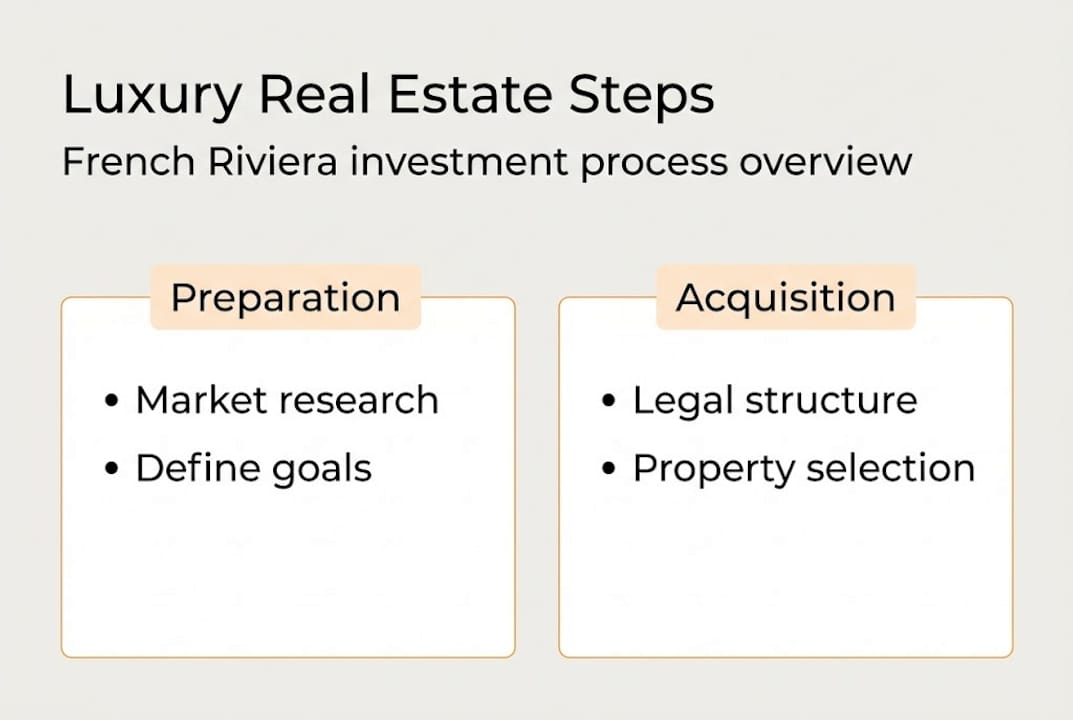
Here is the acquisition process, step by step:
- Shortlist and view — Identify properties aligned with your objectives and structure; conduct initial visits with an advisor present.
- Submit an offer — Negotiate price, conditions, and any included fixtures or furnishings.
- Due diligence — Commission legal title checks, planning permission audits, and a technical survey for structural integrity.
- Sign the compromis de vente — The pre-contract binds both parties; a 10% deposit is typically required.
- Finalise completion — The acte authentique is signed before a notaire, and ownership transfers.
Avoid these red flags at every stage:
- Unclear title history or unresolved planning disputes
- Properties with undeclared extensions or illegal structures
- Vendors reluctant to provide full diagnostic reports
- Rental income claims unsupported by documented accounts
Seasonal rental strategies are most effective when the property’s legal status for short-term letting is confirmed during due diligence, not discovered after closing. This is a detail that separates informed investors from costly surprises. Explore how using seasonal rentals can blend income and personal enjoyment across the calendar year.
Maximise ROI with tax optimisation and rental strategies
After acquisition, ongoing optimisation separates average from elite returns and underpins generational wealth preservation. The Riviera’s rental calendar is among the most lucrative in Europe. Summer weeks in Saint-Tropez or Antibes command extraordinary nightly rates, while Cannes Film Festival and the Monaco Grand Prix create premium short windows that sophisticated owners capitalise on.
Understanding your tax obligations is non-negotiable. IFI applies progressively from 0.5% to 1.5% on net French real estate above €1.3M. On sale, non-residents face a capital gains rate of 19% plus 17.2% social charges — a combined 36.2% on second home disposals. Understanding net capital gains calculations, including allowable deductions for renovation and holding period abatements, can meaningfully reduce your effective rate.
Seasonal rental strategies require careful calibration. Renting your Riviera property during the Cannes Film Festival or the Menton Lemon Festival generates exceptional short-term income, while reserving shoulder seasons for personal use preserves the lifestyle value that makes these assets irreplaceable. A well-managed villa near Antibes’ Provençal markets or overlooking Sainte-Maxime’s Nartelle sands can realistically yield 3 to 5% annually on top of capital appreciation.
Pro Tip: Do not wait until your first tax return to engage specialists. A comprehensive success guide for Riviera investors integrates tax planning, rental management, and estate strategy from day one. The difference in after-tax returns over a decade is substantial.
Legacy planning and wealth transfer: Safeguarding your investment for generations
With your asset generating returns, the final step ensures the investment is truly legacy-proof. French succession law applies to French-situated property regardless of your nationality or domicile, and it imposes strict reserved heir rules that can frustrate estate plans designed under other legal systems.
Inheritance planning must align with your chosen structure from the outset. SCIs facilitate smoother succession by allowing share transfers rather than direct property conveyance, reducing notarial fees and enabling gradual gifting strategies. This is where structure and legacy planning converge most powerfully.
Common mistakes that undermine legacy intentions include:
- Holding property in personal name without a will aligned to French law
- Failing to account for French inheritance tax between non-direct heirs
- Neglecting to update ownership structures after major life events such as divorce or remarriage
- Assuming a foreign trust will be recognised under French property law
The most expensive error in luxury property succession is not the tax itself — it is the family dispute that arises when structure and intent were never formally aligned. Early, bespoke planning through a property investment process tailored to your family’s circumstances is the single most valuable investment you will make alongside the property itself.
The Riviera is not merely a backdrop for wealth — it is a vessel for it. Estates in Menton’s hilltop villages or along Èze’s ancient ramparts carry a timeless quality that financial instruments simply cannot replicate. Structured well, they become heirlooms.
Our perspective: What most guides miss about legacy real estate investments
Most investment guides focus on acquisition mechanics and tax rates. What they rarely address is the psychological and structural discipline required to maintain a legacy asset over decades. We have observed that the investors who achieve the finest outcomes are not necessarily those who buy the most prestigious addresses. They are those who remain actively engaged with their asset’s legal, fiscal, and family context year after year.
Market appreciation of 5 to 8% annually is a compelling headline. But the true compounding effect comes from integrated strategy — bespoke ownership structures, proactive tax management, and rental programmes calibrated to both income and personal enjoyment. Passive ownership on the Riviera is a myth.
Our investing success perspective is grounded in one conviction: the Riviera rewards those who treat their property as a living investment, not a static asset. Laws evolve, family circumstances shift, and rental markets respond to new realities. The investors who thrive are those who adapt with intention, guided by specialists who understand both the salt-kissed allure of this coastline and the rigour required to protect what it represents.
Next steps: Secure your Riviera legacy asset with expert guidance
Armed with a blueprint, it is time to turn intention into action with the Riviera’s leading luxury property specialists. At Living on the Côte d’Azur, we offer access to investment options on the Côte d’Azur that span curated listings, new constructions, and exclusive off-market real estate opportunities that never surface publicly. Our network spans Monaco’s borders to Menton’s lemon-scented lanes, and our expertise bridges lifestyle aspiration with financial rigour. Whether you are acquiring your first Riviera estate or expanding a multi-generational portfolio, we invite you to speak with a Riviera property expert and begin the conversation that transforms ambition into legacy.
Frequently asked questions
What is the minimum investment for luxury real estate on the French Riviera?
Luxury properties typically start above €1.5 million, but legacy-tier assets in prime locations such as Cap d’Antibes or Monaco’s border may command significantly higher capital.
How can non-residents minimise French wealth tax (IFI) liability?
By using debt and the SCI structure, non-residents can reduce the IFI base for properties exceeding €1.3M in net value, meaningfully lowering annual exposure.
What is the capital gains tax rate for non-residents selling a secondary home in France?
Non-residents face a combined CGT rate of 36.2%, comprising 19% capital gains tax plus 17.2% social charges on second home disposals.
Do off-market properties offer higher ROI?
Off-market assets often carry less competition and unique provenance, enabling more favourable pricing and stronger legacy and ROI potential over the long term.
How can I pass my French Riviera property to my heirs efficiently?
Structuring via SCI and aligning your estate plan with French succession law early allows smoother succession and reduces both notarial costs and the risk of family disputes.
Recommended
 //
//