
TL;DR:
- Sustainable luxury properties on the Côte d’Azur command higher demand and appreciation due to eco-features.
- Green-certified estates offer lower resale risk, better value retention, and are future-proofed legally.
- Incorporating sustainability enhances long-term wealth transfer, reputation, and resilience for family legacies.
The notion that luxury and sustainability are somehow at odds is one of the most persistent misconceptions in high-end real estate. On the Côte d’Azur, the opposite is emphatically true. Sustainable luxury properties command higher demand and price appreciation, driven by scarcity, international appeal, and eco-friendly features that resonate with today’s most discerning buyers. From Cap d’Antibes’ salt-kissed coastal sentiers to Menton’s lemon-scented ramparts, the Riviera’s finest estates are being reimagined as green sanctuaries. For high-net-worth investors seeking resilience, legacy value, and genuine ROI, sustainable luxury is not a trend. It is the new standard.
Table of Contents
- Why sustainable luxury properties are in demand on the Côte d’Azur
- Top benefits for legacy and wealth growth
- How sustainability boosts property value and ROI
- Key considerations for choosing the right sustainable luxury property
- The overlooked truth: sustainability as a legacy multiplier
- Unlock your Côte d’Azur legacy with expert guidance
- Frequently asked questions
Key Takeaways
| Point | Details |
|---|---|
| Strong demand drives value | Eco-friendly luxury homes on the Côte d’Azur see higher appreciation due to market scarcity and international interest. |
| Legacy investment edge | Sustainable properties retain value and simplify intergenerational wealth transfer for high-net-worth families. |
| Superior ROI and resilience | Green features lower costs and boost financial performance, while adapting easily to changing regulations and buyer trends. |
| Choose with green credentials | Properties with verified sustainability certifications stand out for resale, regulatory compliance, and long-term prestige. |
Why sustainable luxury properties are in demand on the Côte d’Azur
The Côte d’Azur has always been a place where scarcity and desire meet. Clifftop villas above Èze, belle époque mansions near Monaco, and biophilic new-builds overlooking Sainte-Maxime’s Nartelle beach are not merely homes. They are curated expressions of a life well lived. Yet in 2026, a new layer of value has emerged: sustainability credentials are becoming as prized as sea views.
The eco-luxury market trends on the French Riviera reveal a clear pattern. Buyers from London, Geneva, Dubai, and Singapore are actively seeking properties rated A or B on the DPE (Diagnostic de Performance Énergétique), France’s energy performance scale. Solar panels, water recovery systems, and smart energy management are no longer optional extras. They are baseline expectations for a buyer who understands both comfort and capital.
Scarcity amplifies this dynamic. The Riviera’s buildable land is finite, and eco-certified properties represent a small fraction of the total stock. That combination of limited supply and surging international demand creates a compelling investment thesis. According to luxury market trends 2026, sustainable properties are appreciating faster than their conventional counterparts across the region.
Key features that appeal to legacy investors:
- High DPE energy ratings (A or B classification)
- Photovoltaic solar panel arrays with battery storage
- Rainwater harvesting and greywater recycling systems
- LEED or BREEAM green building certifications
- Smart home energy management platforms
- Thermally efficient construction and natural insulation materials
- EV charging infrastructure integrated into the property
Year-on-year appreciation: sustainable vs standard luxury properties
| Property type | 2023 appreciation | 2024 appreciation | 2025 appreciation |
|---|---|---|---|
| Sustainable luxury (A/B DPE) | 7.2% | 8.1% | 8.6% |
| Standard luxury | 4.8% | 5.1% | 5.3% |
| Riviera average | 3.9% | 4.2% | 4.5% |
Statistic to note: Properties with A or B energy ratings command premiums of up to 20% over equivalent standard luxury homes on the Côte d’Azur, reflecting both regulatory alignment and buyer preference.
This is not speculative. It is a structural shift, driven by European energy directives, evolving buyer values, and the simple fact that a property which costs less to run and meets future regulations is inherently more transferable across generations.
Top benefits for legacy and wealth growth
With strong demand established, it is time to examine how these properties support both legacy ambitions and the growth of your family’s wealth. Sustainable luxury on the Riviera is not merely about lower energy bills. It is about building an asset that retains prestige, transfers efficiently, and grows in relevance as the world changes.
Sustainable properties demonstrate higher long-term value retention and are increasingly preferred for wealth transfer strategies among ultra-high-net-worth families. This is a critical distinction. Standard luxury properties face growing resale risk as regulatory thresholds tighten across France and the EU. Sustainable assets, by contrast, are already ahead of the curve.
Comparing sustainable luxury versus traditional luxury for legacy investors:
| Factor | Sustainable luxury | Traditional luxury |
|---|---|---|
| Resale risk | Low (regulatory compliant) | Medium to high (retrofit costs) |
| Value retention | Strong, 5 to 8% annually | Moderate, 3 to 5% annually |
| Regulatory compliance | Future-proofed | Requires ongoing investment |
| Legacy transferability | High | Variable |
| Tenant appeal for seasonal lets | Premium, eco-conscious market | Broader but less premium |
The legacy benefits of sustainable investments extend well beyond the balance sheet. Consider three core advantages:
- Enhanced intergenerational transfer. Eco-certified estates carry lower retrofit liability for heirs, making them cleaner assets to inherit and simpler to manage across generations.
- Price premium resilience. The value stability in green assets is well documented. Sustainable properties hold their premium even during broader market corrections, offering a buffer that standard luxury cannot reliably provide.
- Long-term buyer appeal. As younger ultra-high-net-worth individuals inherit and accumulate wealth, their preference for sustainability intensifies. Owning an eco-luxury estate today means owning tomorrow’s most desirable asset.
Pro Tip: Focus on properties with reputable green certifications such as LEED or BREEAM. These internationally recognised standards provide the highest returns and the greatest security when it comes to resale and legacy transfer.
The regional investment trends across the Riviera confirm that Monaco-adjacent plots and Cap d’Antibes estates with strong eco-credentials are among the most sought-after legacy plays available to global investors today.
How sustainability boosts property value and ROI
Beyond legacy and status, the practical financial advantages of sustainable features are compelling and measurable. The mechanisms are straightforward once you understand them.
How sustainability drives ROI in luxury real estate:
- Reduced energy costs lower annual running expenses, increasing net rental yield for seasonal lets
- Material efficiency during construction reduces build overruns and maintenance cycles
- Waste reduction systems lower ongoing property management costs
- Regulatory future-proofing eliminates costly retrofit expenditure that erodes returns on standard properties
- Increased buyer trust among international purchasers who conduct rigorous due diligence
- Higher occupancy rates for seasonal rentals, as eco-conscious tenants pay premium rates for certified properties
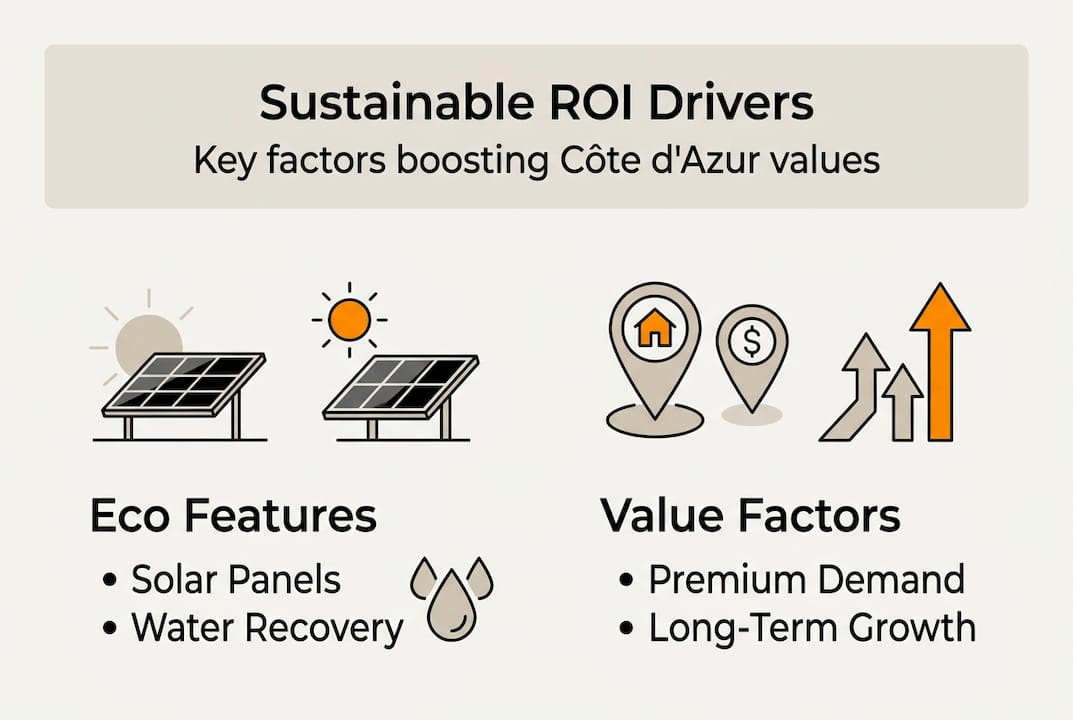
Sustainability drives ROI through cost reduction and improved resilience, making green assets structurally superior performers over a ten-year investment horizon.
“Green retrofits in luxury properties boost values by 11.9%, with certified sustainable homes commanding premiums of up to 20% in prime French coastal markets.”
The regional differences in sustainability ROI are worth noting. Coastal markets like the Côte d’Azur outperform inland equivalents because the combination of climate desirability and regulatory pressure creates a uniquely favourable environment for green asset appreciation.
Pro Tip: When evaluating a property, prioritise those with up-to-date energy systems already installed rather than properties that promise future upgrades. Existing, verified systems enhance liquidity immediately and reduce acquisition risk.
Our international investment guide outlines how to structure due diligence for sustainable acquisitions, including the technical surveys and energy audits that protect your capital from the outset. Note that financial impact always varies by location, property specification, and market conditions, so thorough due diligence remains essential regardless of headline figures.
Key considerations for choosing the right sustainable luxury property
Understanding the financial mechanisms is vital. Here is how you can put this knowledge into practice when evaluating potential properties along the Riviera.
Step-by-step guide to evaluating eco-credentials:
- Assess location and microclimate. Solar orientation, coastal exposure, and proximity to infrastructure all affect the performance of sustainable systems. A south-facing villa above Antibes’ Cap will generate significantly more solar energy than a north-facing plot.
- Verify build quality and materials. Request full construction documentation. Biophilic design elements, natural insulation, and thermally efficient glazing should be specified, not assumed.
- Confirm certifications. LEED, BREEAM, or the French HQE (Haute Qualité Environnementale) label are the gold standards. Sustainability and eco-certifications align directly with market appreciation and reduce resale risk.
- Evaluate maintenance requirements. Solar arrays, water recovery systems, and smart platforms require specialist servicing. Confirm that local providers are available and that maintenance costs are factored into your yield projections.
- Profile the tenant market. For seasonal rental income, understand who your likely tenants are. Eco-conscious ultra-high-net-worth renters during Cannes Film Festival season or the Saint-Tropez summer regattas will pay a significant premium for certified sustainable properties.
Key questions to ask during on-site visits:
- What is the property’s current DPE rating, and is it independently verified?
- Which direction does the main living space face, and how many peak solar hours does the site receive?
- Are water recovery and greywater recycling systems already operational?
- What is the projected regulatory outlook for this property under current EU energy directives?
- Has the property undergone a full technical survey, including seismic resilience assessment?
- Are there green certification nuances specific to this build type that affect its classification?
Balancing scarcity, compliance, and verified green features is the art of acquiring a truly exceptional legacy asset. We always encourage investors to explore the full spectrum of types of luxury assets available across the region before committing, ensuring the property matches both your financial goals and your family’s vision.
The overlooked truth: sustainability as a legacy multiplier
Most guides stop at yield figures and certification checklists. We believe that misses the deeper story entirely. Sustainable luxury on the Côte d’Azur does something that standard assets simply cannot: it multiplies legacy impact across dimensions that no spreadsheet fully captures.
When your heirs inherit a certified eco-villa above Èze or a solar-powered estate near Monaco, they inherit more than bricks and a sea view. They inherit a reputation. They inherit alignment with the values of the next generation of ultra-high-net-worth buyers. They inherit a property that will not require expensive retrofitting as EU energy directives tighten through 2030 and beyond.
Conventional wisdom focuses on today’s premium. We focus on tomorrow’s baseline. Regulatory trends are moving in one direction only, and properties that already meet or exceed those standards will become the new prestige benchmark. Our legacy wealth strategies are built on this conviction. The families who acquire sustainable estates today are not simply buying property. They are shaping the values and reputation of their lineage for generations.
Unlock your Côte d’Azur legacy with expert guidance
If you are considering your next legacy investment on the French Riviera, we are here to guide you with the precision and discretion that your ambitions deserve. Our curated portfolio of Côte d’Azur luxury villas includes estates with verified sustainability credentials, from solar-powered Cap d’Antibes retreats to biophilic new-builds overlooking Sainte-Maxime’s golden sands. We accept cryptocurrency payments and offer bespoke acquisition support for investors who demand more than a transaction. Explore our property acquisition guide for a step-by-step framework tailored to legacy-focused buyers. Your heirloom awaits.
Frequently asked questions
How do sustainable luxury properties compare in value to standard luxury homes?
Sustainable luxury properties on the Côte d’Azur can command premiums up to 20% over equivalent standard homes and demonstrate superior long-term value retention, making them structurally stronger legacy assets.
Are green certifications essential for resale and legacy value?
Yes. Properties with certifications such as LEED or BREEAM benefit from higher buyer appeal, smoother resale processes, and greater legacy transferability. Prioritising green certifications is one of the most effective strategies for protecting long-term wealth growth.
What sustainability features add the most value?
Solar energy systems, water recovery infrastructure, and high DPE ratings are the most impactful features. Solar panels and water recovery systems consistently drive demand and command the strongest premiums among international buyers.
Do sustainable luxury properties cost more to maintain?
Generally, they offer lower running costs. Sustainability reduces running costs by up to 30% in materials and 25% in waste, meaning the net cost of ownership is typically lower than for a comparable standard luxury property.
Recommended
 //
//