
Selecting the right property along the Côte d’Azur often means sorting through layers that go beyond price or aesthetics. For discerning European and North American buyers, the line between luxury and ultra-luxury is sharply drawn by core values like heritage, exclusivity, and transformational lifestyle experiences. As the meaning of luxury evolves, understanding the multifaceted nature of ultra-luxury becomes essential for those aiming to preserve legacy wealth while enjoying privileged access to the Mediterranean’s most coveted addresses.
Table of Contents
- Defining Ultra-Luxury: Core Concepts
- Key Categories and Distinctive Features
- Ultra-Luxury Versus Conventional Luxury
- Market Dynamics and Buyer Profiles
- Risks, Costs, and Investment Implications
Key Takeaways
| Point | Details |
|---|---|
| Understanding Ultra-Luxury | Ultra-luxury transcends mere price and quality by embodying exclusivity, heritage, and access to unique lifestyle experiences. Buyers should assess properties for architectural provenance and cultural significance rather than just market value. |
| Distinct Property Categories | Ultra-luxury properties are divided into Heritage Properties, Bespoke Contemporary Residences, and Experiential Compounds, each serving unique buyer needs and wealth preservation strategies. |
| Buyer Profiles and Motivations | Ultra-luxury purchasers typically include generational wealth families, tech entrepreneurs, and institutional investors, each prioritising specific values like cultural capital and privacy. |
| Investment Risks | Investors should be aware of risks including liquidity concerns, currency exposure, and regulatory changes that may impact the valuation and ownership of ultra-luxury assets. |
Defining Ultra-Luxury: Core Concepts
Ultra-luxury exists at the apex of a spectrum that extends far beyond conventional definitions of wealth and exclusivity. Where standard luxury focuses on premium quality and elevated price points, ultra-luxury transcends these metrics entirely. It encompasses a multidimensional consumption experience that blends tangible assets with intangible value: heritage, legacy, exclusivity, and transformational lifestyle access. For high-net-worth individuals and family offices evaluating properties along the Côte d’Azur, understanding this distinction becomes paramount. A €3M villa isn’t ultra-luxury by virtue of its price alone; it becomes ultra-luxury when paired with irreplaceable location, architectural provenance, and the privilege of membership in an exclusive global community.
The evolution of luxury theory reveals that luxury encompasses shifting definitions rooted in economic positioning, social status, and experiential richness rather than mere acquisition. Contemporary ultra-luxury properties on the French Riviera exemplify this shift. A seafront estate commands premium valuation not simply because of its square footage or marble finishes, but because it represents freedom, independence, and access to curated experiences unavailable to the broader market. The property becomes a portal to Mediterranean culture, international social networks, and generational wealth preservation. This philosophical framework matters profoundly when assessing whether a real estate acquisition truly qualifies as ultra-luxury or merely occupies the luxury tier below it.
From multiple perspectives, luxury has evolved as a multifaceted concept shaped equally by providers, consumers, and co-creation dynamics. An ultra-luxury property represents collaboration between visionary architects, master craftspeople, landscape designers, and the discerning owner who curates the final expression. When you acquire a beachfront villa in Antibes or a hillside estate in Èze, you’re not purchasing a finished product but rather inheriting a legacy of creative excellence and stepping into a narrative that continues with your stewardship. The property’s value appreciation stems partly from structural quality and partly from its increasing cultural significance as a repository of refined taste and timeless design principles.
Pro tip: When evaluating an ultra-luxury property, assess whether it transcends commodity pricing by examining its historical significance, architectural authorship, and the exclusivity of its location within established prestige zones like Cap d’Antibes or the medieval villages surrounding Nice.
Key Categories and Distinctive Features
Ultra-luxury properties along the Côte d’Azur fall into distinct categories, each defined by characteristics that separate them from conventional luxury offerings. The primary distinctions centre on location prestige, architectural significance, bespoke customisation, and experiential ecosystems. A beachfront villa in Saint-Tropez differs fundamentally from a hilltop estate in Èze not merely in square metres or construction cost, but in the lifestyle narrative it commands. Location prestige anchors ultra-luxury properties within zones recognised globally for their exclusivity: Cap d’Antibes for coastal seclusion, Monaco borders for international finance proximity, or medieval villages inland for cultural richness. These aren’t interchangeable; each category attracts distinct buyer demographics and commands different yield potentials for legacy wealth positioning.
Core features distinguishing ultra-luxury encompass uniqueness, quality, exclusivity, and craftsmanship that transcend standard luxury parameters. Beyond construction excellence, ultra-luxury properties embed emotional and social value that appreciates as cultural significance deepens. Consider a recently restored 18th-century Provençal manor: its value multiplies not from updated plumbing alone, but from architectural authenticity, provenance documentation, and the social distinction ownership conveys. The property becomes a conversation piece within global networks of collectors and visionaries. Additionally, personalised services and cultural engagement represent defining features increasingly expected within ultra-luxury real estate. Discerning owners anticipate concierge-level property management, seamless access to Michelin-starred dining and gallery openings, and curated experiences that transform a residence into a lifestyle headquarters.
Three distinct ultra-luxury categories emerge on the Riviera:
- Heritage Properties: Restored estates with documented architectural provenance, often dating to Belle Époque or earlier periods, commanding premium valuations for historical significance
- Bespoke Contemporary Residences: Purpose-built estates designed by renowned architects, featuring cutting-edge sustainability systems and technological integration alongside artistic vision
- Experiential Compounds: Multi-property estates encompassing main residences, guest pavilions, wellness facilities, and private beach or marina access, enabling complete lifestyle autonomy
Each category serves distinct purposes within wealth preservation strategies. Heritage properties function as cultural repositories and social anchors. Contemporary residences appeal to tech-forward collectors prioritising innovation alongside exclusivity. Experiential compounds attract family offices requiring multi-generational accommodation and comprehensive privacy infrastructure.
To clarify the distinct categories of ultra-luxury properties on the Riviera, see the summary below:
| Category | Unique Attributes | Typical Buyer Profile |
|---|---|---|
| Heritage Properties | Historical architecture, cultural legacy | Generational wealth families |
| Bespoke Contemporary Residences | Innovative design, sustainability technology | Entrepreneur collectors |
| Experiential Compounds | Multiple buildings, private amenities | Family offices, privacy-seekers |
Pro tip: When categorising a property candidate, assess whether it commands premium valuation through intrinsic uniqueness (historical significance, bespoke design, irreplaceable location) rather than merely current market conditions, ensuring your investment maintains prestige across market cycles.
Ultra-Luxury Versus Conventional Luxury
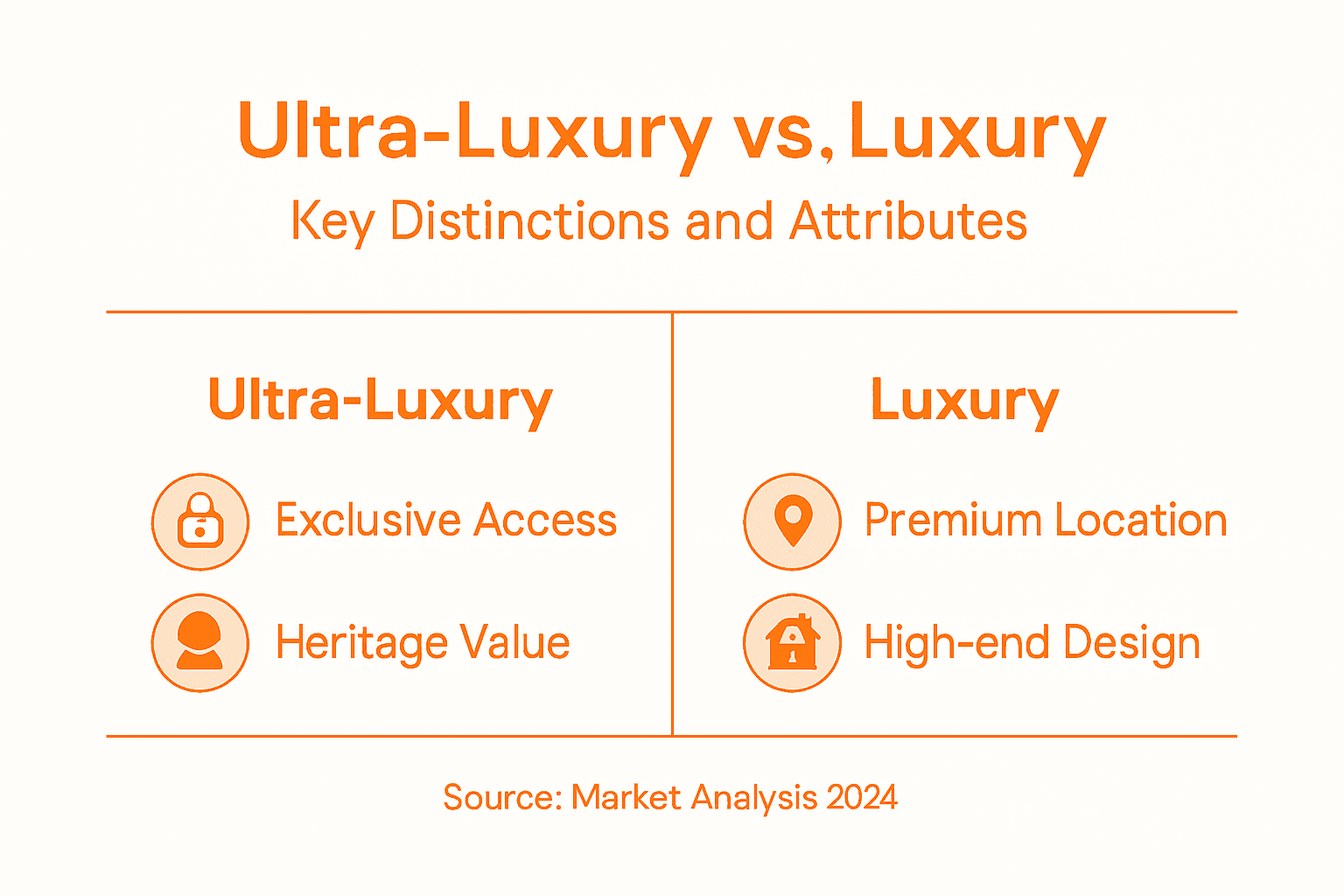
The distinction between ultra-luxury and conventional luxury extends far beyond price differentials, though cost represents a visible marker of separation. Conventional luxury properties emphasise accessibility within premium segments, prioritising desirable locations, quality construction, and refined aesthetics that appeal to affluent buyers seeking status recognition. An ultra-luxury property, by contrast, pursues exclusivity as its primary objective. Where conventional luxury asks “What can I obtain at this price point?”, ultra-luxury instead asks “What cannot be replicated or purchased elsewhere?” A €5M villa in Cannes with sea views and contemporary finishes occupies the luxury segment. A €5M estate in Cap d’Antibes with documented Belle Époque provenance, private beach access, and architectural significance approaches ultra-luxury positioning. The difference lies not in amenity count but in irreplaceability and cultural significance that appreciates over generations.

Market dynamics reveal critical distinctions. Ultra-luxury properties command significantly higher value premiums reflecting their exclusivity, bespoke service infrastructure, and unique location advantages within globally recognised prestige zones. Conventional luxury markets pursue volume and broader accessibility, targeting wider buyer demographics. Ultra-luxury markets attract clientele with distinct perceptions about extreme personalisation and unique experiences unavailable elsewhere. Occupancy rates differ fundamentally as well. Conventional luxury properties generate consistent rental income through frequent turnover and broader appeal. Ultra-luxury residences often maintain lower utilisation rates because owners value privacy and exclusivity over yield maximisation. This philosophical difference shapes investment expectations entirely. A conventional luxury villa might yield 4-5% annually through seasonal lettings. An ultra-luxury compound prioritises legacy preservation and lifestyle autonomy, accepting lower financial yields for cultural capital accumulation.
The luxury market demonstrates clear polarisation. Ultra-luxury brands emphasise extreme personalisation and unique value propositions as competitive advantages, contrasting sharply with conventional luxury strategies targeting broader consumer bases. Ultra-luxury properties along the Côte d’Azur increasingly distinguish themselves through experiential ecosystems rather than material specifications. A contemporary luxury estate features smart home integration and wellness centres. An ultra-luxury compound integrates these elements whilst offering private museum galleries, wine cellars with provenance documentation, and curated access to cultural institutions. This experiential dimension transforms the property from residence into lifestyle headquarters.
Key differences organise across several dimensions:
The following comparison highlights the fundamental differences between ultra-luxury and conventional luxury real estate:
| Dimension | Ultra-Luxury Approach | Conventional Luxury Approach |
|---|---|---|
| Investment Focus | Asset irreplaceability, legacy growth | Rental yield, market demand |
| Buyer Motivation | Cultural capital and exclusivity | Social status and aesthetics |
| Property Features | Provenance, bespoke experiences | Location, standard amenities |
| Market Liquidity | Slow sales, few eligible buyers | Faster turnover, broad appeal |
- Accessibility: Conventional luxury targets affluent professionals and entrepreneurs; ultra-luxury appeals to generational wealth, sovereign funds, and family offices
- Market Strategy: Conventional luxury emphasises product features and amenities; ultra-luxury emphasises rarity and provenance
- Financial Performance: Conventional luxury optimises rental yield and turnover; ultra-luxury prioritises appreciation and legacy preservation
- Buyer Motivation: Conventional luxury seeks status confirmation; ultra-luxury seeks irreplaceable asset positioning
Pro tip: When evaluating whether a property qualifies as ultra-luxury or conventional luxury, examine whether its premium valuation stems from replicable features (location demand, construction quality) or irreplaceable characteristics (architectural provenance, cultural significance, absolute exclusivity), as this determines appropriate investment timeline and wealth preservation strategy.
Market Dynamics and Buyer Profiles
The ultra-luxury real estate market operates within a substantially larger global luxury ecosystem that demonstrates remarkable resilience and growth. Global luxury spending reached €1.5 trillion in 2023, driven by sustained demand across experiential and tangible asset categories. Within this landscape, ultra-luxury property acquisitions represent a distinct market segment characterised by concentrated purchasing power, longer decision cycles, and heightened due diligence requirements. The Côte d’Azur captures disproportionate market share within European ultra-luxury transactions because it combines irreplaceable geographic position, established prestige networks, and proven wealth preservation characteristics. This isn’t coincidental; global high-net-worth individuals strategically position Riviera properties as portfolio anchors within comprehensive wealth diversification strategies.
Buyer profiles within the ultra-luxury segment reveal critical distinctions from conventional luxury markets. The ultra-luxury purchaser typically represents one of three categories: generational wealth families managing multi-billion-pound portfolios; technology entrepreneurs and finance sector leaders with newly accumulated capital seeking cultural legitimacy; or international sovereign wealth funds deploying capital for institutional asset diversification. These buyers rarely operate in isolation. Family offices, wealth advisors, and legal teams orchestrate acquisitions across multiple jurisdictions simultaneously. A Canadian pension fund might acquire a Saint-Tropez waterfront property whilst simultaneously purchasing agricultural land in Provence and contemporary art collections in Nice. This portfolio integration approach fundamentally shapes negotiation dynamics and valuation expectations. Ultra-luxury buyers evaluate properties not solely on individual merit but within comprehensive wealth preservation frameworks spanning tax efficiency, currency diversification, and legacy planning across generations.
Geographic preference patterns further illuminate buyer sophistication. North American and Northern European buyers favour established prestige zones with documented historical significance, such as Cap d’Antibes and medieval Provençal villages. Middle Eastern and Asian investors increasingly target contemporary developments with technological innovation and sustainability credentials. Russian and Eastern European purchasers prioritise absolute privacy infrastructure and defensive architecture. These distinctions matter profoundly because they shape property customisation requirements and expected service ecosystems. A European family office might demand heritage restoration expertise and provenance documentation. An Asian investment vehicle might prioritise smart building systems, cryptocurrency transaction capability, and wellness centre infrastructure. Understanding buyer origin and motivation reveals what ultra-luxury properties must provide beyond architectural excellence.
Key buyer segments organise as follows:
- Generational Wealth Families: Prioritise cultural capital accumulation, tax-efficient structures, and multi-generational usage; typical investment horizon spans 20+ years
- Entrepreneur Collectors: Seek distinctive properties as status symbols and cultural repositories; often pursue renovation projects transforming historic structures
- Institutional Investors: Require yield potential, heritage value appreciation, and portfolio diversification benefits; evaluate properties through structured financial frameworks
- International Privacy-Seekers: Emphasise security infrastructure, complete discretion, and jurisdictional advantages; typically acquire through corporate entities
Pro tip: When positioning an ultra-luxury property to potential buyers, research their geographic origin and wealth source to anticipate which value drivers resonate most powerfully: generational wealth families respond to provenance and cultural significance, whilst institutional investors prioritise appreciation trajectories and diversification benefits.
Risks, Costs, and Investment Implications
Ultra-luxury property investment demands unflinching assessment of financial, operational, and market risks that extend substantially beyond conventional real estate considerations. The sector confronts macroeconomic uncertainties and inflationary pressures that constrain profitability and challenge traditional valuation models. A €8M Riviera estate represents not merely a residential acquisition but a complex asset requiring sophisticated risk management across multiple dimensions. Acquisition costs alone extend far beyond purchase price: legal fees for French property acquisition average 7 percent of transaction value, structural surveys for seismic compliance cost €15,000 to €40,000, and title audits ensuring clear ownership can require months of documentation review. Beyond acquisition, annual operating expenses consume 3 to 5 percent of property valuation for maintenance, property taxes, insurance, and discretionary staffing. These baseline costs exist regardless of occupancy or rental activity, creating minimum financial obligations that persist across market cycles.
Currency and geopolitical risks merit particular attention for international buyers. A North American investor acquiring a €5M property faces inherent currency exposure as Euro strength appreciation reduces home-currency valuation. French wealth taxes, whilst reformed in recent years, continue imposing obligations on non-resident foreign nationals holding French real estate through personal ownership structures. Geopolitical instability, economic sanctions, and shifting regulatory environments create unpredictable cost escalations. Additionally, risks include price sensitivity and evolving consumer values around sustainability, meaning properties lacking modern sustainability certifications face increasing valuation pressure and restricted buyer pools. A beautifully preserved Belle Époque villa without renewable energy systems or contemporary waste management infrastructure becomes increasingly problematic within ultra-luxury markets prioritising environmental responsibility.
Market concentration risk presents another critical consideration. Ultra-luxury properties exhibit lower liquidity than conventional luxury segments. A €3M apartment in central Paris attracts multiple qualified buyers within weeks. A €15M bespoke compound with highly customised architecture might require 18 to 24 months to sell, assuming a qualified buyer materialises. This extended timeframe creates opportunity cost and market-timing risk. Properties appealing to narrow buyer demographics (those requiring specific security infrastructure, for instance) face even more constrained buyer pools. Investment implications demand strategic diversification: ultra-luxury property should represent no more than 15 to 20 percent of a comprehensive wealth portfolio, with remaining capital deployed across liquid assets enabling tactical repositioning as markets shift.
Key risk categories require structured mitigation:
- Liquidity Risk: Ultra-luxury properties sell slowly; extended holding periods lock capital within illiquid assets
- Currency Risk: International buyers face exchange rate exposure and foreign tax complications
- Regulatory Risk: Changing tax structures, wealth restrictions, and foreign ownership limitations reshape valuation frameworks
- Maintenance Risk: Aging structures require escalating specialist expertise and costly restoration interventions
- Market Risk: Shifting preferences toward sustainability and contemporary design diminish appeal of unrenovated heritage properties
Pro tip: Before committing capital to ultra-luxury property acquisition, engage specialised tax advisors understanding French foreign ownership regulations and structure your purchase through appropriate legal entities (often Luxembourg or Irish holding companies) to optimise tax efficiency and minimise wealth tax exposure across your home jurisdiction and France simultaneously.
Discover Your Ultra-Luxury Legacy on the Côte d’Azur
Navigating the world of ultra-luxury real estate requires more than a transaction mindset. This article highlights the deep distinction between conventional luxury and ultra-luxury properties, centred on irreplaceability, architectural provenance, and lifelong cultural value. If you seek a property that is truly a legacy—whether it is a heritage estate in Cap d’Antibes, a bespoke residence with cutting-edge design, or a private compound offering complete lifestyle autonomy—understanding these nuances is essential. The challenge lies in securing an asset that appreciates not just in price but in prestige and exclusivity in a competitive and complex market.
At Living on the Côte d’Azur, we specialise in guiding discerning buyers through the intricacies of acquiring ultra-luxury properties that transcend mere lifestyle to become heirlooms. Tap into expert insights on legacy investments and bespoke new constructions that reflect your vision of sustainable wealth. To explore how your next acquisition can become a cultural capital cornerstone, connect with our team today at Contact Nice to Meet You. Act now to secure your place within the Riviera’s exclusive lineage of property owners and build a heritage that will flourish across generations.
Frequently Asked Questions
What defines ultra-luxury properties compared to conventional luxury properties?
Ultra-luxury properties are characterised by their exclusivity, historical significance, and unique cultural value, going beyond mere pricing to embrace irreplaceability and bespoke experiences. In contrast, conventional luxury properties focus more on accessibility and desirable location.
How can I identify if a property is truly ultra-luxury?
To identify ultra-luxury properties, evaluate their historical significance, architectural provenance, and the exclusivity of their location. The property’s narrative and the unique lifestyle it offers should also play a critical role in the assessment.
What are the key categories of ultra-luxury properties?
The main categories of ultra-luxury properties include heritage properties, bespoke contemporary residences, and experiential compounds, each distinguished by their unique attributes and buyer profiles. Heritage properties often have documented architectural provenance, while bespoke residences focus on innovative design.
What risks should I be aware of when investing in ultra-luxury real estate?
Investing in ultra-luxury real estate involves risks such as liquidity risk, currency risk, regulatory changes, maintenance costs, and market sensitivity to evolving consumer preferences. Strategic diversification and thorough due diligence are essential for mitigating these risks.
Recommended
- The concept of Ultra Luxury on the French Riviera – Living on the Côte d’Azur
- 法国里维埃拉的极致奢华理念 – Living on the Côte d’Azur
- Top Locations High-Value Luxury Real Estate on the French Riviera
- What Defines High-End Real Estate: Complete Guide
- Understanding Hair Keratin Price: A Comprehensive Guide to Treatment Costs | MyHair
- Used guitar or vintage guitar before a new instrument from a luthier
 //
//