TL;DR:
- Offshore real estate on the Côte d’Azur combines scarcity, prestige, and consistent appreciation, attracting discerning investors.
- The French property buying process involves clear legal steps, including offers, notaire involvement, and final deed signing.
- Proper structuring and local expert guidance are essential for tax efficiency and successful legacy planning.
Purchasing prestige real estate on the Côte d’Azur is, for many international investors, perceived as a labyrinthine affair. Currency complexities, unfamiliar legal frameworks, and the sheer opulence of the market can feel overwhelming at first glance. Yet the reality is far more elegant. With the right structure, seasoned advisors, and a clear understanding of each milestone, acquiring a sun-drenched villa above Èze or a sea-view apartment near Nice’s Baie des Anges becomes not just achievable, but deeply rewarding. This guide walks you through every essential layer of offshore property investment on the Riviera, from legal clarity to generational legacy planning.
Table of Contents
- Clarifying the appeal: Why invest offshore on the Côte d’Azur?
- Understanding the offshore purchasing process step-by-step
- Mastering tax, legal, and regulatory hurdles as a non-resident
- Securing your legacy: Structuring offshore ownership for generational wealth
- Our take: Why strategic expertise transforms offshore property outcomes
- Connect with Côte d’Azur’s luxury property specialists
- Frequently asked questions
Key Takeaways
| Point | Details |
|---|---|
| Côte d’Azur’s investment value | The region offers rare prestige, legacy potential, and robust demand for luxury property. |
| Straightforward purchase process | Offshore buyers can expect a sequenced and secure process, typically completed in 2-3 months. |
| Wealth tax implications | The IFI tax applies to high-value property and can be managed through strategic deductions. |
| Legacy-focused structuring | Appropriate ownership vehicles and estate structuring maximise protection and generational planning. |
| Expert advice is crucial | Engaging local and cross-border experts ensures regulatory compliance and access to exclusive opportunities. |
Clarifying the appeal: Why invest offshore on the Côte d’Azur?
The Côte d’Azur is not merely a destination. It is a statement. From the lemon-scented ramparts of Menton to the yacht-lined quays of Antibes, this stretch of coastline has commanded the attention of the world’s most discerning investors for generations. Salt-kissed air, lavender-laced breezes, and an unrivalled quality of life make it one of the few places on earth where lifestyle and legacy converge so naturally.
For high-net-worth investors, offshore property here serves a dual purpose. It is simultaneously a wealth preservation vehicle and a deeply personal asset, one that can be enjoyed during Cannes’ legendary film festival season, passed to the next generation, or let discreetly to elite clientele for yields of 3 to 5% annually. Unlike many global property markets, the Côte d’Azur has demonstrated consistent resilience, with prime properties appreciating at 5 to 8% annually even through periods of broader economic turbulence.
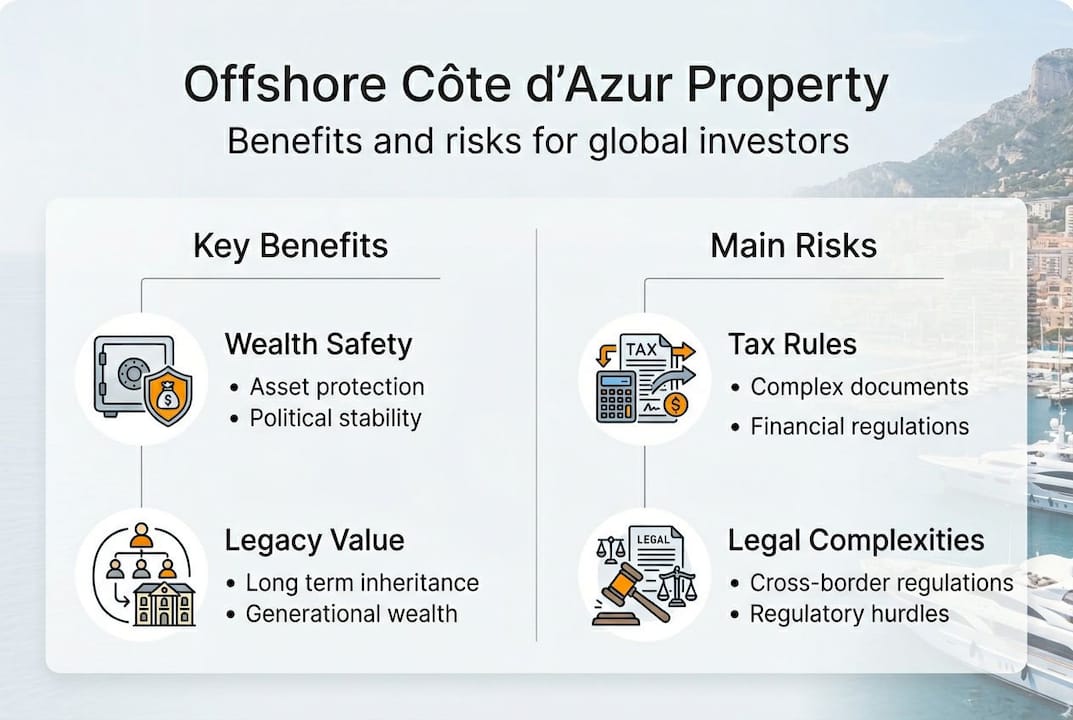
What distinguishes this market from comparable luxury hotspots in Dubai or Bali is its combination of scarcity and prestige. Supply of prime seafront and hillside properties is genuinely finite. Cap d’Antibes offers extraordinary privacy behind stone walls draped in bougainvillea; the Monaco border corridor commands some of Europe’s highest per-square-metre values. These are not merely homes. They are heirlooms etched in stone.
The top criteria our clients prioritise when considering offshore acquisition here include:
- Exclusivity and scarcity: Properties that cannot be replicated, in locations that will not be overdeveloped
- Lifestyle integration: Proximity to Antibes’ Provençal markets, Sainte-Maxime’s Nartelle beach sunsets, or Menton’s celebrated Fête du Citron
- Generational transferability: Assets structured to pass cleanly to heirs with minimal tax friction
- Rental income potential: Elite seasonal lets that generate income while the property appreciates
“A Riviera estate is not a purchase. It is a promise made to future generations, a piece of the Mediterranean sun preserved in stone and light.”
Pro Tip: If you are evaluating offshore locations, compare net yield after local tax, not gross rental income. The Côte d’Azur’s combination of capital appreciation and rental demand makes it exceptionally competitive on a net basis.
Understanding the offshore purchasing process step-by-step
Once the decision to invest is made, clarity on the purchase journey becomes your most valuable asset. The French property acquisition process is structured, transparent, and well-protected by law. It simply requires familiarity.
The key buying steps for international investors are as follows:
- Offer acceptance: Negotiate and agree on price and key terms with the seller
- Appoint a notaire: The notaire (a state-appointed legal officer who oversees the transaction) is mandatory in French property law and protects both parties
- Sign the compromis de vente: This is the preliminary contract, a legally binding agreement that locks in the terms, followed by a 10-day statutory cooling-off period for the buyer
- Pay the deposit: Typically 5 to 10% of the purchase price, held in escrow by the notaire
- Notaire due diligence: The notaire conducts title searches, verifies planning permissions, and checks for charges or encumbrances. This phase takes 2 to 3 months in most cases
- Sign the acte authentique: The final deed of sale, signed before the notaire, at which point funds are transferred and keys are handed over
The table below compares the two key contracts in the French purchase process:
| Contract | Stage | Legal effect | Buyer protection |
|---|---|---|---|
| Compromis de vente | Preliminary | Binding on both parties | 10-day cooling-off period |
| Acte authentique | Final | Transfers full ownership | Title guarantee via notaire |
Pro Tip: International buyers should always appoint their own independent legal counsel alongside the notaire. The notaire is neutral by law, but a bilingual solicitor working exclusively in your interest adds an invaluable layer of protection. Our property acquisition guide outlines exactly how to assemble the right team.
We also strongly recommend assembling what we call a dream team for your purchase: a trusted agent, a bilingual notaire, a tax adviser familiar with your home country’s treaty with France, and a currency specialist to manage exchange rate exposure.
Mastering tax, legal, and regulatory hurdles as a non-resident
For non-resident investors, the French tax landscape requires careful navigation. The most significant levy to understand is the IFI, or Impôt sur la Fortune Immobilière, France’s real estate wealth tax. The IFI applies to non-residents on French property held with a net value exceeding €1.3 million, with progressive rates from 0.5% to 1.5% applied to the taxable base.

Important deductions exist. Mortgage debt secured against the French property reduces the taxable base directly. For those designating a French property as their primary residence, a 30% abatement applies. These allowances can meaningfully reduce the effective IFI burden.
The table below outlines the IFI rate bands as they apply in 2026:
| Net property value | IFI rate |
|---|---|
| Up to €800,000 | 0% |
| €800,001 to €1,300,000 | 0.5% |
| €1,300,001 to €2,570,000 | 0.7% |
| €2,570,001 to €5,000,000 | 1% |
| €5,000,001 to €10,000,000 | 1.25% |
| Above €10,000,000 | 1.5% |
Beyond IFI, non-residents must also consider:
- Taxe foncière: An annual land and property tax payable by the owner
- Capital gains tax: On disposal, non-resident sellers face French capital gains tax at 19%, plus social levies, though tapering reliefs reduce this significantly after 22 years of ownership
- Rental income tax: Rental income sourced in France is taxable in France, typically at 20% for non-residents under the flat-rate regime
- Reporting obligations: Non-residents must file an annual French tax return if they earn French-source income or hold assets above the IFI threshold
Legal structures such as the SCI (Société Civile Immobilière, a French civil property company) can offer advantages in estate planning and income distribution, though they carry their own compliance requirements. Our French Riviera tax guide and luxury real estate tax strategies provide deeper analysis for investors at every stage of planning.
Securing your legacy: Structuring offshore ownership for generational wealth
Beyond acquisition and tax compliance lies the most enduring question of all: how will this asset serve your family in 20 or 50 years? The answer lies in how you structure ownership from day one.
French succession law includes forced heirship rules, meaning a portion of your estate is legally reserved for direct descendants regardless of your wishes. For international investors, this can conflict with structures designed under common law or trust-based systems. The key is to address this before signing the acte authentique, not after.
The main ownership structures available to offshore buyers include:
- Direct personal ownership: Simple and transparent, but subject to French succession law and potentially higher inheritance tax
- SCI (Société Civile Immobilière): Allows shares in the company to be gifted progressively to heirs, reducing inheritance tax liability over time and offering flexibility in income distribution
- Holding via a foreign company: Can offer certain advantages but is increasingly scrutinised by French tax authorities and requires specialist advice
- Life insurance policies (assurance vie): A powerful and tax-efficient tool for passing wealth to nominated beneficiaries outside the standard succession framework
“The most elegant legacy is one that arrives without friction. Structuring your Riviera estate correctly today is the greatest gift you can give those who will inherit it tomorrow.”
Double taxation treaties between France and many investor home countries (including the United Kingdom, the United States, and the UAE) can mitigate the risk of being taxed twice on the same asset or income. Understanding how these treaties interact with your personal tax residency is essential. Our guide on property transfer and legacy explores these intersections in detail.
Pro Tip: Gifting SCI shares to children during your lifetime, rather than bequeathing the property directly, can dramatically reduce inheritance tax through France’s generous abatement system, which allows €100,000 per parent per child every 15 years. Understanding what a luxury portfolio looks like in practice helps frame these decisions within a broader wealth strategy.
Our take: Why strategic expertise transforms offshore property outcomes
We have guided clients from London, Dubai, Singapore, and São Paulo through acquisitions on the Riviera, and one pattern emerges consistently. The investors who achieve the best outcomes are not necessarily those who conduct the most exhaustive due diligence independently. They are the ones who invest in the right relationships early.
The Côte d’Azur luxury market is, by design, opaque. The finest properties rarely appear on public portals. They circulate quietly among trusted networks, exchanged between advisors who have spent decades earning access. Knowing which notaire in Antibes moves quickly, which architect in Èze understands biophilic design, or which off-market estate in Cap d’Antibes is about to become available: this is knowledge that no online search can replicate.
We believe the most critical investment any offshore buyer can make is in mastering the investment process with locally embedded, internationally fluent advisors. Structure matters. Timing matters. But relationships, built on trust and genuine expertise, are what transform a transaction into a legacy.
Connect with Côte d’Azur’s luxury property specialists
Your Riviera legacy begins with a conversation. At Living on the Côte d’Azur, we offer access to off-market luxury properties that never reach public listings, alongside personalised guidance that bridges your compliance obligations with your lifestyle aspirations. Whether you are seeking a sun-drenched villa above Saint-Tropez’s Pampelonne shores or a sleek sea-view residence near Nice’s Promenade des Anglais, our specialists tailor every step of your property acquisition on the Riviera to your unique vision. We also accept cryptocurrency payments, reflecting our commitment to serving the next generation of digital wealth creators. Speak to one of our experts and take the first step towards your Riviera heirloom.
Frequently asked questions
How long does buying property on the Côte d’Azur typically take for international investors?
The purchase process usually takes 2 to 3 months from offer acceptance to closing, encompassing due diligence, the compromis de vente, and the final signing of the acte authentique.
What are the main taxes for non-residents buying French property valued above €1.3 million?
The IFI real estate wealth tax applies, with progressive rates between 0.5% and 1.5%, alongside deductions for mortgages and a 30% allowance for primary residences.
What documents should offshore buyers prepare before starting the purchasing process?
You will need valid identification, certified proof of funds, and, for legal entities, full company documentation along with authorised representative credentials.
Can property purchases be structured for inheritance or family trusts in France?
Yes, structures such as the French SCI and life insurance policies are widely used to manage succession planning, subject to French inheritance law and applicable double taxation treaties.
Recommended
 //
//