
Every investor knows the stakes are higher when legacy and lifestyle are on the line. Real estate offers unique advantages such as tangible stability, reliable income, and sustained capital appreciation that few asset classes can match. For high-net-worth buyers, wealth building through property creates generational security—especially on the Côte d’Azur, where global demand and premium locations ensure enduring value. Discover how strategic ownership in Cannes, Nice, or Cap-d’Ail can protect your capital and provide sophisticated avenues for long-term wealth growth.
Table of Contents
- Defining Wealth Building Through Real Estate
- Luxury Property Types and Investment Strategies
- Legal, Tax and Financial Considerations
- Protecting Generational Wealth and Legacy
- Risks, Market Trends and What to Avoid
Key Takeaways
| Point | Details |
|---|---|
| Wealth Building Through Real Estate | Real estate offers stability and dual income through appreciation and rental revenue, making it a key vehicle for generational wealth. |
| Property Types and Investment Strategies | Diverse luxury property categories cater to varying investor goals; understanding these helps make strategic choices. |
| Legal and Tax Considerations | Navigating tax obligations and legal structures is crucial for wealth protection and efficient ownership in the French market. |
| Market Risks and Mitigation | Understanding market dynamics and potential risks can prevent costly investment mistakes; due diligence is essential for successful acquisitions. |
Defining Wealth Building Through Real Estate
Wealth building through real estate transcends simple property ownership—it’s about creating generational security through tangible assets that appreciate and produce income. For discerning investors seeking to protect their legacy, real estate remains unmatched among wealth-building vehicles.
Unlike volatile markets, real estate offers concrete stability. You own something physical, something that cannot disappear overnight. This tangibility provides psychological reassurance alongside financial returns.
Real estate investment remains effective for long-term wealth accumulation, offering multiple income streams simultaneously. Your property generates rental revenue while the underlying asset appreciates.
Consider the core advantages:
- Inflation protection: Property values and rental income rise with inflation, preserving purchasing power across decades
- Leverage advantage: You control substantial assets with modest capital, amplifying returns on your invested funds
- Tax efficiency: Depreciation deductions, mortgage interest write-offs, and capital gains strategies reduce your tax burden
- Consistent income: Monthly rental payments create reliable cash flow independent of market cycles
- Capital appreciation: Historical Riviera properties appreciate 5–8% annually, doubling value in 10 years
The Côte d’Azur exemplifies this principle perfectly. Mediterranean villas and exclusive apartments don’t just shelter families—they build wealth systematically. Property in Cannes, Nice, or Cap-d’Ail commands premium valuations because global buyers recognise the dual benefit: lifestyle and financial security.
Real estate portfolios integrate profitability with risk management, allowing sophisticated investors to balance capital growth with consistent yields. You’re not gambling; you’re building.
The mathematics are compelling. A €2 million villa appreciating at 6% annually gains €120,000 in value whilst generating €120,000 in annual rental income during peak seasons. That’s €240,000 in total wealth creation yearly—without touching your principal investment.
For families with substantial capital, real estate becomes the cornerstone of generational wealth transfer. Unlike stocks or bonds, property endures. Your children inherit not just financial assets, but tangible legacy—a Mediterranean sanctuary with proven income potential.
Real estate builds wealth through dual mechanisms: appreciation and income. This combination creates resilience that markets alone cannot match.
The Riviera positions you at the intersection of global demand and limited supply. Wealthy families from every continent compete for addresses here, ensuring consistent demand and steady appreciation.
Pro tip: Begin your wealth-building journey by identifying a secondary residence that generates 4–6% annual rental yields whilst appreciating steadily, ensuring your legacy asset works for you immediately rather than merely holding value.
Luxury Property Types and Investment Strategies
The Riviera presents distinct property categories, each serving different wealth-building objectives. Understanding which type aligns with your goals separates casual buyers from strategic wealth builders.
Mediterranean villas remain the cornerstone of Riviera investment. These properties command premium valuations because they offer privacy, gardens, and direct sea access—luxuries that apartments cannot replicate. A restored villa in Mougins or Cap-d’Ail typically appreciates faster than comparable urban properties.

Beachfront apartments attract different investors entirely. Properties along Cannes’ Croisette or Nice’s Promenade des Anglais generate exceptional seasonal rental income. You’re trading privacy for accessibility and consistent occupancy rates.
Town houses in perched villages like Saint-Paul-de-Vence or Èze appeal to lifestyle buyers and renovation enthusiasts. These properties often require restoration but reward investors with authentic Provençal character that modern apartments cannot match.
Here is a side-by-side overview of popular luxury Riviera property types and their strategic roles:
| Property Type | Primary Benefit | Typical Investor Profile |
|---|---|---|
| Mediterranean Villa | Strong capital appreciation | Long-term wealth builders |
| Beachfront Apartment | High seasonal rental income | Income-focused short-term buyers |
| Village Town House | Lifestyle and restoration | Renovation enthusiasts |
| Golf-adjacent Property | Lifestyle plus steady yields | Investors prioritising enjoyment |
Understanding how to evaluate luxury properties helps you identify which category suits your investment timeline and income objectives.
Consider your investment priorities:
- Capital appreciation focus: Mountain villas in Cabris or Roquefort-les-Pins appreciate steadily with minimal management
- Rental income priority: Beachfront apartments in Cannes, Antibes, or Menton generate €15,000–€25,000 monthly during summer
- Lifestyle balance: Golf-adjacent properties in Mandelieu-la-Napoule combine personal enjoyment with 4–5% annual yields
- Legacy planning: Larger estates in Valbonne or Mougins provide space for extended families whilst maintaining investment value
Your strategy should match your timeline. Short-term investors (5–7 years) prioritise rental-generating properties in high-demand locations. Long-term wealth builders (15+ years) select undervalued villas in emerging neighbourhoods with strong appreciation potential.
The dual-income strategy remains optimal for Riviera investors. Purchase a villa that appreciates whilst financing a beachfront apartment generating monthly rentals. This approach balances growth and cash flow simultaneously.
The most successful Riviera investors own multiple property types, diversifying between appreciation assets and income-generating properties across different market segments.
Market dynamics favour property owners who understand seasonal patterns. Summer months flood the Riviera with wealthy holidaymakers willing to pay premium rates. Properties positioned for this influx outperform those marketed year-round at lower rates.
Propertyies in villages like Peymeinade or Saint-Jean-Cap-Ferrat offer growth potential because they’re less saturated than famous locations yet increasingly attract international buyers seeking authentic Riviera experiences beyond mainstream tourist zones.
Pro tip: Acquire your primary property in an established location with proven rental demand, then deploy capital gains into emerging villages where appreciation potential remains untapped—building wealth through strategic geographic diversification.
Legal, Tax and Financial Considerations
Purchasing luxury Riviera property involves more than finding the perfect vista—it requires navigating complex legal structures, tax obligations, and financial strategies that protect your wealth across generations.
France imposes specific regulations on foreign property ownership. Unlike some European nations, France permits non-residents to purchase real estate without restrictions, but your obligations shift significantly once you own property here.
Understanding tax aspects of real estate investments across European markets helps you structure acquisitions efficiently. French property tax, wealth tax implications, and inheritance considerations demand strategic planning before purchase.
Consider these financial dimensions:
- Acquisition costs: Notary fees (7–8%), land registration, and legal services add €140,000–€160,000 to a €2 million purchase
- Annual property tax: Taxe foncière ranges from 0.5–1.5% of cadastral value yearly
- Rental income taxation: Generated income faces standard income tax rates (45% marginal rate for high earners)
- Wealth tax threshold: Properties exceeding €1.3 million trigger wealth tax obligations for French residents
- Inheritance planning: Without proper structuring, heirs face 60% taxation on property transfers
Foreign investors frequently structure acquisitions through companies or trusts to reduce tax exposure. A French company holding property generates different tax treatment than personal ownership, potentially reducing annual obligations by 30–40%.
Cross-border investment frameworks outline how different jurisdictions treat property ownership and income generation. Your residency status determines which tax rules apply—non-resident versus resident status creates vastly different outcomes.
Due diligence extends beyond price negotiation. Verify property titles rigorously, confirm no outstanding debt encumbers the asset, and audit building permits for renovations completed previously. A single undocumented modification can trigger substantial fines from French authorities.
Professional legal counsel isn’t optional—it’s essential. One overlooked tax classification costs more than quality advice prevents.
Inheritance planning demands attention immediately upon purchase. Without proper structures, your children face inheritance taxes consuming 40–60% of property value. Strategic planning reduces this to 5–15% through legitimate mechanisms.
Currency considerations matter for international buyers. Property prices display in euros, but acquisition costs, ongoing taxes, and future sales involve currency risk. Hedging strategies protect against unfavourable exchange movements across transaction phases.
Finance your purchase strategically. French mortgages for non-residents exist but carry higher rates (4–5.5%) than resident buyers receive. Many international investors prefer cash purchases to avoid complications, though leveraging debt can enhance returns when rental yields exceed borrowing costs.
Pro tip: Engage a French notaire and international tax advisor simultaneously during due diligence—their combined expertise identifies structural inefficiencies before you commit capital, potentially saving €200,000+ in taxes across your ownership timeline.
Protecting Generational Wealth and Legacy
Legacy planning through real estate transcends financial transactions. You’re orchestrating how your family flourishes across generations, ensuring values persist alongside wealth.
Most families fail at wealth transfer because they treat it as an afterthought. Property purchased without inheritance structures creates chaos for heirs—forcing them to navigate probate, inheritance taxes, and potential disputes over assets worth millions.
Real estate strategies to build generational wealth emphasise structured ownership through trusts and funds. These mechanisms protect assets whilst enabling smooth wealth transfer. A Côte d’Azur villa placed in a properly structured trust passes to heirs with minimal tax friction.
Structured ownership provides multiple benefits:
- Asset protection: Trusts shield property from creditors and legal claims
- Tax efficiency: Proper structures reduce inheritance taxes from 60% to 5–15%
- Probate avoidance: Trusts bypass lengthy court processes, enabling immediate family access
- Control persistence: You dictate how heirs use property, preserving your vision across decades
- Privacy maintenance: Trust structures keep wealth details confidential, unlike public probate records
Different structures serve different purposes. A simple will works for modest estates but fails spectacularly for multimillion-pound properties across multiple jurisdictions. Trusts, holding companies, and family offices provide sophisticated protection for substantial wealth.
Education strengthens legacy planning. When children understand property as an investment vehicle—not merely inherited treasure—they protect and grow assets intelligently. Riviera properties offer tangible lessons in supply-demand economics, market cycles, and wealth multiplication.
Strategic real estate investments provide tangible assets with appreciation potential and steady cash flow. Properties positioned to generate rental income during peak seasons teach heirs about income streams whilst funding property maintenance and taxes.
Consider these protection mechanisms:
- French inheritance law limitations: Local law restricts how aggressively you can direct asset distribution
- Double taxation risk: Property ownership across multiple countries triggers overlapping tax obligations
- Currency exposure: Wealth held in euros faces exchange-rate fluctuations affecting pound-sterling or dollar heirs
- Market timing considerations: Property values fluctuate; purchasing timing affects inherited value
Generational wealth protection requires professional guidance. One structural oversight costs more than comprehensive planning prevents.
Your legacy encompasses more than financial figures. Properties in Saint-Paul-de-Vence or Mougins become family anchors—places where generations gather, celebrate, and reconnect with heritage. This emotional wealth matters alongside financial security.
Timing matters profoundly. Property acquired today appreciates for thirty years before transfer, multiplying initial value substantially. Early acquisition maximises appreciation benefit whilst allowing decades for tax-efficient structuring.
Pro tip: Establish your property holding structure now through a French notaire, then gradually transfer assets during your lifetime using annual gifting allowances—reducing inheritance-tax burden whilst enabling heirs to understand assets before inheriting control.
Risks, Market Trends and What to Avoid
Riviera real estate attracts global wealth, but not every property appreciates. Understanding market risks separates successful investors from those who lose millions through preventable mistakes.
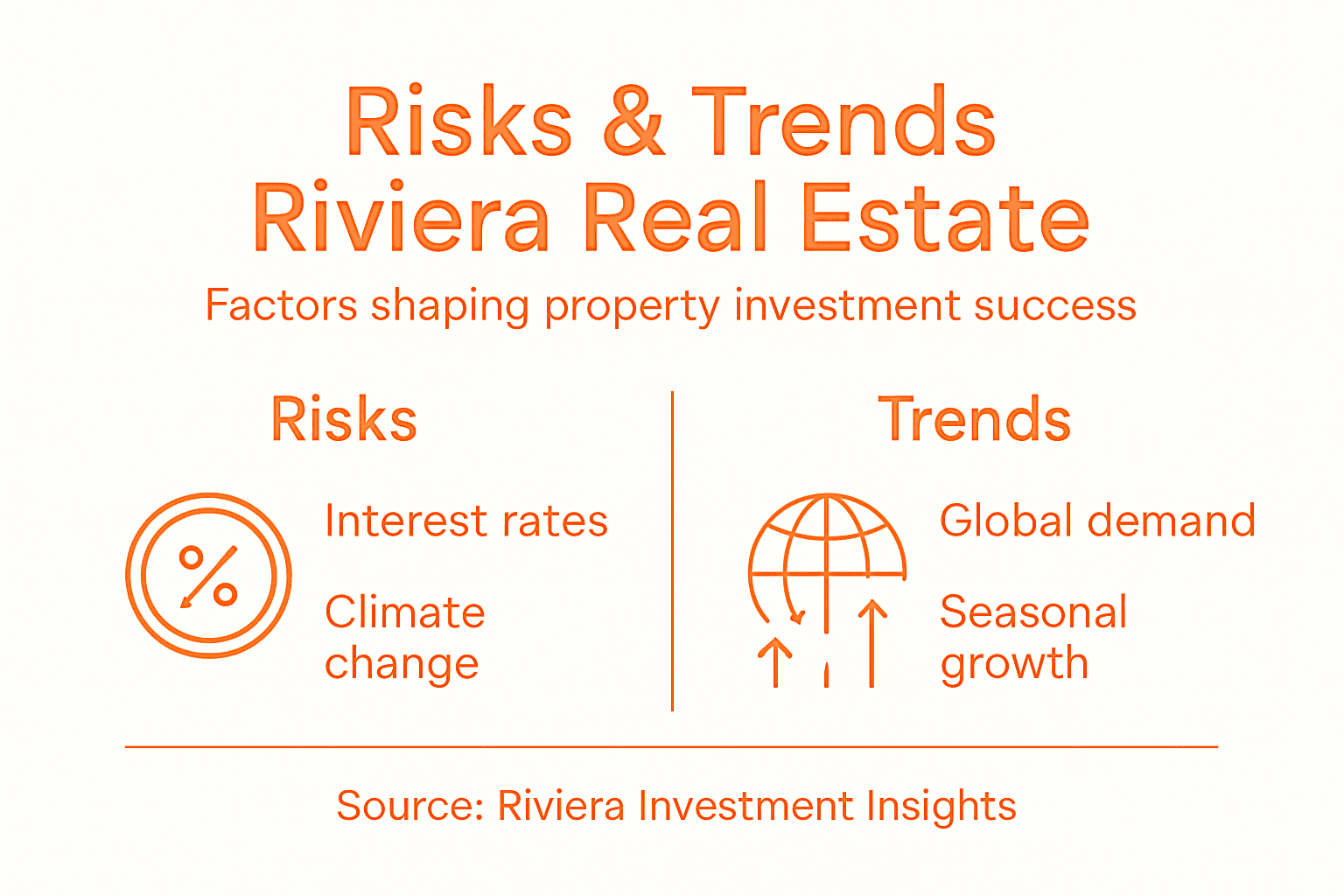
Interest rates directly impact property valuations. When borrowing costs rise, buyers disappear, pushing prices downward. The Riviera experienced this during 2022–2023 as European Central Bank rate increases cooled demand. Properties priced aggressively during low-rate periods become vulnerable when conditions shift.
Market volatility and value stabilisation uncertainty require careful analysis before committing capital. Properties purchased at peak valuations can take years to recover if broader economic conditions deteriorate unexpectedly.
Avoid these common pitfalls:
- Overpaying for location prestige: Famous addresses command premium prices that don’t justify returns; emerging villages offer better appreciation potential
- Ignoring renovation requirements: Cosmetic appeal masks structural defects costing €300,000+ in concealed repairs
- Neglecting market cycles: Buying at peaks rather than troughs dramatically reduces wealth-building outcomes
- Underestimating holding costs: Property tax, insurance, and maintenance drain 2–3% annually from capital
- Assuming permanent rental demand: Economic downturns destroy seasonal occupancy rates rapidly
Climate risks increasingly threaten Riviera properties. Rising sea levels, flooding, and extreme weather events affect coastal valuations long-term. Environmental and regulatory risks mean properties without resilience features face declining values whilst eco-certified properties appreciate steadily.
Properties below 300 metres elevation near the sea face regulatory restrictions within twenty years. Insurance costs climb sharply for flood-prone locations. Forward-thinking investors select elevated properties with comprehensive climate resilience instead.
Rental market saturation damages returns. Cannes and Antibes beaches attract so many short-term rentals that occupancy rates dropped from 80% to 55% between 2019 and 2024. Villages like Mougins and Valbonne maintain stronger occupancy because fewer properties compete for bookings.
Property selection determines wealth outcomes. One poor acquisition wastes a decade’s appreciation potential across your entire portfolio.
Foreign exchange exposure undermines returns for International buyers. A villa appreciating 6% annually whilst sterling weakens 8% creates negative total returns. Hedging strategies protect wealth across currency movements.
Due diligence gaps create catastrophic losses. Properties with undisclosed structural issues, contaminated soil, or legal encumbrances become unsellable liabilities. Professional surveys and legal audits cost €5,000–€8,000 but prevent million-pound disasters.
Below is a summary of key risks Riviera property investors should assess before purchase:
| Risk Factor | Potential Impact | Mitigation Approach |
|---|---|---|
| Market Timing | Lower appreciation or negative returns | Buy during market dips, not peaks |
| Climate Exposure | Decreased value, higher insurance | Select elevated, resilient properties |
| Rental Market Saturation | Reduced occupancy and rental income | Target less crowded villages |
| Foreign Exchange Fluct. | Erodes capital gains for non-euro investors | Use hedging or multi-currency accounts |
Pro tip: Purchase properties in secondary villages with emerging international appeal rather than saturated famous locations; emerging areas provide 7–9% appreciation whilst maintaining lower entry prices and stronger rental demand than overcrowded destinations.
Elevate Your Legacy With Riviera Real Estate Expertise
Building wealth through real estate is no ordinary investment journey. It requires navigating complex legal landscapes, optimising tax efficiency and strategically selecting iconic Riviera properties that deliver both capital appreciation and dependable rental income. If your goal is to craft a lasting family legacy rooted in the unique allure of the Côte d’Azur, you need a partner who understands how to transform these challenges into opportunities.
At Living on the Côte d’Azur, we specialise in connecting discerning buyers like you with high-value properties that double as enduring heirlooms. Whether you seek Mediterranean villas with eco-luxury finishes, income-generating beachfront apartments or off-plan masterpieces, our insider knowledge ensures your acquisition aligns with your wealth-building vision and estate planning goals. Explore our insights on buying luxury real estate on the French Riviera and discover how our tailored guidance can protect your capital and maximise returns amid shifting market conditions.
Ready to secure your family’s future through the Riviera’s timeless beauty and investment resilience? Start your wealth-building journey with us now by reaching out through Contact Nice to Meet You. Let us help you navigate generational wealth protection and seize legacy investment opportunities today.
Frequently Asked Questions
What are the main advantages of investing in real estate for wealth building?
Investing in real estate offers advantages such as inflation protection, leverage benefits, tax efficiency, consistent rental income, and capital appreciation.
How does leverage work in real estate investments?
Leverage allows investors to control substantial assets with a relatively small amount of their own capital, thereby amplifying potential returns on their investments.
What tax considerations should I be aware of when investing in real estate?
Investors should consider acquisition costs, annual property taxes, rental income taxation, and inheritance planning to ensure effective tax efficiency and compliance with local regulations.
How can I protect my generational wealth through real estate?
Wealth protection can be achieved through structured ownership, such as using trusts, which provide benefits like asset protection, tax efficiency, and allowing for smoother transfers of wealth to heirs.
Recommended
 //
//