
TL;DR:
- A luxury portfolio combines high-value assets for legacy, income, and enjoyment, not just expensive properties.
- Building a resilient portfolio requires strategic asset selection, diversifying locations, and balancing passion with performance.
- Managing risks like illiquidity, high maintenance, and tax complexities is essential for long-term success.
Most high-net-worth investors assume that owning several premium properties automatically constitutes a luxury portfolio. It does not. The distinction is sharper than it appears, and confusing the two can cost you both capital and legacy. A true luxury portfolio is a living strategy, one that weaves together personal enjoyment, generational wealth transfer, and financial performance into a single, coherent vision. Across the Côte d’Azur, from the salt-kissed corniches of Èze to the yacht-dotted marinas of Antibes, we see this distinction play out every season. This guide clarifies exactly what a luxury portfolio is, what belongs inside one, and how to build it with precision and purpose.
Table of Contents
- The foundation of a luxury portfolio
- What’s included: Assets, attributes, and strategic purpose
- Risks and nuances: From illiquidity to legacy planning
- Best practices for building and managing your luxury portfolio
- Our perspective: What most guides miss about luxury portfolios
- Connect with Côte d’Azur luxury property experts
- Frequently asked questions
Key Takeaways
| Point | Details |
|---|---|
| Strategic curation is essential | A luxury portfolio involves careful selection of assets with lasting value, not just costly properties. |
| Balance passion and legacy | Success blends legacy ambitions with the enjoyment of unique real estate. |
| Manage unique risks | Risks like illiquidity and maintenance require proactive planning and expert guidance. |
| Professional management adds value | Engaging experts protects portfolio value and simplifies tax and legacy transitions. |
The foundation of a luxury portfolio
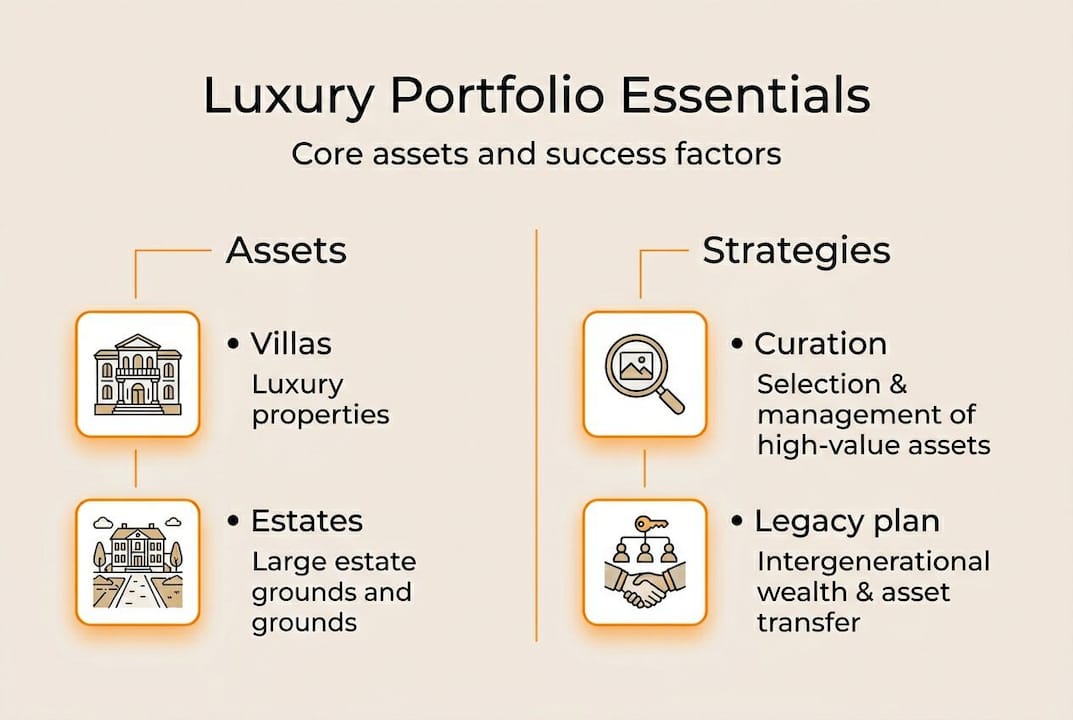
A luxury portfolio is not simply a collection of expensive properties. It is a curated constellation of high-value assets, each chosen for a specific role: legacy anchor, yield generator, or personal sanctuary. Defining luxury real estate is the first step, because not every property priced above €2M qualifies. Provenance, architecture, location prestige, and long-term liquidity all determine whether an asset earns its place.
The core components of a well-structured luxury portfolio typically include:
- Villas and private estates: The cornerstone assets, often in prestige locations such as Cap d’Antibes or the Monaco border communes, offering both capital appreciation and elite seasonal rental income.
- Penthouses and sky residences: Urban luxury in cities like Nice or Cannes, providing liquidity advantages and access to cultural life, from the Croisette’s film festival energy to Cours Saleya’s flower-scented morning markets.
- Heritage estates and Provençal mas: Restored farmhouses and historic properties that carry deep provenance, cultural resonance, and strong emotional value for families building multigenerational legacies.
- New-build and off-plan assets: Contemporary eco-villas and biophilic residences, such as those emerging along Sainte-Maxime’s Nartelle coastline, offering ten-year warranties, lower notary fees, and zero-interest payment plans.
Geographic spread matters enormously. A portfolio anchored entirely in one commune is exposed to localised market shifts. Spreading assets across Nice, Menton, and Saint-Tropez creates natural resilience.
The dual purpose of a luxury portfolio is what truly separates it from standard property investment. As luxury property marketing specialists understand, these assets must perform financially while also delivering genuine joy of ownership. Modern luxury portfolios blend passion with performance, balancing personal enjoyment against investment returns in a way that standard buy-to-let strategies never attempt.
“Luxury portfolios require balancing passion and performance. The most successful investors treat their properties as both heirlooms and assets, never sacrificing one for the other.”
Modern turnkey estates are increasingly favoured over rustic properties precisely because they reduce friction. Less maintenance burden means more time enjoying Nietzsche’s trails above Èze or the lemon-scented ramparts of Menton during the February Fête du Citron.
What’s included: Assets, attributes, and strategic purpose
Building on the foundation, it is essential to examine the variety of assets and the intent behind a high-value portfolio. Not all luxury assets are created equal, and the Côte d’Azur offers a remarkable range of options, each with distinct advantages.
| Asset type | Key advantage on the Côte d’Azur |
|---|---|
| Turnkey villa | Immediate rental income, low maintenance, strong capital growth |
| Penthouse | Urban liquidity, cultural access, prestige address |
| Heritage estate | Provenance, emotional legacy, unique market positioning |
| Off-plan new build | Warranty protection, eco-certification, flexible payment terms |
| Provençal mas | Authenticity, rural prestige, multigenerational family appeal |
Provenance and physical asset risk, including damage to unique amenities, bespoke interiors, or integrated art collections, are key considerations that many first-time luxury investors overlook. A villa in Cap d’Antibes with a rare Picasso-era mosaic pool surround carries both exceptional value and exceptional responsibility.
To assess strategic intent before curating high-value assets, we recommend a structured approach:
- Define your yield expectations: Are you targeting 3 to 5% annual returns through elite seasonal rentals, or is capital appreciation your primary measure of success?
- Clarify your legacy horizon: Is this asset intended for your children, a family trust, or eventual sale? The answer shapes every decision from purchase structure to renovation choices.
- Assess personal enjoyment value: A property you love to inhabit during the Cannes Film Festival or Saint-Tropez’s summer regattas is worth more to your overall wellbeing than a higher-yielding asset you never visit.
- Evaluate market liquidity: Prime Riviera addresses sell within weeks in strong markets. Secondary locations may take months. Your portfolio needs both types, balanced deliberately.
A legacy real estate strategy that ignores personal enjoyment tends to underperform emotionally, even when it performs financially. The most enduring portfolios we encounter are those where investors genuinely love what they own.
Risks and nuances: From illiquidity to legacy planning
With the landscape of assets and intent clarified, attention turns to the real-world challenges luxury portfolio holders face. These are not theoretical risks. They are the practical realities that separate informed investors from those who learn costly lessons.

| Risk category | Description | Mitigation approach |
|---|---|---|
| Illiquidity | Prime properties may take months to sell | Maintain liquid reserves; diversify asset types |
| High maintenance | Estates require ongoing, specialist upkeep | Budget 1 to 2% of asset value annually |
| Physical asset risk | Damage to art, bespoke features, unique amenities | Specialist insurance; condition surveys |
| Provenance issues | Title disputes or unclear ownership history | Legal audit before purchase |
| Tax exposure | Cross-border ownership creates complex obligations | Engage specialist tax counsel early |
| Generational transfer | Inheritance structures vary by jurisdiction | Establish trusts or SCI structures proactively |
Illiquidity, high maintenance, and legacy planning nuances are the edge cases that most guides gloss over, yet they are precisely where portfolios falter. A villa in Menton may be worth €4M on paper, but if it requires €200,000 in annual upkeep and takes nine months to sell, its role in your portfolio must be planned accordingly.
Pro Tip: Always maintain a liquidity reserve equivalent to at least 18 months of combined maintenance costs across your portfolio. This protects you from forced sales during market downturns and preserves your negotiating power when exceptional off-market opportunities arise.
Tax structuring for cross-border assets is a field in itself. French SCI (Société Civile Immobilière) structures are widely used to hold Riviera properties, offering both inheritance planning advantages and operational flexibility. Understanding luxury real estate investment risks before committing capital is not optional. It is the foundation of responsible ownership.
Generational transfer deserves particular attention. French inheritance law applies forced heirship rules, meaning children have legally protected shares of an estate. Investors from common law jurisdictions are often surprised by this. Engaging a notaire and an international real estate tax strategies specialist before purchase, not after, is the mark of a truly prepared investor. Explore investment strategies for legacy to understand how structure shapes outcome.
Best practices for building and managing your luxury portfolio
Appreciating the risks, it is critical to know how to build and manage a luxury portfolio that actually delivers value. The Côte d’Azur rewards the prepared and the patient. Impulsive acquisitions, however beautiful, rarely serve a portfolio’s long-term purpose.
Modern turnkey villas are increasingly preferred over rustic properties by investors seeking performance alongside enjoyment. The reason is straightforward: a turnkey asset in Antibes generates rental income from day one, requires minimal capital expenditure, and appeals to the discerning seasonal tenant who expects perfection.
Pitfalls to avoid when building your portfolio:
- Buying for passion alone: Emotional attachment to a property is natural, but it must be balanced against yield, liquidity, and strategic fit.
- Neglecting liquidity planning: Every portfolio needs assets that can be converted to cash within a reasonable timeframe without catastrophic loss.
- Overlooking tax obligations: French wealth tax (IFI), capital gains rules, and cross-border reporting requirements are not optional considerations.
- Underestimating management complexity: A portfolio of three or more properties across different communes requires professional oversight, not a part-time approach.
- Ignoring eco-credentials: In 2026, green certifications and solar arrays are no longer optional extras. They protect future value and appeal to the next generation of buyers.
Pro Tip: Treat property management tips as seriously as acquisition strategy. The finest villa in Saint-Tropez loses value quickly if poorly maintained between seasons. Professional management preserves both the asset and the experience.
Financing strategy also shapes portfolio performance. Leveraging property financing strategies intelligently, particularly as European rates ease through 2026, allows you to amplify returns without concentrating risk. A well-financed portfolio grows faster than one built entirely on equity.
Our perspective: What most guides miss about luxury portfolios
Most guides treat luxury portfolios as purely financial instruments. We disagree, and our experience across the Riviera confirms it. The investors who build the most enduring portfolios are those who understand that real luxury value is inseparable from lived experience.
Conventional advice focuses on yield percentages and diversification ratios. It rarely addresses the soft factors: the joy of watching your grandchildren swim in a Cap d’Antibes cove, the pride of owning a heritage mas that carries four centuries of Provençal history, or the quiet confidence of knowing your assets are structured to protect your family regardless of what markets do.
We also observe that many investors underestimate the importance of a robust exit strategy. Markets shift. Family circumstances evolve. The portfolio that serves you brilliantly at fifty may need restructuring at sixty-five. Building in flexibility from the outset, through diverse asset types, sound legal structures, and professional management, is what separates a luxury portfolio that endures from one that merely exists.
True success lies in the blend: strategic curation, willingness to adapt, and an unwavering commitment to both legacy and lifestyle.
Connect with Côte d’Azur luxury property experts
With a deeper understanding of what a luxury portfolio truly requires, the next step is finding the right partner to bring that vision to life. At Living on the Côte d’Azur, we offer access to exclusive Riviera villa and penthouse listings, including off-market opportunities that never reach public portals. Our team combines intimate local knowledge with a global network spanning Ibiza, Dubai, Bali, and beyond. We also accept cryptocurrency payments, making acquisition seamless for digital asset holders. Explore our Côte d’Azur luxury property guide for curated insights, or speak to a local advisor to begin your bespoke portfolio conversation today.
Frequently asked questions
What makes a property suitable for a luxury portfolio?
A property fits a luxury portfolio when it offers proven provenance, amenities, and strategic market value alongside the ability to support both legacy ambitions and personal enjoyment. Location prestige, liquidity, and legal clarity are equally non-negotiable.
What are the main risks in building a luxury portfolio?
The primary risks are illiquidity, high maintenance, and legacy planning nuances, compounded by cross-border tax complexity and the physical risks inherent in maintaining bespoke, high-value assets over time.
How do legacy and enjoyment coexist in a luxury portfolio?
Luxury portfolios balance passion and performance through careful curation and professional management, ensuring that properties deliver genuine joy of ownership while also meeting financial and generational objectives.
Why are modern turnkey villas preferred to rustic estates?
Modern turnkey villas are increasingly favoured because they offer immediate rental performance, minimal capital expenditure on restoration, and a lifestyle-ready experience that both owners and elite tenants expect from a premium Riviera property.
Recommended
- Real Estate Investment Strategies Shaping Legacy and Yield
- Luxury asset advisory: Secure your Côte d’Azur legacy
- How to select luxury amenities for legacy investments 2026
- Curating High-Value Real Estate: Legacy and ROI
- Curated Event Portfolio: Elevating Luxury Experiences – Winelands Function – For Every Occasion, Your Celebration
 //
//