
TL;DR:
- Italian villas are historic symbols of civilizational prestige rooted in Renaissance architecture and noble lineage.
- They offer low rental yields but high capital appreciation, cultural value, and multigenerational legacy.
- Ownership emphasizes privacy, heritage preservation, and authentic Italian lifestyle over immediate financial returns.
Not all luxury villas are created equal. While Monaco-border estates and Cap d’Antibes retreats inspire breathless admiration, Italian villas occupy an entirely singular position in the global property firmament. They are not simply homes. They are stone-bound chronicles of civilisation, shaped by Renaissance aristocracy, softened by cypress-lined gardens, and defined by an architectural opulence that no new build can replicate. For high-net-worth investors who seek more than yield, who measure wealth in centuries rather than quarters, understanding precisely what distinguishes Italian villas is the first step towards one of the most profound legacy investments available in 2026.
Table of Contents
- Foundations of Italian villa prestige
- Comparing financial profiles: Italian villas vs. other luxury assets
- Lifestyle and legacy: beyond investment
- Practical steps for high-net-worth buyers in 2026
- Italian villas: what most guidebooks won’t tell you
- Explore exceptional legacy opportunities
- Frequently asked questions
Key Takeaways
| Point | Details |
|---|---|
| Heritage and lifestyle value | Italian villas offer a blend of cultural prestige, privacy, and history unmatched by other luxury properties. |
| Balanced investment returns | Luxury villas yield lower returns compared to city properties but provide stable value and rental income potential. |
| Restoration boosts legacy | Renovations can raise villa values by 10–20% while preserving irreplaceable heritage. |
| Tax regimes for HNWIs | Italy’s flat tax options attract wealthier buyers seeking efficient legacy planning. |
Foundations of Italian villa prestige
To appreciate why Italian villas command the reverence they do, you must first understand where they come from. The Italian villa tradition stretches back to ancient Rome, but it was the Renaissance, particularly the 15th and 16th centuries, that crystallised the form we recognise today. Florentine banking families, Venetian merchant princes, and Papal nobility commissioned architects such as Palladio and Michelozzo to create estates that announced power, taste, and permanence in one graceful composition. These were not retreats from the world. They were declarations of it.
The architectural hallmarks that survive today are irreplaceable. Consider the defining features found across key features in Italian estates: the loggia (an open-sided gallery that frames garden vistas like a living painting), hand-painted frescoes adorning vaulted ceilings, geometrically planted gardens aligned with seasonal light, and stone facades that grow more distinguished with every passing decade. These elements cannot be sourced from a catalogue or specified in a VEFA contract. They exist because generations of craftsmen, patrons, and guardians chose to protect them.
This heritage creates a prestige value that is fundamentally different from the prestige of a sleek Monaco-adjacent penthouse or a Sainte-Maxime beachside apartment. It is earned through centuries, not marketing budgets.
“Historic villas offer prestige but lower yields, with luxury Varenna villas on Lake Como yielding as little as 0.5% gross, compared to urban properties exceeding 6%. However, restoration boosts value 10–20%, and flat tax regimes continue to attract high-net-worth individuals despite bureaucracy being higher than in Spain.” — Danilo Romolini, Italian luxury real estate specialist
What this means in practice is that the acquisition of a historic Italian villa is not purely a yield play. It is a capital appreciation story, a cultural stewardship story, and, above all, a legacy story. Restoration, when executed with expertise and sensitivity, meaningfully increases both financial value and what we might call historical capital, the rare intangible that makes a property genuinely irreplaceable.
Key architectural and cultural distinguishing features of Italian villas include:
- Frescoes and original decorative artwork, often by named Renaissance or Baroque artists, adding authenticated artistic value
- Loggias and colonnaded terraces, providing indoor-outdoor living that predates every biophilic design trend by five centuries
- Formal Italian gardens, geometrically precise, often containing centuries-old olive trees or grapevines with documented provenance
- Stone and terracotta construction, materials that regulate temperature naturally and improve aesthetically over time
- Aristocratic ownership histories, some estates having passed through noble families for generations, providing compelling narratives for discerning buyers and their heirs
These qualities form the bedrock upon which Italian villa prestige is built. No competing European luxury asset class, whether a French Riviera Belle Époque mansion or an Andalusian cortijo, carries quite the same density of civilisational heritage per square metre.
Comparing financial profiles: Italian villas vs. other luxury assets
Understanding the roots of Italian villa prestige, we now explore how these foundations play out economically compared to other luxury investments. The financial picture is nuanced, and any investor who approaches Italian villas expecting the same metrics as urban rental portfolios will be surprised. Knowingly so, in the best sense.
Italian rental yields average 7.27% nationally in Q3 2025, with cities like Palermo reaching 8.51% and Catania 9.19%. These are compelling urban figures. Luxury villas, however, occupy a different universe: Tuscany averages 4.84% gross and 3.33% net, while Lake Como averages 4.6% gross and 3.1% net. The gap is significant and intentional.
| Property type | Gross yield | Net yield | Typical buyer profile |
|---|---|---|---|
| Italian urban apartment (Palermo) | 8.51% | 5.5–6.5% | Income-focused investor |
| Tuscany luxury villa | 4.84% | 3.33% | Legacy and lifestyle buyer |
| Lake Como luxury villa | 4.60% | 3.10% | Ultra-HNW legacy buyer |
| Varenna historic villa | ~0.5% | Negligible | Prestige and heritage buyer |
| French Riviera villa (comparable) | 3.5–5% | 2.5–3.5% | International elite buyer |
What the table reveals is not a weakness in Italian luxury villa investment. It reveals a different value proposition entirely. For families channelling inherited capital into multi-generational assets, the net yield is one metric among several, and often not the most important one.
€4.84% gross yield in Tuscany may seem modest beside urban alternatives, but when paired with capital appreciation driven by scarcity (there are a finite number of historic villas), plus the premium commanded by carefully restored properties, the total return calculation changes materially.

Short-term luxury rentals represent the most effective income strategy for Italian villa owners in 2026. A restored Chianti farmhouse with a private pool and authenticated frescoes can command €15,000 to €30,000 per week during peak summer season, accommodating eight to twelve guests who seek an experience utterly unavailable in any hotel. Operated for eight to ten peak weeks annually, such a property can generate meaningful income while remaining a private family retreat for the remainder of the year. This seasonal model, familiar to anyone who studies our luxury rental yield guide, is well-established across the Mediterranean arc.
Pro Tip: When assessing Italian villa investments, calculate yield on total cost of ownership including restoration, not just acquisition price. A thoughtfully restored villa will outperform a neglected comparable property on both income and capital grounds within five years.
Italy’s flat tax regime, available to new residents and structured to attract high-net-worth individuals, further adjusts the net return calculation in favour of discerning buyers. Our Italy real estate guide outlines how this regime works in practical terms for non-resident investors considering primary or secondary villa ownership.
Lifestyle and legacy: beyond investment
While yields and costs are tangible, the true legacy of an Italian villa lies deeper, within the lifestyle and heritage they preserve. This is the dimension that spreadsheets cannot capture and that separates this asset class from every alternative.
Privacy is among the most valued commodities in 2026 for ultra-high-net-worth families. A Tuscan estate of ten hectares, shielded by cypress allées and rolling vineyards, offers a form of seclusion that no gated development can engineer. The landscape itself becomes a protective perimeter. Lake Como villas offer a different but equally precious privacy, framed by water and mountains, accessible only by boat or winding road, the kind of retreat that has attracted European aristocracy for two centuries and continues to attract the world’s most discerning owners.
“The decision to acquire a historic Italian villa is rarely purely financial. It is most often the recognition that certain things cannot be created again, only stewarded.” — A perspective shared consistently by specialists in Italian heritage property
Multi-generational value is the defining characteristic that makes Italian villas resonate with elite investor buyer trends in 2026. When a family acquires a property with a documented history stretching back centuries, they are not purchasing a home. They are joining a lineage. The estate becomes the anchor point for family gatherings, the backdrop for milestones, and ultimately the most tangible form of wealth transfer available to any generation.
The lifestyle advantages of Italian villa ownership extend well beyond the property boundaries:
- Cultural immersion in communities where festivals, harvests, and seasonal traditions have remained largely unchanged for generations
- Culinary provenance, with many estates producing their own olive oil, wine, or citrus, creating an authentic connection to the land that resonates deeply with families who value sustainability
- Conservation stewardship, whereby villa owners contribute to the preservation of Italian cultural heritage, sometimes qualifying for state restoration grants that further enhance the property’s financial profile
- Community prestige, because in the villages and towns surrounding historic estates, villa ownership carries a social recognition that no urban apartment can confer
In 2026, we observe a clear shift among ultra-HNW buyers away from purely yield-oriented luxury property towards what might be called experience-rich assets. Italian villas sit at the apex of this category. Authenticity, privacy, heritage, and lifestyle return are the metrics that matter most to buyers who already have financial security and are now building something more enduring.
Practical steps for high-net-worth buyers in 2026
After understanding both tangible and intangible advantages, let’s break down a step-by-step approach for securing the right Italian villa investment in 2026.
Engage a specialist local agent with verifiable transaction history in the specific region you are targeting. Tuscany, Lake Como, Puglia, and the Amalfi Coast each have distinct micro-markets, regulations, and valuation dynamics. A Florentine agent’s expertise does not transfer automatically to a Lecce acquisition.
Commission a full legal title audit before any offer. Italian property law is layered, and historic villas may carry agricultural use restrictions, heritage listing obligations (vincoli), or unresolved inheritance claims from earlier ownership transfers. These are manageable with the right legal counsel, but they must be identified early.
Conduct a thorough structural and restoration survey. Many historic villas present beautifully but carry deferred maintenance. Understanding the true cost of bringing a property to its optimal condition is essential to accurate investment modelling. Remember: restoration boosts value 10–20%, but only when executed professionally.
Assess flat tax eligibility. Italy’s flat tax regime for new residents can be transformative for high-net-worth buyers, bureaucracy and taxes being higher than in Spain, yet offset meaningfully by this structure. Work with a specialist Italian tax adviser to model the full fiscal picture before acquisition.
Model seasonal rental income conservatively. High-end short-term rentals deliver the best income performance for Italian villas, but revenue projections should be based on verified comparable transactions, not aspirational peak-week rates.
| Acquisition stage | Key action | Specialist required |
|---|---|---|
| Pre-offer | Legal title audit and heritage status check | Italian property lawyer |
| Offer stage | Structural and restoration survey | Certified geometra or architect |
| Financial planning | Flat tax regime assessment | Italian tax adviser |
| Post-acquisition | Rental management strategy | Luxury villa management company |
| Ongoing | Heritage grant applications (if applicable) | Specialist restoration consultant |
Pro Tip: Consider acquiring a villa that has already been partially restored and is generating seasonal rental income. This reduces both financial risk and the time before your investment begins working. You can then phase further restoration using income generated by the property itself.
For those who value cross-border portfolio diversification, exploring regional investment patterns across Italy, the French Riviera, and other Mediterranean markets reveals how Italian villas complement rather than compete with other luxury assets.
Italian villas: what most guidebooks won’t tell you
We have guided clients through acquisitions across the Mediterranean arc for many years, and the lesson that recurs most consistently is this: the buyers who achieve the most satisfaction, and often the strongest long-term returns, are those who stopped trying to make Italian villas fit a conventional investment model.
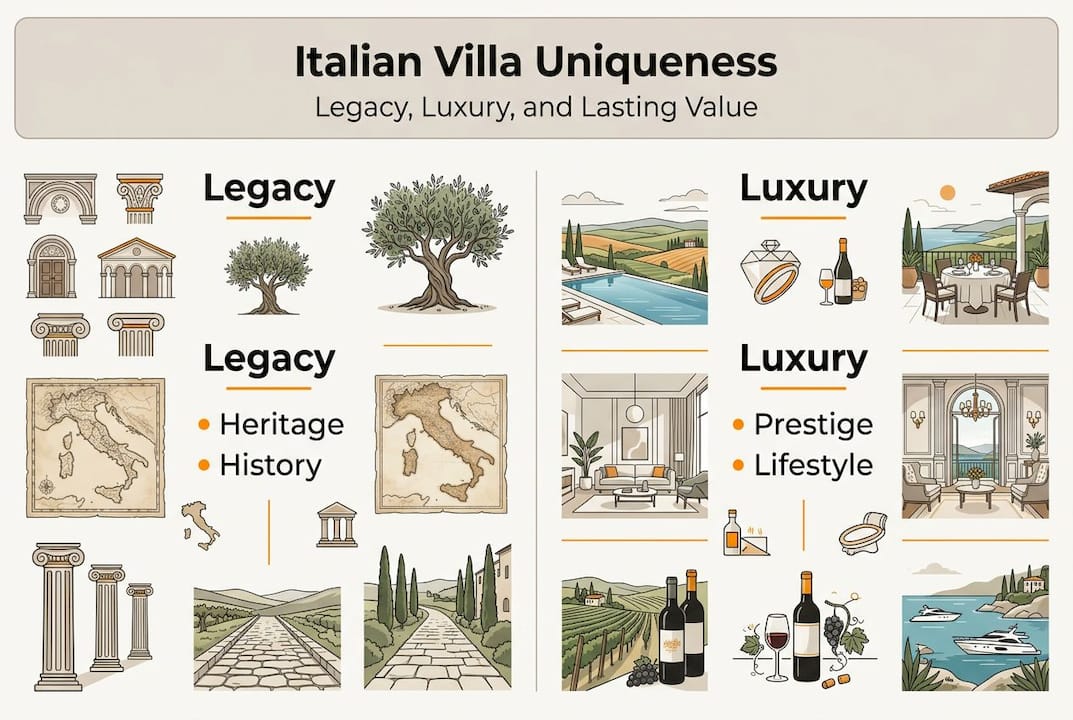
The common myth is that modest yields indicate a weak investment. In reality, the scarcity of authentically historic, well-located Italian villas creates a supply constraint that drives long-term capital appreciation in ways that higher-yielding urban properties rarely match. The families we work with who purchased Tuscan estates a decade ago have not merely preserved wealth. They have created the kind of family mythology that money alone cannot buy.
Emotional value and legacy consistently outweigh yield for ultra-HNW families at a certain stage of wealth accumulation. When financial security is established, the question shifts from “what will this return?” to “what will this mean?” Italian villas answer the second question with extraordinary eloquence.
We have seen clients who initially approached restoration projects with trepidation transform hesitant acquisitions into defining family assets, with the restored villa becoming the backdrop for weddings, the venue for multigenerational summer gatherings, and ultimately a gift to children that carries more meaning than any financial instrument. Our prime investment case studies illustrate how this principle applies across Mediterranean legacy markets, including the Côte d’Azur.
The guidebooks focus on yields. We focus on what endures.
Explore exceptional legacy opportunities
At Living on the Côte d’Azur, we curate legacy investments across the world’s most prestigious markets, from Cap d’Antibes to Lake Como, from Tuscany’s rolling hillsides to the sun-warmed terraces of Puglia. If Italian villas have captured your imagination, our legacy and luxury ROI guide offers a thorough framework for evaluating these extraordinary assets alongside other elite opportunities. For those newer to the category, what luxury real estate represents at this level of the market is a useful foundation. We welcome cryptocurrency payments and work exclusively with buyers who see property as an heirloom, not merely a transaction. Connect with our team to begin your curated search.
Frequently asked questions
What are the main tax advantages for high-net-worth buyers of Italian villas?
Italy’s flat tax regime offers significant advantages for qualifying new residents, effectively offsetting the higher tax and bureaucracy that otherwise make Italy more complex than Spain for property acquisition.
How do restoration projects affect Italian villa investment value?
Professionally executed restoration can increase villa values by 10–20% while adding significant heritage appeal and rental premium for legacy-focused buyers.
Are luxury Italian villas a high-yield investment?
Tuscany and Lake Como villas yield 3.1–4.84% gross, which is modest compared to urban alternatives, but high-end short-term seasonal rentals can substantially offset holding costs.
What lifestyle benefits come with owning an Italian villa?
Owners gain unrivalled privacy, deep cultural prestige, and a multi-generational legacy asset that appreciates in meaning and value with every passing generation, well beyond what any yield metric can quantify.
Recommended
 //
//